


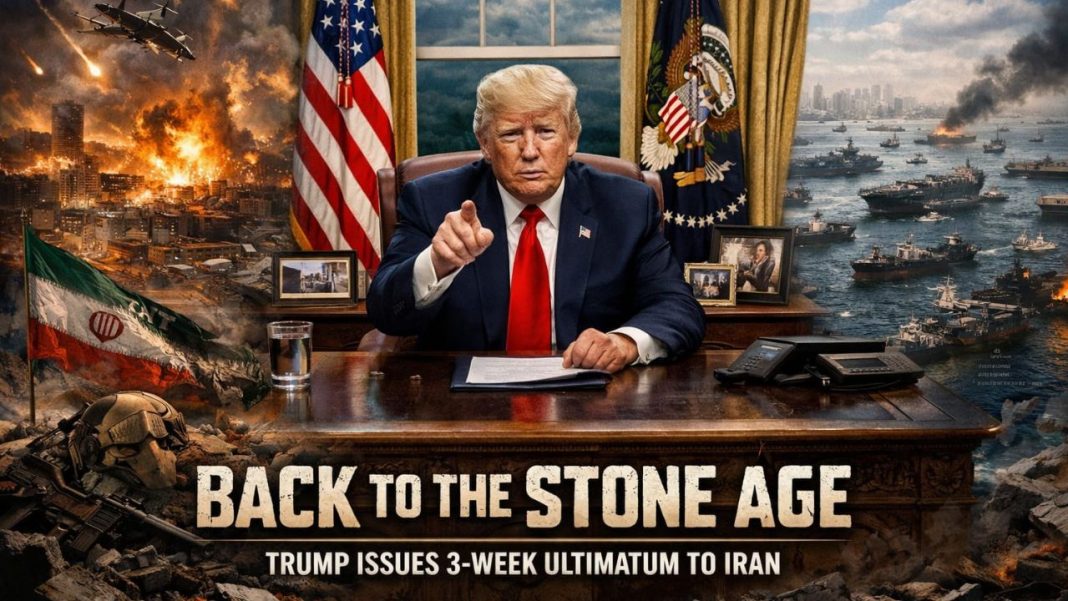

Will Send Iran Back to the Stone Age’: In a high-stakes prime-time address to the nation on April 1, 2026, U.S. President Donald Trump declared that the United States is on the verge of total victory in its conflict with Iran.
During his 20-minute speech from the White House, Trump issued a chilling warning: if a deal is not reached immediately, a massive military escalation in the next two to three weeks will send Iran “back to the Stone Age.”
The address, centered on the ongoing “Operation Epic Fury,” painted a picture of a decimated Iranian regime, though the President stopped short of announcing a ceasefire or a clear end date for the war.
“The Hard Part is Done”: Claims of Military Victory
President Trump claimed that the U.S. military has already achieved its primary goals. He stated that Iran’s navy has been “annihilated” and its air force left in “ruins.”
According to Trump, the leadership of the Islamic Republic has been effectively neutralized.
“Their leaders most of them and the terrorist regime they led are now dead. The command and control of the IRGC (Islamic Revolutionary Guard Corps) is being decimated as we speak,” Trump told to the audience.
He suggested that because the top leadership is gone, “regime change” has essentially already occurred, even if it wasn’t the initial official goal.
He described the remaining “new group” of leaders in Tehran as “less radical and more rational.”
The 3-Week Ultimatum: “Back to the Stone Age”
Despite claiming victory, Trump promised a “tremendous” increase in military pressure over the next 14 to 21 days to “finish the job.”
He warned that the U.S. is prepared to target Iran’s entire power grid and civilian infrastructure if they do not surrender their nuclear ambitions.
“We are going to hit them extremely hard,” Trump said. “We will bring them back to the Stone Age, where they belong.”
He emphasized that Iran can never be trusted with nuclear weapons, claiming they would use them “very quickly” if given the chance.
The Strait of Hormuz: “Not Our Problem”
Addressing the global panic over rising oil prices and the blockade of the Strait of Hormuz, Trump took a detached stance. Currently, over 400 ships are reportedly stuck at the Strait, a vital choke point where 20% of the world’s oil passes.
Trump asserted that the U.S. no longer relies on Middle Eastern oil thanks to his “Drill, Baby, Drill” policy.
Energy Independence: Trump claimed the U.S. is now the world’s top producer and has “no shortage of fuel.”
Message to Allies: He told countries that depend on the Strait (like Japan and South Korea) to “show some courage” and protect the passage themselves.
The Advice: “Go to the Strait and just take it. Protect it. Use it for yourselves. We don’t need it.”
Economic Impact and Domestic Pressure
The speech comes at a time when Trump is facing significant pressure at home. While he boasted about the “strongest economy in history,” recent polls show his economic approval rating has dipped to around 31% as gas prices in the U.S. have surged past $4 per gallon due to the conflict.
Global markets reacted sharply to the speech. Asian stocks fell, and oil prices spiked once again as investors feared the promised “Stone Age” bombing campaign would further destabilize global energy supplies.
What Happens Next?
While Trump mentioned that “discussions are ongoing” behind the scenes, the world remains on edge.
If no diplomatic breakthrough occurs within the President’s two-to-three-week window, the Middle East could see the most intense aerial bombardment in modern history.
For now, the U.S. remains in a state of “military buildup,” preparing for what Trump calls the final chapter of the war.
By: Snigdha