

2027 Assembly Elections: According to media reports, political parties in India, including the Bharatiya Janata Party (BJP) and major opposition groups, are rapidly reshaping their electoral strategies ahead of crucial assembly elections scheduled across seven key states in 2027.
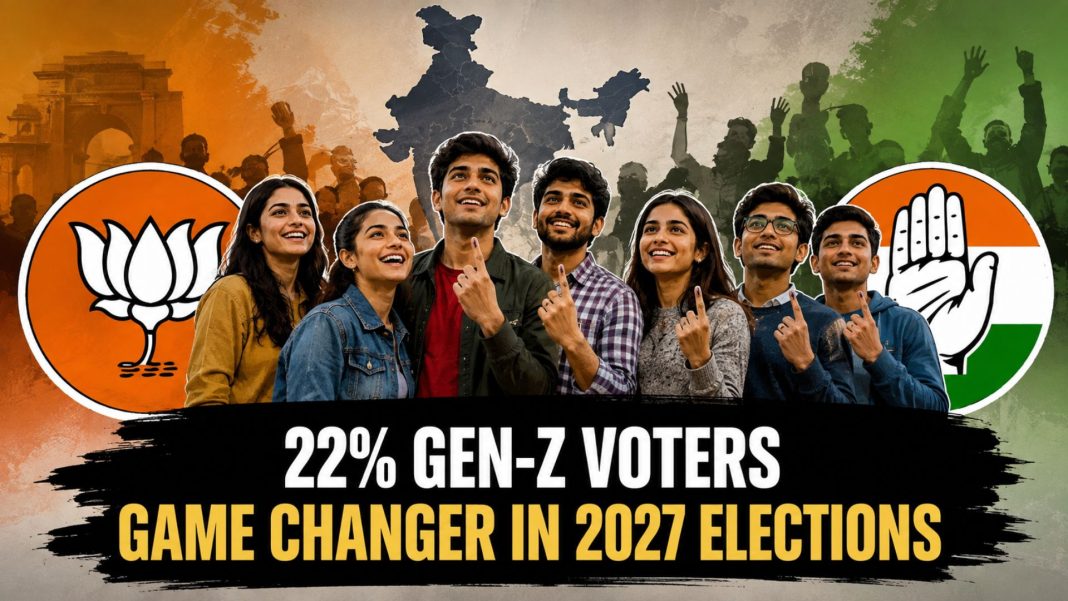
Following recent youth-led political movements in Delhi, as well as notable by-poll outcomes in Bihar’s Bankipur and Madhya Pradesh’s Budhni, political analysts emphasize that Gen-Z voters aged between 18 and 29 are emerging as a decisive voting bloc that could overturn existing political equations.
Statistical analysis of electoral rolls indicates that Gen-Z voters constitute approximately 22% of the total electorate in the seven states set for polls in 2027: Uttar Pradesh, Gujarat, Punjab, Uttarakhand, Himachal Pradesh, Manipur, and Goa.
As per media reports, experts estimate that even a modest 5% consolidation or shift among these young voters toward or away from any political coalition could decide victory or defeat in close contests.
The Electoral Math: Tight Victory Margins Across 257 Assembly Seats
2027 Assembly Elections: According to reports, an evaluation of the previous assembly election results across these seven states reveals that 257 out of 940 seats (27%) were decided by a victory margin of 5% or less.
Because Gen-Z voters make up over a fifth of the electorate in every state, their collective choice carries enough weight to swing these tight constituencies entirely.
Key Victory Margins from Previous Elections:
Uttar Pradesh: 131 out of 403 seats were won with a margin under 5%.
Gujarat: 27 out of 182 seats saw victory margins under 5%.
Punjab: 24 out of 117 seats had margins below 5%.
Uttarakhand: 15 out of 70 seats were decided by less than 5%.
Himachal Pradesh: 29% of seats saw paper-thin victory margins under 5%.
Manipur & Goa: 48% of seats in Manipur and 27% of seats in Goa were decided by margins of less than 5%.
At the national level, the 2024 Lok Sabha elections underscored a similar trend, where 127 out of 543 parliamentary seats were decided by a margin under 5%.
Demographics: Uttar Pradesh Leads in Youth Electorate Numbers
As per election commission data cited in media reports, Uttar Pradesh holds the highest absolute volume of young voters among the upcoming polling states.
| State | Total Population (Est.) | Post-SIR Voter Electorate | Gen-Z Voters (18–29 Yrs) | Gen-Z Share (%) |
|---|---|---|---|---|
| Uttar Pradesh | 24.3 Crore | 13.3 Crore | 2.8 Crore | 21% |
| Gujarat | 7.4 Crore | 4.4 Crore | 1.0 Crore | 23% |
| Punjab | 3.1 Crore | 2.1 Crore | 45 Lakh | 21% |
| Uttarakhand | 1.2 Crore | 71.3 Lakh | 15.8 Lakh | 22% |
| Himachal Pradesh | 75.8 Lakh | 57.1 Lakh | 12.5 Lakh | 22% |
| Manipur | 33.1 Lakh | 19.3 Lakh | 4.59 Lakh | 24% |
| Goa | 16.0 Lakh | 10.5 Lakh | 2.07 Lakh | 20% |
(Note: Population projections are estimated based on census growth trends).
5 Ways Gen-Z is Disrupting Traditional Caste and Religion Dynamics
2027 Assembly Elections: Political experts Prof. Sanjay Kumar and Yashwant Deshmukh highlight that young voters are increasingly moving away from conventional identity politics:
Focus on Direct Economic Issues: According to expert analysis, young electors prioritize job creation, skill development, digital infrastructure, and quality education over abstract promises. Political parties will need to address employment execution rather than relying solely on rhetoric.
Disruption of Traditional Vote Banks: While older generations often voted strictly along caste or religious lines, Gen-Z voters display greater independence. Parties are expected to give higher ticket distribution priority to self-made youth candidates.
Behavioral Shifts Similar to Women Voters: Much like female voters who have historically voted independently of traditional family/caste lines, youth voters are showing a similar inclination to consolidate as an independent bloc.
Rejection of Short-Term Freebies: Reports note that young voters prefer sustainable solutions such as entrepreneurship support, startup hubs, and career pipelines over temporary freebies or cash handouts.
Practical Grassroots Politics: Political organizations are being forced to alter their messaging, deploying young leaders directly on the ground and across digital media channels to build authentic connections.
Strategic Shift: Direct Outreach by Top Political Leaders
In response to these changing dynamics, major political figures including Prime Minister Narendra Modi, RSS Chief Mohan Bhagwat, and Opposition Leader Rahul Gandhi have initiated direct engagement programs targeting students, young entrepreneurs, and first-time voters.
As political parties reframe their manifestos ahead of 2027, the focus is shifting visibly toward career development, digital growth, and realistic employment roadmaps.