


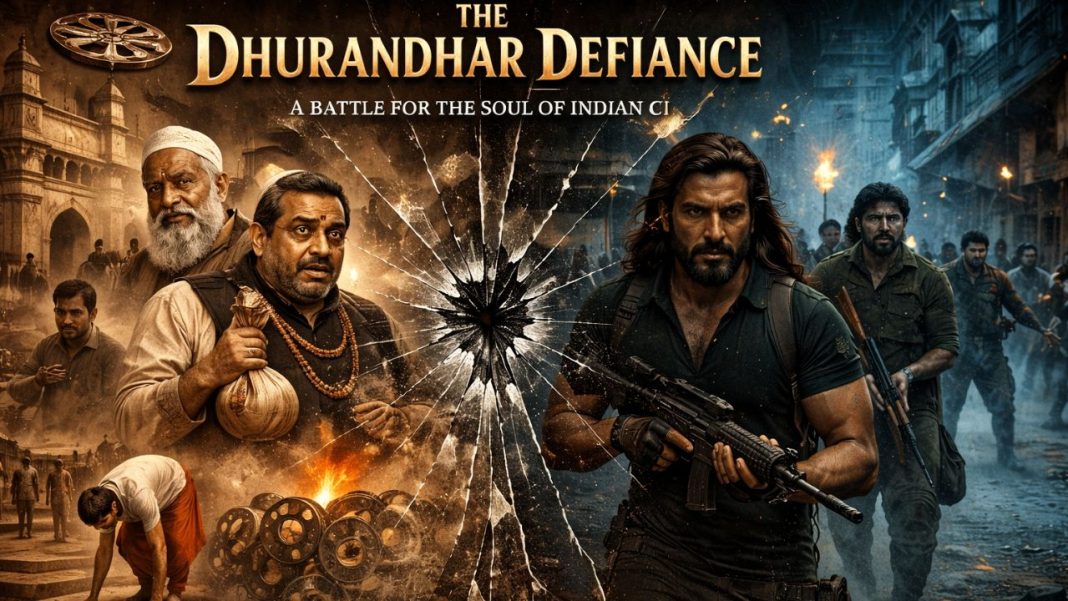

The Dhurandhar Defiance: For seven decades, the flickering silver screen of Mumbai was more than a window into a dream; it was a silent architect of the Indian psyche.
But beneath the veneer of “secular” storytelling lay a calculated, cinematic anatomy of erasure.
While the “Saintly Chacha” and the “Sufi Mystic” were elevated to the status of national conscience, the Hindu identity was systematically dismantled reduced to the caricature of a bribe-taking priest, a regressive patriarch, or a superstitious villain.
This was not a coincidence; it was a 70-year-old cultural apparatus designed to make an entire civilization feel like a stranger in its own stories.
However, the era of the “Apologetic Hindu” has reached its expiration date. With the explosive rise of the Dhurandhar franchise, the glass house of “Urduwood” hasn’t just been cracked it has been shattered, signaling a fierce reclamation of narrative where the hero no longer asks for permission to exist.
“Repetition turns depiction into perceived reality. Over decades, Bollywood did not just reflect culture — it manufactured it.”
The Year Everything Was Written
To understand what Bollywood became, you must return to 1975. In twelve months, two films were released that together define the fault lines of everything that followed.
The first was Jai Santoshi Maa — a low-budget devotional film made with minimal resources and no marketing machinery.
It became a massive cultural phenomenon not because of hype but because audiences invested in it emotionally and spiritually. Women approached cinema halls barefoot, as if entering a temple.
The film functioned as a sacred space, not a product. In this phase, cinema acted as a true mirror — reflecting societal faith rather than interrogating or reframing it.
The second film released that same year was Deewar — and it introduced a template whose reverberations are still felt today.
Within Deewar’s narrative structure lay a subtle but striking asymmetry. The protagonist Vijay carries the number 786 auspicious in Islamic tradition which appears to protect him at crucial moments of peril.
In contrast, his engagement with faith in a Hindu context is framed entirely through disillusionment. His mother remains devoted to Lord Shiva, yet her life is defined by suffering rather than divine response.
Vijay himself rejects the temple, delivering one of cinema’s most iconic dialogues from its very steps only to meet his end in that space.
One symbol offers protection and continuity. The other becomes associated with pain, unanswered devotion, and eventual death.
No equivalent critique or irreverence is directed toward Islamic symbolism within the film. This asymmetry, embedded within a genuinely powerful narrative, became the founding reference point for what analysts would later identify as a systemic pattern.
The same year, Sholay contributed another data point. A sacred Shivling is used as part of a comedic deception. In the same film, the character of Imam Saab is portrayed with profound respect and moral authority.
Within a single narrative, two religious identities were subjected to dramatically different treatment one irreverent, the other reverential.
These were not isolated artistic choices. They were the first grammar lessons of a language Bollywood would spend the next four decades perfecting.
The Corrupt Pandit and the Factory of Tropes
By the 1980s, a recurring character had solidified into an archetype recognizable across every Indian drawing room: the fraudulent priest.
The phrase ‘Ram Naam Japna, Paraya Maal Apna’ — praying to God while pocketing others’ wealth — became emblematic of a certain kind of character in Hindi cinema.
While social critique of religious hypocrisy has legitimate cinematic tradition, the frequency of this particular archetype crossed a critical threshold: it stopped being social commentary and became a reflexive default.
Ram Lakhan (1989) presented temple priests as complicit in criminal activity. Karan Arjun (1995) routinely showed ritual worship preceding acts of violence — turning devotion into a narrative signal for impending wrongdoing.
Dabangg (2010) and Singham (2011) continued this visual grammar, associating the tilak and rudraksha with antagonism. As recently as Shamshera (2022), the same imagery persisted in similarly coded roles.
“The tilak, once a marker of identity, became a shorthand for villainy. The rudraksha, once sacred, became a costume for the corrupt.”
The concern documented by critics was never the existence of flawed characters within a religious context — complex characters are the lifeblood of cinema. The concern was the consistency with which this imagery was applied in one direction, and one direction only.
For decades, no equivalent archetype the fraudulent maulvi, the crooked padre achieved anything approaching comparable screen frequency or negative cultural weight.
The figure of the ‘dhongi baba’ the fraudulent holy man appeared so reliably that it ceased to register as a narrative choice and began to appear as simple reportage. That is the precise moment when representation becomes propaganda.
The Music Didn’t Lie It Just Whispered Differently
Music in Hindi cinema operates at a register deeper than dialogue. Where dialogue engages logic, music embeds associations before conscious analysis can intervene.
And it is in the musical architecture of Bollywood that perhaps the most revealing asymmetry is found.
Kun Faya Kun from Rockstar (2011) and Arziyan from Delhi-6 (2009) were filmed with sweeping visual grandeur set in Sufi spaces — atmospheres of spiritual transcendence, surrender, and ecstatic discovery.
Bajrangi Bhaijaan (2015) placed a Hindu protagonist’s emotional resolution in a dargah, reinforcing the idea that the highest spiritual destination was found across a religious boundary.
These were beautifully crafted sequences. They were also consistently coded.
In contrast, Hindu devotional songs across the same era were disproportionately framed within contexts of helplessness — accompanying scenes of suffering, longing, failed prayer, and resignation.
The cumulative effect was a subtle cinematic hierarchy: one tradition associated with transcendence and spiritual richness, the other associated with endurance in the face of divine silence.
And occasionally, the asymmetry became overt. The song ‘Radha on the Dance Floor’ from Student of the Year (2012) sparked widespread controversy for its modern — and for many, disrespectful — reframing of a deeply revered figure. Critics demanded a simple question be answered: would the same creative liberty have been taken with a figure from another tradition? The answer, borne out by the evidence of four decades, was self-evident.
The Stories That Were Never Told
Cinema is defined not only by what it shows but by what it chooses not to show. And few silences in Indian cinema are more deafening than the near-total erasure of the Kashmiri Pandit exodus from mainstream narrative for more than three decades.
The Kashmir conflict was not ignored by Bollywood. Roja (1992), Mission Kashmir (2000), and Haider (2014) all engaged with the region — through lenses of militancy, political complexity, and state action.
These were critically acclaimed works. But the specific, documented, mass displacement of approximately 100,000 Kashmiri Pandits in the winter of 1990 the largest forced migration of a religious minority in post-independence India remained peripheral. Absent. Unfilmed.
Shikara (2020) attempted to address this silence, but did so through a romantic framework that many viewers particularly survivors felt diluted the gravity of the historical event into sentiment.
It was not until The Kashmir Files (2022) that the subject was brought to the screen with uncompromising directness.
The film ignited controversy precisely because it refused the softening frameworks its predecessors had employed.
Its enormous box office success — and the fury with which segments of the critical establishment received it — were two sides of the same coin: an audience hungry for a story it had been denied, and an industry shaken by the implications of that hunger.
The Rewritten Hero
The selective lens extended beyond omission to active revision. Chak De! India (2007) remains one of Bollywood’s most celebrated films a powerful story of perseverance, national identity, and redemption through sport.
The film was inspired by the real-life story of hockey coach Mir Ranjan Negi. For reasons that were never publicly explained with satisfying clarity, the protagonist’s identity was rewritten as Kabir Khan, introducing a religious dimension and a specific burden of national loyalty that did not exist in the source story.
For many viewers, this was not merely an artistic choice. It was a pattern. A real Hindu man’s story of professional shame and redemption was given to a Muslim character who carries the additional weight of having to prove his patriotism to a suspicious nation.
Whatever the filmmakers’ intentions, the effect was to implicitly locate doubt about national loyalty within a specific religious identity.
My Name Is Khan (2010), released in the charged aftermath of the 26/11 Mumbai attacks, placed the exploration of post-attack identity and prejudice almost exclusively within the frame of one community’s experience of discrimination.
While the film was widely praised for its emotional power, critics noted that it conspicuously avoided examining the ideological origins of the attacks themselves, choosing instead to pivot the entire national trauma into a story about Islamophobia in the West.
These films did not exist in a vacuum. They were part of a consistent grammar one that located moral complexity, victimhood, and spiritual authority in some communities while distributing corruption, superstition, and caricature in others.
The Audience Rewrites the Script
The grammar of Bollywood worked for as long as the audience remained passive. The mid-2010s ended that passivity.
The rise of YouTube commentary, social media analysis, and independent film criticism created an entirely new mode of audience engagement.
Viewers began archiving tropes, building comparative databases, and doing what film schools had long done but now in public, at scale, and with viral distribution.
A scene from a 1995 film could be placed side by side with a scene from 2015 and the pattern made visible in thirty seconds.
This shift created accountability of a kind the industry had never previously faced. Box office results began to reflect it.
Films that aligned with emerging audience sentiments — that treated Hindu identity without apologetic framing, that engaged with suppressed historical narratives, that refused the grammar of moral equivalence found extraordinary commercial support.
Films that continued the old grammar, regardless of budget or star power, found increasingly hostile audiences.
The industry’s initial response was dismissal: these were ‘nationalist’ audiences, ‘politically motivated’ reactions, ‘propaganda’ films. But the commercial mathematics could not be argued away. Something structural had shifted.
The Dhurandhar Correction
Into this shifting landscape came the Dhurandhar franchise and it represents something more precise than a commercial success story.
It represents a narrative correction. The franchise’s protagonist, Jaskirat Singh Rangi, embodies a deliberate inversion of established Bollywood grammar. He is modern, professional, and competent and he carries the tilak not as a signal of villainy but as a marker of personal discipline and identity.
Philosophical references drawn from the Bhagavad Gita appear in the narrative not as retrograde religious baggage but as frameworks for moral decision-making under pressure.
The films adopt a direct approach to geopolitical conflict, engaging with real-world events without the softening of moral equivalence that characterized earlier productions. The use of Sanskritized Hindi long treated by mainstream cinema as a marker of backwardness or comedy is deployed as a signal of cultural sophistication and rootedness.
Individually, any of these choices might read as minor. Collectively, they constitute a grammar a counter-grammar, consciously or not, to the one that spent seven decades embedding itself in the Indian subconscious.
The Reckoning and the Risk
It would be tempting to read this shift as straightforward correction the screen finally reflecting the audience rather than conditioning it.
But the temptation should be resisted. The risk of replacing one distorted grammar with another is real and documented.
Cinema is a powerful cultural instrument precisely because it operates below the threshold of argument. It does not persuade; it habituates.
Seven decades of one kind of habituation cannot be corrected by a decade of its mirror image without inflicting new distortions on new communities.
The genuine promise of this moment lies not in the inversion of the old hierarchy but in its dismantling — the emergence of a cinema confident enough to portray all of India’s religious and cultural identities with the same complexity, the same irreverence, and the same respect that each tradition deserves in equal measure.
That cinema does not yet fully exist. But for the first time in the history of Indian film, an audience exists that is demanding it loudly, at the box office, and in the language the industry has always understood best.
The celluloid mirror is cracking. What replaces it will define Indian culture for the next seven decades.
written by- Namita Deora