


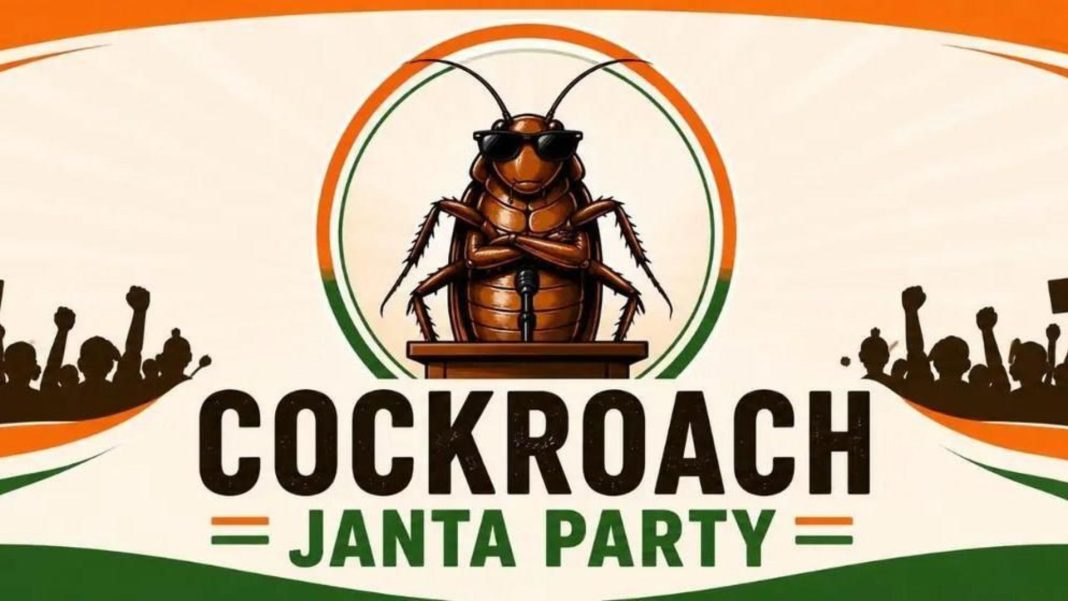

Cockroach Janta Party: A highly unusual political phenomenon has taken Indian social media by storm. Millions of young Indians are proudly calling themselves “cockroaches” and joining a satirical yet deeply serious initiative called the Cockroach Janta Party (CJP).
What started as an impromptu digital pushback has rapidly evolved into a massive youth movement, channeling deep-seated economic frustration, unemployment anger, and resentment against systemic apathy.
The movement was sparked by a controversial remark made during a Supreme Court hearing on May 15, 2026. Chief Justice Surya Kant, while criticizing digital attacks on Indian institutions, referred to certain individuals as “youngsters like cockroaches” who turn to social media and activism to “start attacking everyone” because they cannot find traditional employment.
While Chief Justice Kant later clarified that his comments specifically targeted individuals using “fake and bogus degrees” rather than the broader unemployed youth population, the analogy struck a massive nerve.
For millions of Gen Z and millennial youth battling a tough job market, the “cockroach” label felt like a symbol of how the ruling elite views ordinary citizens.
From a Single Tweet to Millions of Followers
Cockroach Janta Party: Responding to the remark on May 16, 2026, Abhijeet Dipke a 30-year-old Boston University public relations graduate and former social media strategist for the Aam Aadmi Party (AAP) posted a simple question on X: “What if all cockroaches come together?” He shared a Google Form inviting people to join a new platform.
The response was unprecedented. Within just over a week, by May 25, 2026, the Cockroach Janta Party’s digital footprint exploded:
Instagram: The official CJP account surged past 20.5 million followers, eclipsing the digital following of major mainstream political entities like the BJP (which stands at 8.8 million).
X (formerly Twitter): The original account amassed over 200,000 followers within days. After it was withheld in India following a legal demand citing national security concerns raised by the Intelligence Bureau, a replacement account was quickly set up, racking up over 150,000 followers within hours.
The Core Issues: Paper Leaks and Graduating into Unemployment
Cockroach Janta Party: The “cockroach” identity has resonated so deeply because it directly taps into severe economic anxiety. According to the Indian government’s Periodic Labour Force Survey for 2025, youth unemployment (ages 15–29) stood at 9.9%, spiking to 13.6% in urban areas.
More alarmingly, the recent 2026 State of Working India report by Azim Premji University highlighted that unemployment among young graduates aged 15 to 25 is hovering close to 40%.
This structural crisis has been compounded by a series of high-profile examination scandals. The CJP movement gained massive traction right after the nationwide cancellation of India’s competitive medical entrance exam due to a paper leak scandal, which affected 2.3 million students who took the test on May 3.
This follows previous major disruptions, including the 2024 cancellation of the Uttar Pradesh police recruitment exam (affecting 4.8 million applicants) and the scrapping of the UGC-NET exam.
The CJP Manifesto: Satire Meets Radical Demands
The Cockroach Janta Party describes itself on its website as “a political party for the people the system forgot to count.” Its official membership criteria targets those who are “unemployed, lazy, chronically online, and able to rant professionally.”
However, beneath the heavy satire lies a highly specific and radical political manifesto:
Judicial Accountability: A ban on retired Chief Justices receiving seats in Parliament’s Upper House (Rajya Sabha) as post-retirement rewards.
Political Anti-Defection: A strict 20-year ban on politicians who defect between political parties.
Gender Representation: A mandatory 50% reservation for women in Parliament and cabinet positions.
Media Reform: Revoking the broadcasting licenses of corporate-owned media giants to clear the path for genuinely independent journalism.
Political Backing and Growing Criticism
The movement has quickly caught the attention of mainstream politics. High-profile opposition figures including Trinamool Congress MPs Mahua Moitra and Kirti Azad, Samajwadi Party chief Akhilesh Yadav, and AAP leader Manish Sisodia have publicly expressed solidarity with the CJP.
Conversely, critics have dismissed the movement as an opposition-orchestrated PR stunt, pointing to Dipke’s past employment with AAP between 2020 and 2023. Dipke has strongly denied these allegations, maintaining that the initiative was entirely spontaneous.
Other political analysts question whether an online trend can translate into real-world change. Commentators on platforms like The Quint note that online movements remain “performance theatre” unless they transition into structured, boots-on-the-ground political organizing.
What Lies Ahead for the Movement?
As of May 25, 2026, Dipke has stated that the CJP will remain peaceful, constitutional, and democratic, downplaying any immediate plans to transition into an official electoral party or replicate aggressive youth uprisings seen recently in neighboring countries.
Instead, the immediate goal is to build a robust, digitally-driven civic platform. The organization aims to mobilize Indian youth toward active civic engagement, teaching them how to use constitutional tools like Right to Information (RTI) applications to hold local authorities and governments accountable. Whether the Cockroach Janta Party remains an internet phenomenon or shifts the landscape of mainstream Indian politics remains to be seen, but it has undeniably given India’s frustrated youth a unified, loud, and defiant voice.