


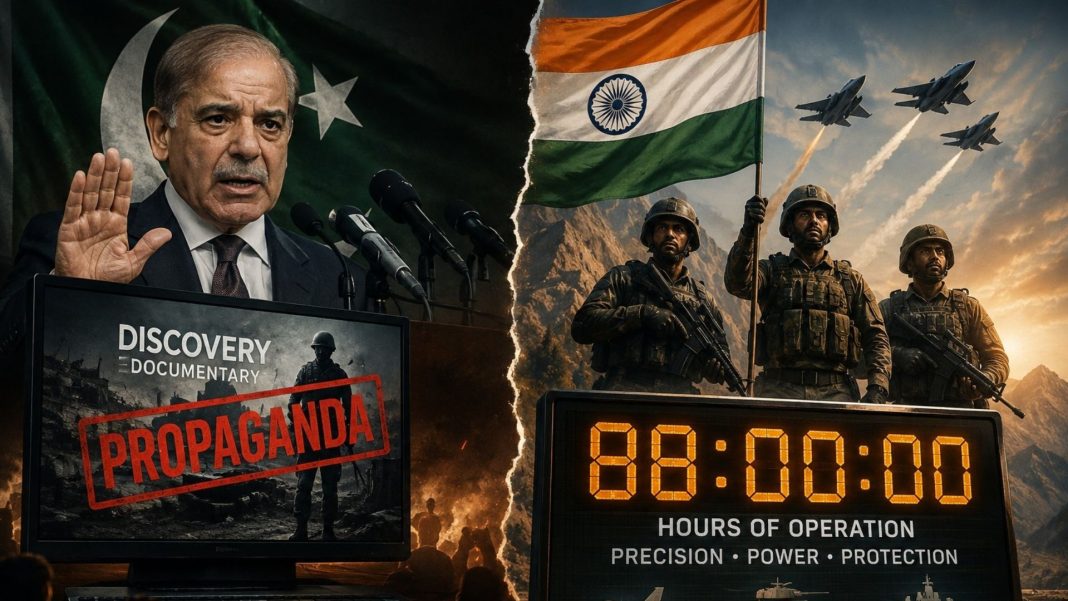

Operation Sindoor Fallout: The geopolitical tensions between India and Pakistan have once again spilled over from the Line of Control onto global media screens.
A newly released documentary titled “Operation Sindoor,” which premiered on the Discovery channel on August 15, 2026, has triggered intense diplomatic and online friction between the two nuclear-armed neighbors.
The two-part documentary provides an insider look into the high-stakes military planning, war-room decisions, and cross-border operations that unfolded in May 2025. While the film has been lauded in India for highlighting a decisive security response, it has drawn sharp, defensive reactions from Islamabad.
Late Tuesday night, Pakistani military spokesperson Lieutenant General Ahmed Sharif Choudhary took to social media platform X to brand the documentary as pure “propaganda,” dismissing it as a mix of tragedy and comedy designed to mask what he termed a military failure.
What Led to Operation Sindoor? The 2025 Timeline
Operation Sindoor Fallout: To understand the core of the documentary, one must look back at the harrowing sequence of events in the spring of 2025 that altered security dynamics in South Asia.
April 22, 2025: Tragedy struck the picturesque Baisaran Valley in Pahalgam, where tourists were enjoying their holiday. Heavily armed terrorists suddenly opened fire, systematically isolating victims by asking for their names and religious affiliations, specifically targeting Hindu tourists.
The Ultimatum: According to revelations made in the documentary by National Security Advisor (NSA) Ajit Doval, surviving witnesses reported that the attackers shouted, “Go tell Modi to do whatever he can!” before fleeing.
Prime Minister Modi’s Midnight Directive
Operation Sindoor Fallout: Upon receiving the distressing news of the Pahalgam massacre, Prime Minister Narendra Modi cut short an official visit to Saudi Arabia and flew directly back to New Delhi.
The Airport Briefing: Convening an emergency high-level security meeting right at the airport tarmac, PM Modi pressed NSA Doval for immediate answers regarding the masterminds behind the attack.
The Iron Resolution: While typically composed, the Prime Minister was uncharacteristically grim that evening. According to the documentary, he issued a clear-cut, uncompromising directive to India’s security apparatus: “We will go after the terrorists. Whether they are hiding in the earth, the sky, or the netherworld, wherever they are, we will not spare them.”
Inside the War Room: How Operation Sindoor Unfolded
The documentary details how India’s military leadership formulated a calculated strategy to dismantle the terror infrastructure responsible for the bloodshed, intentionally avoiding direct engagement with the Pakistani regular army unless provoked.
Targeting the Core: Chief of Army Staff General Upendra Dwivedi revealed in the film that the primary objective was not Pakistan’s armed forces, but rather nine major terror headquarters belonging to groups like Jaish-e-Mohammed and Lashkar-e-Taiba. It was PM Modi himself who officially designated the mission “Operation Sindoor.”
Deep Cross-Border Strikes: On the intervening night of May 6–7, the Indian armed forces executed precision airstrikes across the International Border and the Line of Control (PoK).
For the first time, deep-seated terror strongholds like Bahawalpur and Muridke were successfully neutralized, eliminating over 100 terrorists in a meticulously coordinated operation.
Pakistan’s Counter-Response and Rapid Deterioration
Faced with massive internal security breaches, the Pakistani military launched a retaliatory effort codenamed “Operation Bunyan al-Marsoos,” dispatching F-16 and JF-17 fighter jets toward Indian defensive positions.
The Air Defense Duel: The Indian Air Force responded swiftly, targeting vital Pakistani radar stations, military installations, and the Noor Khan Airbase.
The Breaking Point: By the morning of May 11, 2025, Pakistani defense strategists realized that if the conflict dragged on any longer, their entire multi-layered air defense grid would face total collapse under the weight of India’s technological and tactical superiority.
The Climax: Kneeling for Peace in 88 Hours
Despite state-run media attempts to paint a picture of resilience domestically, behind closed doors, Islamabad’s diplomatic channels were frantic.
The Admission: The documentary highlights how Pakistan’s Foreign Minister, Ishaq Dar, privately acknowledged that precision drone strikes had dealt catastrophic blows to key military infrastructure.
The Hotline Rings: On May 11 at around 12:00 PM, the secure military hotline at the New Delhi headquarters rang. In what the documentary portrays as a deeply humbling moment, Pakistan’s Director General of Military Operations (DGMO) requested an immediate cessation of hostilities from his Indian counterpart.
This phone call effectively concluded the intense 88-hour military conflict, resulting in a strategic, unilateral victory for India that restored deterrence in the region.
Islamabad’s Backlash: Dismissing the Film as “Fiction”
Unsurprisingly, the documentary’s release on August 15 has reignited a war of words between the two nations.
The Propaganda Tag: Lt. Gen. Ahmed Sharif Choudhary dismissed the entire project as a sensationalized compilation of selective interviews and emotional storytelling. He argued that turning a military setback into a cinematic victory cannot rewrite historical facts on the ground.
Disputed Casualties: Pakistan aggressively contested the casualty and operational success figures, claiming instead that its forces successfully downed eight Indian military aircraft during the four-day engagement, a claim that New Delhi has repeatedly and firmly rejected.
Contradictory Claims on the Ceasefire: Islamabad also pointed out logistical contradictions in the documentary’s narrative. Pakistani officials argued that because the fighting officially concluded following direct communication between the two nations’ DGMOs, framing it purely as a one-sided Indian triumph is misleading.
Furthermore, they criticized the film’s premise that India chose to limit the scale of the conflict out of restraint, calling it a narrative loophole.
A Narrative War That Continues
From the tragic days of late April 2025 to the tactical precision of Operation Sindoor in May, and now to the digital and cinematic battlegrounds of August 2026, the Pahalgam aftermath continues to shape South Asian security politics.
While “Operation Sindoor” offers a gripping, insider account of India’s swift retaliatory doctrine, Pakistan’s vehement pushback underscores how deeply sensitive this chapter remains for both militaries.
Ultimately, whether viewed as a definitive national security milestone or criticized as a dramatized narrative, the documentary has successfully dragged the ghosts of the 2025 border crisis back into the global spotlight.
Also Read : Ukraine Gets a New Defense Chief: Who is Yevhenii Khmara and What Does His Appointment Mean?