


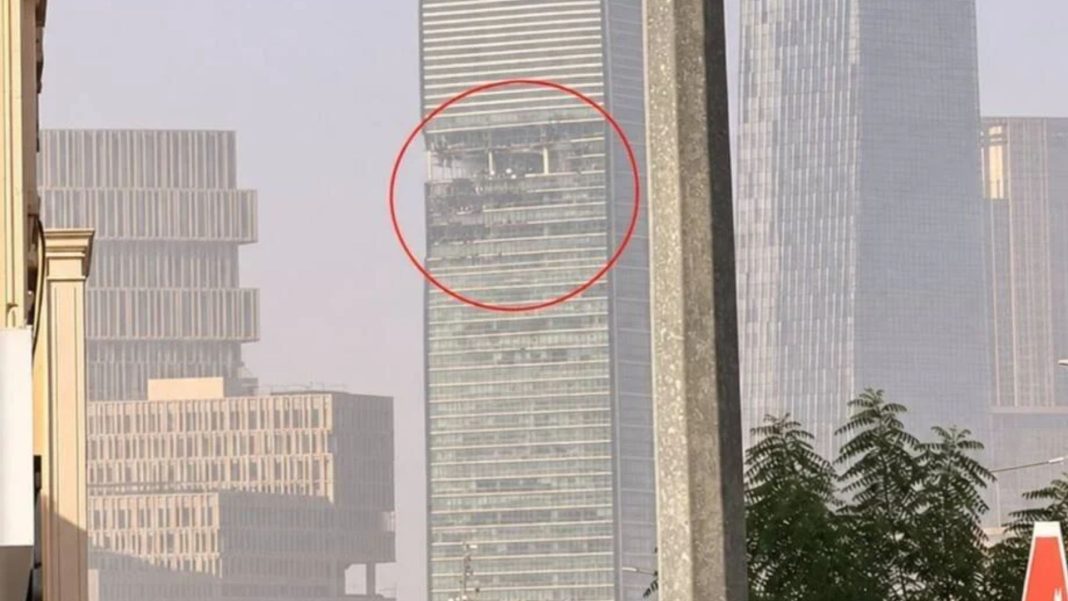

Riyadh Shaken by Explosions: Tensions in the Middle East have taken a sharp and alarming turn after a missile and drone attack targeted Riyadh, the capital of Saudi Arabia.
According to media reports, the assault resulted in minor damage to a building belonging to the state-owned oil giant, Aramco. While air defense systems successfully intercepted incoming projectiles, the incident underscores the growing security challenges faced by the kingdom amidst an intensifying regional conflict.
Riyadh Under Threat: Air Defenses Intercept Incoming Missiles
Riyadh Shaken by Explosions: On Sunday, high drama unfolded in the skies above Riyadh as air defense units sprang into action. Saudi military officials reported that two ballistic missiles and two cruise missiles fired toward the capital were successfully intercepted and neutralized.
Despite the successful defense, the sheer proximity of the attack triggered emergency alerts across Riyadh. Local civil defense authorities issued potential danger warnings to residents.
Viral videos circulating on social media captured shattered glass and structural damage across multiple floors of an Aramco facility. Eyewitnesses also reported seeing emergency medical vehicles rushing to the scene. Fortunately, official statements confirmed that there were no fatalities or injuries reported from the incident.
Although the Houthi movement in Yemen has not formally claimed responsibility for Sunday’s specific strike, the timing leaves little room for ambiguity. The attack followed closely on the heels of consecutive airstrikes in Yemen’s capital, Sana’a, after which Houthi leadership explicitly vowed retaliation.
The Catalyst: Deadly Airstrikes in Yemen Fuel the Cycle of Retaliation
Riyadh Shaken by Explosions: The missile barrage on Riyadh did not occur in a vacuum. It came hot on the heels of devastating airstrikes in Yemen that claimed dozens of lives.
According to Houthi officials, intense Saudi-led coalition airstrikes near Sana’a resulted in the deaths of at least 33 people, including women and children. This followed an even bloodier incident just days prior on November 6, when a crowded marketplace in Yemen’s Taiz province was struck, leaving roughly 30 people dead. Houthi authorities immediately blamed the Saudi coalition for both tragedies.
Escalating the rhetoric, senior Houthi spokesman Mahdi al-Mashat issued a stern warning, declaring that the blood of Yemeni citizens would be avenged. The group maintains that as long as Saudi Arabia continues its aerial bombardment and blockades on Houthi-controlled territories, retaliatory drone and missile strikes targeting Saudi infrastructure will persist.
Modern Defense Systems Pushed to the Brink
The ability of Houthi forces to strike deep inside Saudi territory has once again turned the spotlight on the kingdom’s military capabilities and defense strategies.
Data from the Stockholm International Peace Research Institute (SIPRI) highlights that Saudi Arabia is among the top 10 defense spenders globally, allocating roughly 7.8 lakh crore rupees to national security last year.
The nation boasts some of the most advanced military hardware available, including US-made fighter jets, Patriot missile batteries, and the sophisticated THAAD (Terminal High Altitude Area Defense) system, alongside acquisitions from France and Britain.
However, protecting a vast geographical expanse with critical economic infrastructure remains a monumental task. Geopolitically, Saudi Arabia finds itself surrounded by pressure points:
To the East: Iran.
To the North: Iran-backed militias active in Iraq.
To the South: The Houthi movement in Yemen.
Military analysts note that the simultaneous deployment of ballistic missiles, cruise missiles, and long-range loitering munitions (drones) by the Houthis creates a complex saturation threat. While Saudi air defenses intercept a vast majority of these threats, the sheer volume and unpredictable trajectories mean that occasional projectiles still manage to slip past the security umbrella.
A Protracted Conflict with No Easy End in Sight
The ongoing skirmishes are part of a broader, deeply entrenched civil and regional war. Armed hostilities between Houthi rebels and the internationally recognized Yemeni government reignited fiercely in July. According to United Nations estimates, the renewed fighting has already claimed over 1,600 lives and displaced more than 300,000 people from their homes.
Saudi Arabia entered the fray back in 2015, heading a multi-nation coalition after Houthi forces seized control of Sana’a in 2014. The primary objective of the intervention was to restore the legitimate Yemeni government to power and push back the insurgency.
Yet, years of sustained military campaigns and airstrikes have failed to dislodge the Houthis entirely, who continue to hold sway over vast swathes of Yemeni territory. With neither side willing to back down and retaliatory strikes becoming a recurring cycle, the prospects for a lasting peace remain fragile, leaving the entire region sitting on a geopolitical powder keg.
Also Read : Tehran’s 7 Demands: Iran Sends New Nuclear Proposal to US via Qatar Amid Escalating Conflict