


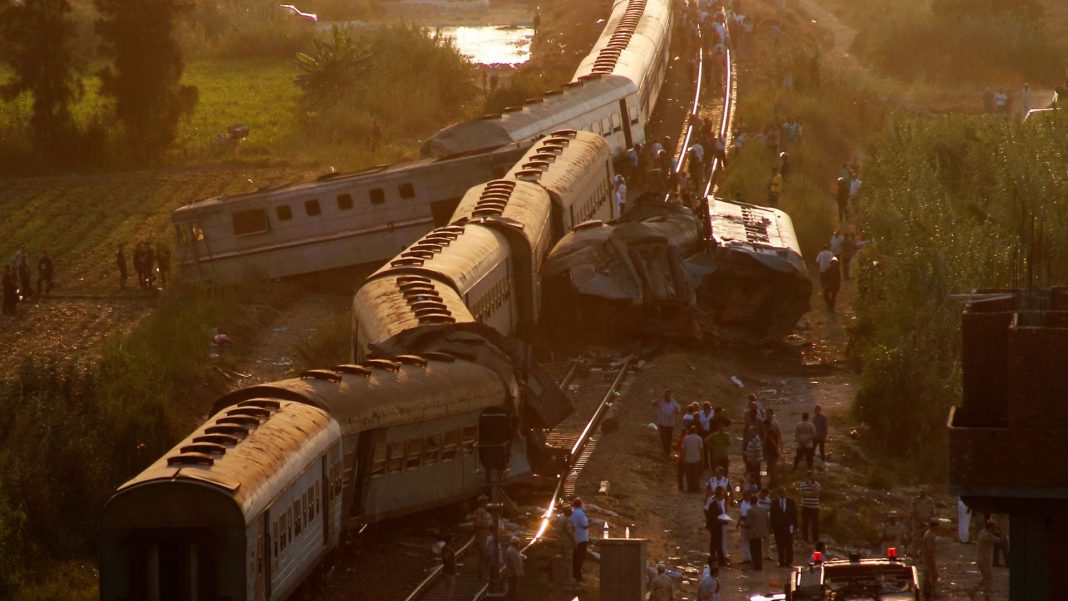

Tragedy on the Tracks: Travelers on a Sunday afternoon in Egypt experienced every commuter’s worst nightmare when two passenger trains collided violently, leaving a trail of twisted metal, shattered windows, and profound grief. According to recent updates, the death toll from the crash has risen to 7, while approximately 125 people sustained injuries ranging from minor cuts to critical trauma.
The incident took place in the Giza governorate, roughly 76 kilometers (47 miles) south of the nation’s capital, Cairo. What was supposed to be a normal transit day quickly transformed into a scene of utter chaos and frantic rescue operations, drawing national attention and prompting immediate intervention from the country’s highest leadership.
How the Disaster Unfolded
Tragedy on the Tracks: According to details shared by the Ministry of Health and railway authorities, the collision involved two specific services running on the same rail corridor:
Train One: Traveling from Giza toward Fayoum.
Train Two: Traveling from Cairo toward Aswan.
Preliminary accounts indicate that the train originating from Giza rear-ended the Cairo-to-Aswan service from behind. The impact of the collision was so severe that multiple carriages derailed, violently tearing off the tracks and scattering debris across the railway corridor. Tragically, among the 7 individuals confirmed dead is one of the train drivers, who was trapped at the controls during the impact.
Rescue teams and ambulances rushed to the scene within minutes of the crash. Emergency workers scrambled to triage the wounded, pulling trapped passengers from the mangled wreckage. The injured were swiftly transferred to nearby hospitals for urgent medical treatment. Meanwhile, heavy-duty cranes were deployed to clear the debris, lift the derailed cars, and restore clearance to the vital transport link.
Presidential Intervention and Accountability
Tragedy on the Tracks: The scale of the disaster has ignited a fierce national conversation regarding railway safety and accountability. Egyptian President Abdel Fattah el-Sisi expressed deep concern over the tragedy and immediately ordered a formal, comprehensive investigation into the root causes of the collision.
In a firm address regarding the incident, the President emphasized that anyone found guilty of negligence, operational failure, or protocol breaches will face strict legal consequences.
Railway authorities have also launched an internal technical inquiry. Investigators are working tirelessly to piece together how two passenger trains ended up on a collision course on the same track. While the precise sequence of signaling failures or human errors is still being unraveled, the immediate priority remains clearing the remaining wreckage and ensuring the safety of surviving passengers.
A Troubled History: Egypt’s Rail Safety Crisis
This latest tragedy has reignited scrutiny over Egypt’s railway infrastructure, bringing long-standing safety concerns back into the spotlight. Media reports highlight that this incident marks the 9th major train disaster in Egypt over the past 25 years.
To understand the magnitude of the country’s rail safety challenges, a look back at previous major accidents reveals a painful history:
February 2002: A devastating fire broke out on a crowded train near Cairo, resulting in 373 deaths, widely recorded as Egypt’s worst-ever rail disaster.
August 2006: A collision between two passenger trains in the city of Kalyub killed 57 people and injured 128.
October 2009: In the Al-Ayyat area of Giza, a train rear-ended a stationary train, claiming 30 lives.
November 2012: A horrific crash occurred when a train plowed into a school bus at a railway crossing, killing 51 people, predominantly young children.
August 2017: Two passenger trains collided near Alexandria, leaving 41 dead and 179 injured.
February 2019: A runaway locomotive slammed into a buffer at Cairo’s main railway station, triggering a massive fire that killed over 25 people.
March 2021: A multi-train collision in the southern Sohag province killed at least 18 people and injured nearly 200.
April 2021: Four carriages of a train derailed in the Tukh region, causing 23 deaths and 139 injuries.
September 2024: A previous collision in the city of Zagazig resulted in 2 fatalities and 29 injuries.
The Road Ahead: Restoring Trust and Infrastructure
As the dust settles on the Giza governorate crash site, the nation is left mourning those who lost their lives on their way home or to work. The psychological scars of recurrent rail disasters run deep among everyday commuters who rely on trains as their primary mode of intercity travel.
While repair crews continue track restoration and technical teams decode the final moments leading up to the impact, the overarching question remains: what systemic changes are necessary to finally secure Egypt’s railways? For the families of the victims and the survivors recovering in hospital beds, promises of investigations and accountability are only the first step toward preventing another heartbreaking catastrophe on the tracks.
Also Read : Tehran’s 7 Demands: Iran Sends New Nuclear Proposal to US via Qatar Amid Escalating Conflict