


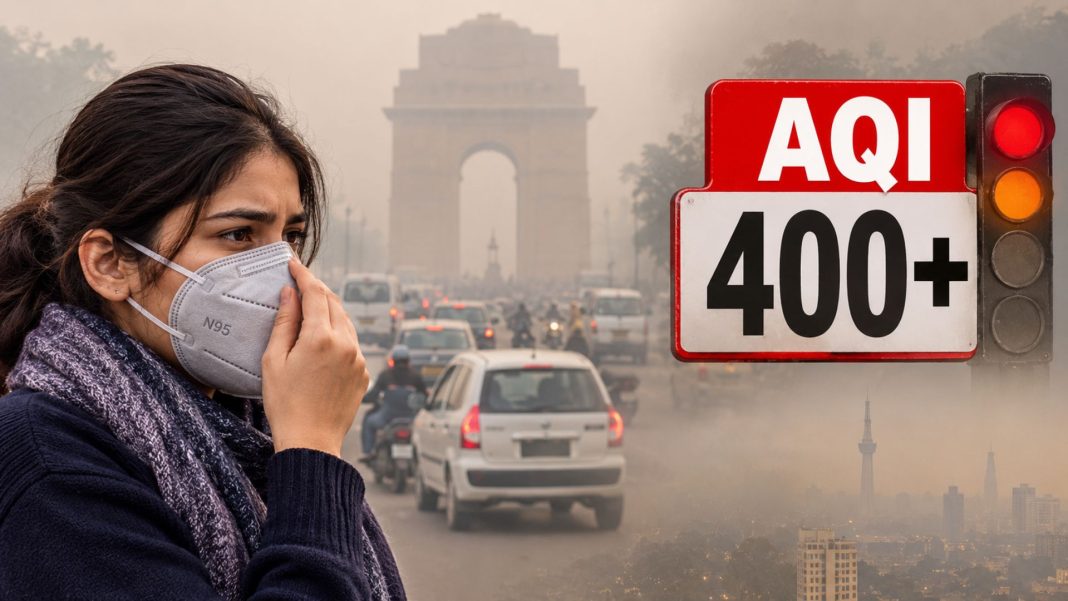

Delhi AQI Crosses 400 Post-Diwali: Atmospheric pollution levels across the National Capital Region (NCR) escalated dramatically following Diwali celebrations, with Delhi’s citywide Air Quality Index (AQI) surging past the 400 mark into the “severe” category.
According to media reports, central monitoring authorities recorded an average AQI of 483 on Monday morning, while international digital tracking platforms logged localized particulate matter spikes exceeding 1,000 in specific urban clusters.
The severe smog layer has prompted health experts and pulmonologists to issue urgent health advisories urging residents to take immediate preventive measures to protect their respiratory systems.
The Controversy Surrounding Delhi’s AQI Data Discrepancies
Delhi AQI Crosses 400 Post-Diwali: A major discussion has emerged regarding substantial variations between official governmental pollution metrics and figures reported by independent global monitoring agencies.
According to media reports, while the Central Pollution Control Board (CPCB) capped several localized station reports near the upper threshold of its standard 0–500 numerical scale, private platforms using different measurement algorithms such as Swiss-based IQAir reported AQI figures well above 1,000 in areas including Defence Colony and Shahdara.
Scale Capping Mechanisms: India’s national AQI framework operates on a standard index capped at 500. Consequently, once fine particulate matter ($PM_{2.5}$) concentrations surpass severe thresholds, official indices display 500 or $500+$ even as raw pollutant density continues to rise.
Algorithmic Differences: Private global networks often utilize alternative conversion matrices based on international environmental frameworks, leading to varying numeric outputs for identical physical air samples.
Data Transmission Gaps: Environmental analysts noted that technical outages at selected monitoring stations during peak hours on Diwali night contributed to analytical gaps, complicating real-time public reporting.
Political figures and civic activists have raised questions regarding station placement and monitoring transparency, demanding standardized reporting to reflect ground realities accurately.
Practical Outdoor Precautions to Limit Fine Particulate Exposure
Delhi AQI Crosses 400 Post-Diwali: Medical professionals emphasize that when ambient AQI crosses the 400 benchmark, toxic airborne particles pose immediate health risks to healthy individuals, pregnant women, children, and elderly citizens with pre-existing cardiac or respiratory conditions.
According to media reports citing senior pulmonologists, residents should strictly adhere to key outdoor safety protocols:
Deploy Certified Respirator Masks: Standard cloth wraps and single-layer surgical masks fail to filter microscopic $PM_{2.5}$ pollutants Individuals stepping outdoors must wear well-fitted N95 or N99 respirators that create an airtight seal over the nose and mouth.
Suspend Strenuous Outdoor Exercise: Outdoor morning walks, jogging, and athletic activities should be halted. Rapid breathing during intense physical exercise draws fine toxic particles deeper into pulmonary tissues.
Optimize Outdoor Movement Windows: Cold morning and late-evening air layers trap pollutants close to ground level. Necessary outdoor errands should ideally be scheduled during mid-afternoon hours when solar radiation and mild thermal movement assist in temporary pollutant dispersion.
Indoor Air Quality Management and Lifestyle Recommendations
Delhi AQI Crosses 400 Post-Diwali: Protecting domestic indoor environments is equally critical during severe smog episodes, as outdoor pollutants easily penetrate residential structures through structural gaps and unsealed ventilation routes.
According to health experts, households should implement systematic indoor protection strategies:
Seal Living Quarters: Doors and windows should remain closed during peak smog hours. Utilizing door draft guards or damp cloth barriers under door frames helps minimize ambient smog infiltration.
Utilize Certified Air Purifiers: Operating air purifiers equipped with true HEPA filtration units inside frequently occupied spaces—particularly bedrooms helps reduce internal particulate concentration. Regular filter cleaning is essential to maintain purification efficiency.
Eliminate Domestic Combustion: Households should avoid burning incense, scented candles, or mosquito coils indoors, while using kitchen exhaust systems during meal preparation. Wet-mopping floors instead of dry-sweeping prevents settled dust from recirculating into the air.
Maintain Hydration and Respiratory Care: Consuming adequate water helps keep mucosal membranes moist, assisting natural respiratory clearing mechanisms. Dietary intake of antioxidant-rich foods containing Vitamin C, Vitamin E, and omega-3 fatty acids can support cellular defense against pollution-induced inflammation.
Medical authorities advise individuals experiencing persistent coughing, chest tightness, wheezing, or acute shortness of breath to consult healthcare professionals promptly.