


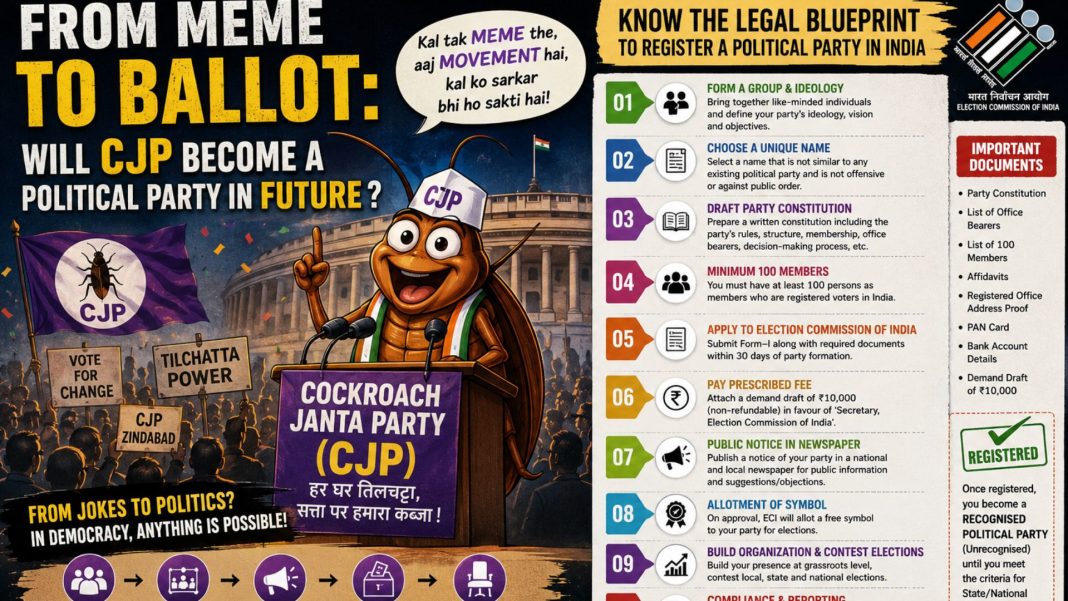

From Meme to Ballot: The Indian internet is currently witnessing a massive, viral wave. What started as a mere joke on social media has now taken the form of a major online movement under the name of the ‘Cockroach Janta Party’ (CJP). From hilarious reels to trendy discussions among the youth, the CJP is dominating everywhere on social media today, completely capturing the attention of Gen Z and young voters.
The fact is that a single question dominates the mind of every social media user today, will this ‘Cockroach Janta Party’ going viral on social media be able to meet the rules and benchmarks of the Election Commission? Let us tell you whether a party like the CJP, or any other party in the india, will be able to legally position itself to compete with the country’s mainstream political parties, and what the complete legal process is to form a real party.
Let us tell you that having millions of likes or followers on social media cannot automatically give any party a place on the Electronic Voting Machine (EVM). Moving from a trending hashtag to an official ballot paper requires navigating a highly serious and legal process governed by the Election Commission of India (ECI).
Step 1: Logging Off, Stepping In – Activating Section 29A
From Meme to Ballot: A viral meme can go global in seconds, but a real political entity needs a solid legal anchor. In India, launching a political party is strictly governed by Section 29A of the Representation of the People Act, 1951.
To start this journey, the leadership of the CJP must submit a physical, formal application to the ECI headquarters in New Delhi. The law enforces a strict, non-negotiable timeline: this application must be filed within 30 days of the party’s formal creation date. If the creators miss this 30-day window, the application is automatically rejected.
Once you clear this initial statutory timeframe, the next logical step requires moving from virtual subscribers to real-world voters.
Step 2: Gathering the Swarm – The 100-Member Rule
From Meme to Ballot: The Cockroach Janta Party might have lakhs of virtual supporters, but the ECI does not accept Instagram followers or email sign-ups. You need flesh-and-blood citizens to build the core foundation.
The 100-Member Clause
The law demands a core structural threshold consisting of at least 100 registered electors (voters) as founding members. You cannot register a political party with just one internet influencer or a small circle of online friends.
The Non-Affiliation Affidavits
Every single one of these 100 founding members must submit an individual, notarized affidavit. This legal document must state under oath that they are valid voters and do not belong to any other registered political party in India.
Appointing Core Leaders
The CJP must establish an organized governing body, formally electing individuals to mandatory executive positions like Party President, General Secretary, and Treasurer.
Once your core 100 members form an organized team, the group needs an internal book of rules to define its principles and operations.
Step 3: Swapping Sarcasm for Sovereignty – Drafting the Constitution
While the CJP’s online reels and mock manifestos are full of humor and satire, their official Party Constitution (rulebook) must be completely serious and legally sound to pass ECI vetting.
The Mandatory Sovereign Declaration: Under Section 29A(5) of the Act, the party’s constitution must explicitly state that the party bears true faith and allegiance to the Constitution of India, and to the principles of socialism, secularism, and democracy. It must firmly pledge to uphold the sovereignty, unity, and integrity of India.
Additionally, the ECI looks for internal democracy. The constitution must mandate that the party will hold fair internal organizational elections to choose its office-bearers every 4 to 5 years, preventing permanent individual or familial control. It must also feature a strict clause banning any form of violence.
With a compliant constitution ready, the next step involves gathering administrative paperwork and clearing the mandatory processing fees.
Step 4: The Paperwork Trail – PAN Cards, Fees, and Offices
A trendy digital movement can survive on zero budget, but formal party registration requires a transparent administrative paper trail. The CJP must submit a detailed dossier on its official letterhead including:
A non-refundable processing fee of ₹10,000, paid strictly via a Demand Draft (DD) to the Under Secretary, ECI.
Certified copies of the latest electoral rolls and voter IDs of all 100 founding members.
A Permanent Account Number (PAN) card made specifically in the party’s name, along with official bank account details.
A No-Objection Certificate (NOC) from the property owner of a physical building designated as the party’s official Head Office.
Once these documents are submitted, the ECI shifts the burden of validation from its office to the court of public opinion.
Step 5: The Public Vetting – Facing the 30-Day Objection Window
Transparency is a fundamental pillar of the ECI’s registration framework. The CJP will be directed to publish a standard public notice in two national daily newspapers and two local regional daily newspapers.
This notice openly displays the proposed party name, office address, and leadership names. Following publication, a strict 30-day window opens for the general public. If any citizen or opposing group feels the name “Cockroach Janta Party” hurts public sentiments, is socially offensive, or is too similar to an existing party, they can lodge a formal objection with the ECI. The commission will then hold a joint hearing to take a final call.
If no valid objections are sustained within 30 days, the party successfully gains its official legal status, clearing the path to enter active electoral battles.
Step 6: The Ultimate Upgrade – Unrecognized to Recognized Status
Upon clearing the objection window, the ECI registers the CJP as a Registered Unrecognized Political Party. The party is now completely legal and can field candidates in elections, but it must still fight hard to earn a permanent identity.
Initially, unrecognized parties like the CJP do not own a permanent election symbol. For every election, their candidates must choose temporary graphics from a list of “free symbols” provided by the ECI on a first-come, first-served basis.
To upgrade from an unrecognized party and lock in an exclusive, permanent election symbol that no rival can touch, the CJP must hit real electoral benchmarks in subsequent election cycles.
To achieve State Party status, the CJP must win at least 3% of the total seats in a State Assembly election, or secure a 6% vote share in that state while winning at least 2 MLA seats.
To climb to the ultimate tier of a National Party, the CJP must grow large enough to gain recognition as a State Party in at least four different states, or it must secure a 6% vote share across four or more states in a Lok Sabha election while winning at least 4 MP seats.
If the minds behind the Cockroach Janta Party want to step out of the digital world and transition into the real political arena, they must follow this exact regulatory roadmap.
The incredible trend of the Cockroach Janta Party proves that a simple internet idea can spark huge political engagement among young people. However, turning digital popularity into real political power requires following the country’s strict legal systems. By completing this step-by-step regulatory roadmap with proper connectivity and discipline, any trendy youth movement can successfully make the leap from social media screens straight onto the Indian ballot paper.