


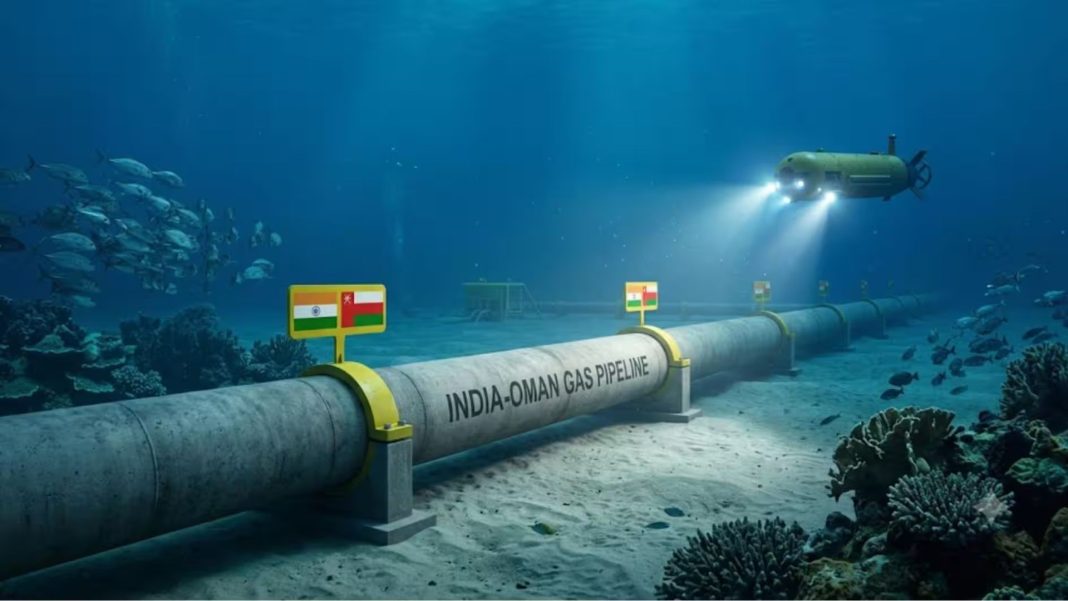

Oman to Gujarat Undersea Pipeline: Every flashpoint in the Strait of Hormuz sends shockwaves through global energy markets, but India may finally be looking at a multi-billion-dollar escape route.
The proposed Oman-India Deep-Sea Gas Pipeline, a massive 2,000-kilometer underwater project linking Oman directly to the coast of Gujarat, is flashing back onto the radar of top policymakers. With an estimated price tag of ₹40,000 crore (around $4.8 billion), this ambitious venture is being framed as New Delhi’s ultimate geopolitical shield against energy supply disruptions in Western Asia.
Unlocking the Vault: Why the Project is Bouncing Back After 30 Years
Oman to Gujarat Undersea Pipeline: The concept of a Middle East-India Deepwater Pipeline is not new; it has been sitting on the drawing boards for over three decades. Historically, the project was repeatedly shelved due to astronomical costs, extreme engineering barriers, and doubts over its financial viability.
However, India’s Ministry of Petroleum has recently breathed fresh life into the plan. State-owned energy giants, including GAIL, Engineers India Limited (EIL), and Indian Oil Corporation (IOC), have been tasked with preparing a detailed feasibility report based on data provided by South Asia Gas Enterprise (SAGE), a consortium that has championed the project for years.
SAGE has already conducted preliminary seabed surveys and technical assessments, signaling that the project is closer to a green light than ever before.
Bypassing the Choke Point: Cutting Reliance on the Strait of Hormuz
Oman to Gujarat Undersea Pipeline: Currently, India is heavily dependent on imported energy, buying the vast majority of its crude oil and Liquefied Natural Gas (LNG) from overseas. A massive chunk of these imports must travel through the narrow Strait of Hormuz, which connects the Persian Gulf to the Arabian Sea.
The Vulnerability: Any conflict, piracy, or military blockade in this narrow maritime corridor instantly spikes shipping insurance, triggers sudden LNG price volatility, and threatens India’s national energy security.
By laying a direct pipeline along the bed of the Arabian Sea, India would establish a locked-in energy corridor. Unlike standard LNG imports, which require gas to be liquefied, loaded onto vulnerable tankers, transported via volatile waters, and re-gasified upon arrival, the pipeline would offer a continuous, direct flow of natural gas from the source to Indian industries.
The Blueprint: Piercing the Abyssal Zone of the Arabian Sea
If constructed, this pipeline will go down in history as one of the most complex engineering feats ever attempted.
The Length: Approximately 2,000 kilometers of deep-sea infrastructure.
The Depth: Parts of the pipeline will rest at an staggering depth of over 3,000 meters (nearly 10,000 feet) below the ocean surface.
The Cost of Transport: Project proposals estimate the transit cost of gas at $2.00 to $2.25 per MMBtu, though final pricing remains tied to construction expenses.
Operating at depths of 3,000 meters exposes the pipeline to crushing underwater pressure and treacherous, unexplored seabed topography. Repairing a leak or managing a structural failure at these depths requires highly specialized, unmanned submersibles and incredibly expensive maritime technology.
Reality Check: The Triple Hurdles of Engineering, Economy, and Cash
Despite its massive strategic appeal, the mega-project faces three glaring roadblocks:
The Engineering Nightmare: Building and maintaining a pipeline under extreme oceanic pressure means traditional construction methods won’t work. The risk of costly repairs remains a major deterrent for critics.
Economic Viability: Megaprojects are notorious for delays and budget overruns. Whether the pipeline turns a profit depends heavily on long-term global gas prices and India’s shifting domestic demand.
Financing Dilemma: Securing $4.8 billion in funding requires ironclad, long-term supply guarantees between India and Oman to assure international investors that the project will generate steady returns.
Beyond Gas: A Future Corridor for Clean Energy?
For New Delhi, this is more than just a commercial transaction for natural gas; it is a step toward complete energy self-reliance. A direct connection with Oman could rewrite India’s economic ties with the entire Gulf region.
Furthermore, forward-looking energy experts note that the infrastructure built today for natural gas could eventually be repurposed. As the world transitions toward green energy, this very pipeline could one day be used to transport green hydrogen, turning a decades-old fossil fuel project into a futuristic clean energy highway.
The question is no longer whether the Oman-Gujarat pipeline is a brilliant idea. The real question is whether modern technology, shifting geopolitics, and international finance can finally come together to turn this 30-year-old dream into a reality.
Also Read : TRAGEDY AT SEA: Three Indian Seafarers Confirmed Dead After US Military Strike on Oil Tanker Off Oman