


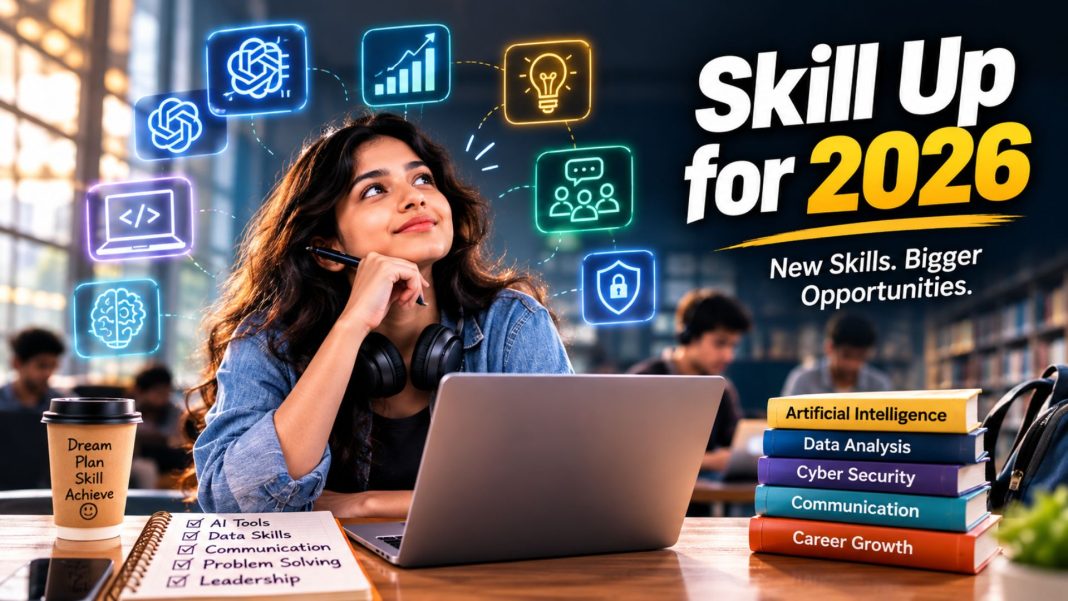

Skills for College Students in 2026: The global labor market is experiencing a profound transformation as artificial intelligence, advanced data analytics, and automation reshape traditional industry paradigms.
For academic cohorts navigating higher education, preparing for post-graduation employment now requires a deliberate pivot beyond traditional textbook syllabi.
Contemporary industry studies and workforce analytics underscore that technical proficiency combined with high-level cognitive adaptability has become the primary benchmark for entry-level hiring.
According to media reports analyzing global employment trends, employers across technology, finance, healthcare, and creative sectors are prioritizing candidates who can seamlessly bridge human critical thinking with automated machine intelligence.
To secure sustainable career trajectories in an increasingly competitive landscape, college students must focus on acquiring dynamic, high-impact skill sets.
Here is an in-depth examination of the essential competencies required for academic and professional success.
1.AI Literacy, Prompt Engineering, and Tool Orchestration
Skills for College Students in 2026: As artificial intelligence shifts from standard automated processing to real-time strategic assistance, basic familiarity with digital platforms is no longer sufficient. Modern enterprise environments expect graduates to demonstrate functional AI literacy.
According to media reports examining workplace technology integration, understanding how to interact with large language models, machine learning frameworks, and automated productivity software is rapidly becoming a baseline expectation.
Prompt engineering the capability to structure precise contextual inputs to generate accurate, actionable machine outputs has emerged as a foundational professional skill.
Rather than treating AI as a replacement for human intellect, successful students must learn to utilize machine learning tools for research synthesis, code verification, data extraction, and rapid workflow prototyping.
2.Advanced Data Analysis and Quantitative Interpretation
Skills for College Students in 2026: Data generation across commercial, scientific, and social sectors continues to grow exponentially. Consequently, the ability to clean, process, interpret, and visually present complex datasets remains one of the most sought-after qualifications for entry-level professionals.
Industry reports highlight that technical data analysis is no longer confined strictly to computer science or statistics majors.
Employers across marketing, corporate strategy, human resources, and supply chain management now expect foundational competency in quantitative tools such as Python, SQL, advanced data visualization platforms, and automated spreadsheet modeling.
Students who can extract actionable insights from unstructured data and communicate those findings clearly to executive stakeholders hold a distinct competitive advantage during recruitment cycles.
3.Critical Thinking, Fact Verification, and Problem-Solving
Skills for College Students in 2026: With generative tools capable of producing vast quantities of automated text and synthetic information instantaneously, the demand for rigorous human evaluation has risen dramatically.
Critical thinking and source verification are critical defensive skills against algorithmic hallucination and misattribution.
According to educational research cited in media reports, top-tier global corporations are placing significant premiums on candidates who demonstrate robust logical reasoning.
College students must cultivate the ability to question assumptions, verify algorithmic outputs against primary empirical data, and construct sound, evidence-based arguments.
Complex problem-solving identifying root causes, evaluating secondary consequences, and designing multidimensional solutions remains uniquely human territory that machine models cannot replicate independently.
4.Cyber Hygiene, Digital Ethics, and Data Privacy
Skills for College Students in 2026: As corporate reliance on cloud architecture, automated processing, and remote infrastructure expands, vulnerabilities related to data breaches, identity fraud, and regulatory non-compliance have magnified.
Consequently, foundational knowledge of cybersecurity and digital ethics has become vital across every corporate department.
Media reports tracking enterprise risk management show that entry-level employees are often the primary defense against phishing campaigns, credential theft, and operational oversights.
Students across all academic disciplines benefit significantly from understanding core principles of data protection, regulatory frameworks (such as global privacy standards), and the ethical implications of deployment decisions particularly regarding algorithmic bias and consumer data handling.
5.Emotional Intelligence, Interpersonal Communication, and Leadership
While technical mastery secures initial interviews, emotional intelligence (EQ) and collaborative adaptability dictate long-term career progression.
As routine operational tasks become increasingly automated, human interaction, team coordination, and empathetic client management represent the irreplaceable core of organizational success.
According to media reports analyzing graduate hiring feedback, hiring managers frequently report skill gaps in verbal articulation, structured business writing, negotiation, and cross-cultural collaboration.
College students who actively develop strong interpersonal communication learning to pitch ideas concisely, manage workplace friction constructively, and lead cross-functional peer groups consistently outperform candidates who rely solely on technical credentials.
Strategies for Integrating High-Value Skills into Academic Life
Which skill is best for college students? Acquiring these capabilities does not require abandoning traditional degree curricula; rather, it involves augmenting standard coursework with targeted practical application:
Cross-Disciplinary Electives: Engineering students should consider introductory courses in management, ethics, or strategic communication, while humanities majors benefit from foundational coursework in data science or programming.
Practical Project Portfolios: Employers increasingly value demonstrable proof of capability over passive academic scores. Building a public portfolio containing real-world projects, data analysis case studies, or published research offers tangible evidence of expertise.
Continuous Micro-Credentialing: Utilizing certified digital platforms to complete industry-recognized specializations in cloud computing, project management, or analytics demonstrates self-directed learning and professional initiative.
Future-Proofing the Entry-Level Workforce
The dynamic nature of the modern global economy means that specialized software tools and industry frameworks will continue to evolve rapidly.
However, the combination of advanced technical literacy, rigorous quantitative reasoning, and strong interpersonal communication creates an enduring professional foundation.
By proactively developing these essential capabilities during their academic tenure, college students can navigate evolving industry requirements with confidence, establishing themselves as valuable assets in an increasingly automated workforce.
Also Read: Tamil Nadu Teen Earns ₹3.55 Crore Scholarship to Study at Ivy League’s Brown University