


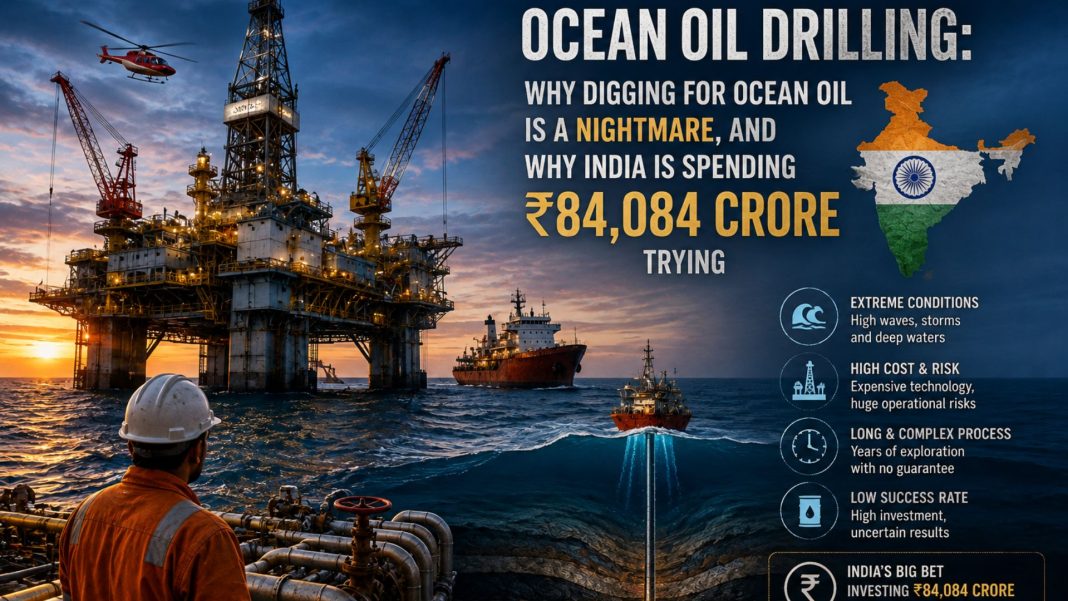

Ocean Oil Drilling: In a bid to counter falling domestic crude output, record high import reliance, and intensifying geopolitical turbulence in West Asia, India has launched one of its most aggressive energy exploration pushes to date.
The Union Cabinet approved Samudra Manthan (National Offshore Exploration Scheme) , a massive ₹84,084 crore blueprint designed to hunt for deep-sea oil and natural gas beneath the Indian Ocean.
The move comes at a crucial juncture: India’s domestic crude oil production has slumped from 36.9 million tonnes (MT) in FY16 to 28.7 MT in FY25, driving foreign import reliance to an all-time high of 88.7%.
The 5-Point Geological Lottery: Why Finding Oil Is So Rare
Ocean Oil Drilling: Geologists often remark that finding oil is like solving a high-stakes puzzle where all pieces must align perfectly. For an offshore oil field to form, five distinct conditions must coexist in the exact same spot at the exact same time:
Source Rock: An ancient layer of organic-rich shale buried deep enough under intense heat and pressure to “cook” organic matter into liquid hydrocarbons.
Reservoir Rock: A porous, permeable layer (typically sandstone or limestone) capable of holding oil like a rigid sponge.
Seal (Cap Rock): An impermeable layer of clay or salt directly above the reservoir to prevent crude from escaping to the surface.
Trap: A natural structural fold, fault, or geometric anomaly in the seabed rock that stops the oil from dispersing.
Flawless Timing: The seal and reservoir must form before the source rock finishes releasing its oil. If the oil generates before the trap is ready, the hydrocarbons migrate away into open rock and vanish forever.
Because all five conditions rarely intersect, three out of every four offshore exploratory wells end up as empty, dry holes.
Where Will the ₹84,084 Crore Go?
Ocean Oil Drilling: Underwriting deepwater exploration is notoriously expensive, costing hundreds of crores per well. Private global players have traditionally shied away from uncharted Indian deep-sea waters due to high risks and a lack of precise geological data.
To fix this, the Indian government is changing tactics , moving from being a passive regulator to an active financial co-investor by picking up up to 50% of the cost (capped at ₹675 crore per well) for exploratory drilling.
Samudra Manthan Budget Breakdown
Advanced Seismic Data Acquisition (₹28,534 Crore): Comprehensive 2D and 3D ocean floor mapping and geological modeling.
Deepwater Exploratory Drilling (₹43,200 Crore): Co-funding ~60 offshore wells to test promising frontier basins.
Shared Offshore Infrastructure (₹10,000 Crore): Pipelines, platforms, and offshore terminals for rapid evacuation upon discovery.
Indigenous Manufacturing & Ecosystem (₹2,350 Crore+): Domestic equipment development and digital programme management.
Why Now? The West Asia Crisis & Import Vulnerability
While the scheme addresses long-term structural needs, the immediate driver is geopolitical volatility.
Supply Route Shock: Escalating regional conflicts in West Asia have repeatedly threatened supply choke points along the Strait of Hormuz and the Red Sea.
Freight and Insurance Spikes: Rerouting oil tankers around Africa adds weeks to transit times and drives up shipping and insurance costs for Indian refiners.
The Massive Foreign Bill: India currently shells out approximately USD 144 billion (~₹13 lakh crore) every year on crude imports.
With the International Energy Agency (IEA) projecting India to be the world’s largest single source of oil demand growth over the coming decades, relying entirely on foreign shipments poses an existential economic risk.
Long Odds vs. High Rewards: Can the Bet Pay Off?
Success in frontier deep-sea basins is far from guaranteed. Out of 60 planned deepwater wells, standard industry hit rates suggest about 15 might find hydrocarbons. For the scheme to deliver a commercial return, several of those 15 discoveries will need to be substantial “field openers”.
However, early indicators from ONGC and exploratory drilling in key offshore zones offer room for cautious optimism:
Andaman Sea: Recent exploratory testing revealed significant natural gas deposits (testing at 87% methane concentration).
Mahanadi Basin: ONGC recently spudded its first ultra-deepwater well off the coast of Odisha, kickstarting a multi-well campaign in eastern offshore waters.
The Big Target
If Samudra Manthan reaches its operational targets by 2031, domestic oil and gas production is projected to jump from 62 MMTOE (Million Metric Tonnes of Oil Equivalent) to 80 MMTOE annually. Government projections estimate this could cut India’s yearly oil import bill by nearly ₹1,000,000 crore (₹1 lakh crore).
Even as India aggressively scales up renewable power, EV adoption, and green hydrogen capacity, crude oil remains vital to power heavy transport, petrochemical production, and aviation. Samudra Manthan represents a strategic bridge, buying the country energy independence and time while its green energy ecosystem scales up.
Also Read : From Darjeeling Tea to Banarasi Sarees: Discover How GI Tags Are Revolutionizing India’s Crafts!