


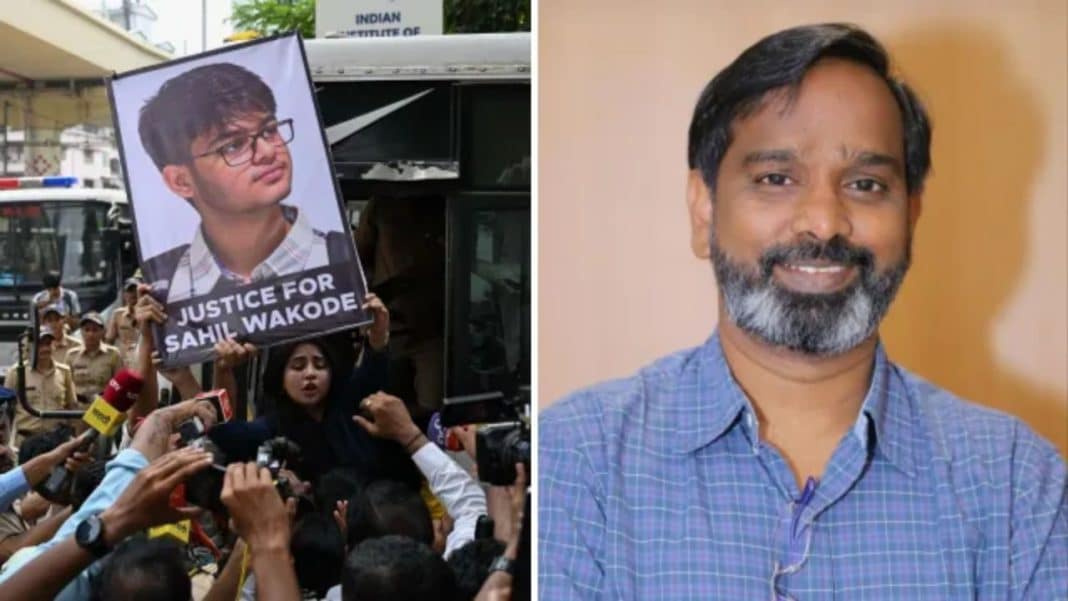

New CCTV footage has emerged in the case of 20-year-old IIT Bombay BTech student Sahil Wakode, who died by suicide on September 18, hours after he was allegedly caught using ChatGPT during an examination.
According to media report, CCTV cameras covering the examination hall and campus captured the events between approximately 12:30 pm and 1:25 pm on the day of the incident. Investigators are now examining the footage as they attempt to reconstruct Sahil’s final hours.
Sources cited by The Indian Express said that during the examination, Sahil appeared to bend down and look at something in his pocket. Professor Suryanarayana Doolla, who was invigilating the examination, was then seen questioning him before taking him to the side, away from the other students.
The footage reportedly does not show the professor publicly humiliating Sahil or engaging in any visible physical confrontation. Instead, the reported sequence shows the professor speaking to the student and subsequently asking him to leave the examination hall.
Sahil Remained Outside the Examination Hall
The CCTV trail reportedly shows Sahil remaining outside the examination hall until around 1:25 pm, even though the examination was scheduled to conclude at 1 pm.
He then returned towards his hostel room. Investigators are now examining the CCTV footage from the hostel and other parts of the campus to establish what happened during the period between his departure from the examination hall and his death.
The Mumbai Crime Branch has also searched Sahil’s hostel room and collected CCTV footage and other material as part of the investigation. Officials have said the evidence will be analysed to establish the sequence of events. No suicide note has reportedly been recovered so far.
Allegations of Caste-Based Harassment
The case took a different turn after Sahil’s parents alleged that their son had faced caste-based discrimination and mental harassment.
Based on a complaint filed by Sahil’s father, Mumbai Police registered an FIR naming Professor Doolla under provisions relating to abetment of suicide and the Scheduled Castes and Scheduled Tribes (Prevention of Atrocities) Act. The family alleged that Sahil had been subjected to caste-based remarks and harassment over a period of months.
However, these allegations remain part of the investigation and have not been established as facts.
IIT Bombay has denied the allegation of caste-based discrimination. The institute has also stated that no complaint relating to caste discrimination had been made by Sahil either to the administration or its SC/ST Cell during his tenure.
No Earlier Complaint Found Against Professor or Director
According to the institute’s position reported by The Indian Express, there was no earlier complaint from Sahil to the administration or the SC/ST Cell alleging caste-based discrimination.
The SC/ST Cell also stated that it had received no such complaint from Sahil. At the same time, the institute has said that the circumstances surrounding his death remain under investigation and has urged people to avoid speculation.
The absence of an earlier complaint does not, by itself, establish that the allegations made after Sahil’s death are false. It is, however, a relevant fact being considered alongside the family’s allegations and other evidence.
Professor Doolla Removed as Dean, But Investigation Continues
Amid protests on campus, IIT Bombay removed Professor Doolla from his position as Dean (Administrative Affairs). He continues to remain a faculty member at the institute while the investigation proceeds.
The IIT Bombay Faculty Forum has publicly backed Doolla and called for an independent and unbiased investigation, saying that his reputation should not be judged before the facts are established.
Meanwhile, students protesting on campus have demanded stronger action against the professor and have submitted a broader set of demands concerning student welfare, grievance redressal and mental-health support.
What the CCTV Evidence Can — and Cannot — Establish
The newly examined footage provides an important visual record of what happened inside and immediately outside the examination hall. But CCTV alone cannot establish what Sahil was thinking, what conversations may have taken place outside the camera’s range, or what ultimately led to his decision to take his own life.
That is why the ongoing Crime Branch investigation remains crucial.
At present, there are several established pieces of the timeline: Sahil was allegedly found using a phone during an examination, he was questioned and asked to leave the examination hall, he later returned to his hostel, and he died by suicide the same day. The allegations of caste-based harassment, however, remain under investigation, while the institute has denied having received any prior complaint from Sahil on the issue.
The CCTV footage could therefore become an important piece of evidence—not as a standalone answer to the case, but as part of a larger investigation into what happened inside the examination hall, what happened afterwards, and what circumstances preceded Sahil Wakode’s death.