


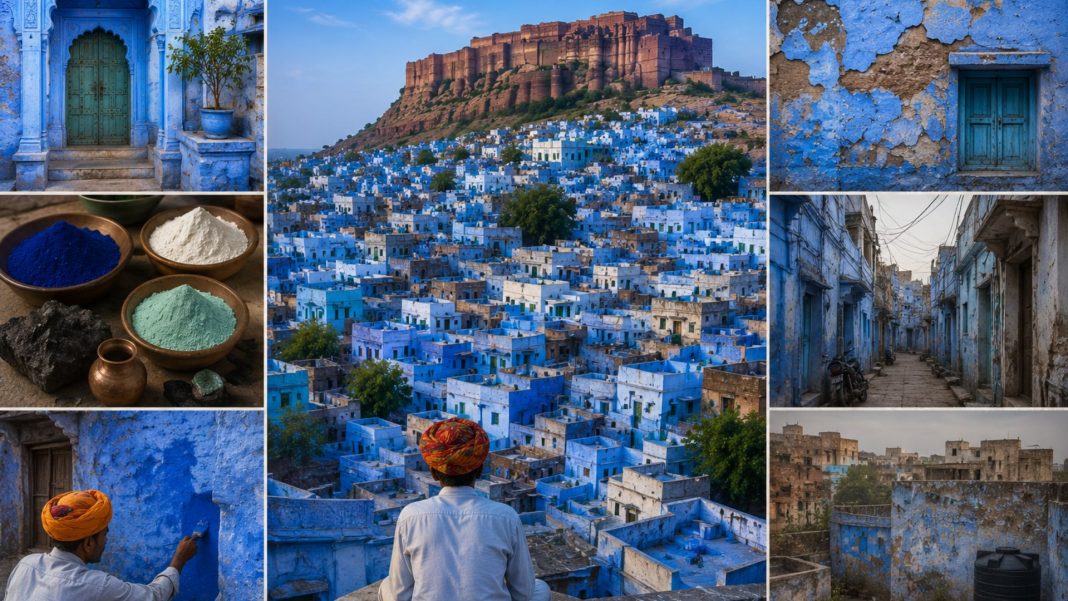

Why Jodhpur Turned Blue: For centuries, tourists and visual storytellers from across the globe have flocked to the edge of the Thar Desert to witness an awe-inspiring sight: a dense, labyrinthine sea of cobalt, sapphire, and indigo houses clinging to the base of the majestic Mehrangarh Fort.
Yet, step into the narrow alleyways of Brahmapuri or ask a local elder atop a rooftop terrace, and you will hear conflicting stories. Was Jodhpur painted blue out of royal decree, religious reverence, caste identity, or sheer pest control?
While no single historical record yields a definitive answer, historians, chemists, and cultural experts generally point to six primary reasons that converged to make Jodhpur India’s “Blue City”.
The Top 6 Reasons Behind Jodhpur’s Legendary Blue Hue
- The Brahmin Status Symbol
Why Jodhpur Turned Blue: Historically, the blue wash was concentrated in the neighborhood of Brahmapuri, located directly under the shadow of Mehrangarh Fort. The priestly class, the Brahmins, began adding indigo to their traditional lime wash to distinguish their residences from the rest of the populace. Over time, as non-Brahmin households observed the practical and aesthetic benefits, the color spread throughout the old walled city.
- The Science of Pest Control (Termite Proofing)
In the dry, arid climate of Rajasthan, wood and sandstone structures face severe threats from termites and subterranean pests. To combat this, residents mixed low concentrations of copper sulphate (blue vitriol) and copper compounds into traditional slaked lime (calcium hydroxide). The resulting chemical mixture produced a distinct pale-to-vibrant blue reaction while acting as a natural repellent against termites, mosquitoes, and fungi.
- Desert Heat Reduction & Passive Solar Cooling
Temperatures in Jodhpur frequently soar past 45°C (113°F) during summer months. Traditional limestone wash is highly reflective. When infused with indigo or copper compounds, the light blue pigments absorb far less solar radiation than darker sandstones, bouncing sunlight back and reducing interior temperatures of stone homes by several degrees.
- Sacred Devotion to Lord Shiva (Neelkanth)
Blue holds a sacred place in Hindu theology, symbolizing divinity, cosmic infinity, and Lord Shiva, also known as Neelkanth (“The Blue-Throated One”). According to mythology, Shiva drank the deadly poison halahala to save the universe, turning his throat blue. Painting homes in shades of azure was seen by devout locals as an act of spiritual protection and reverence.
- Royal Mandate & Symbolic Sky Replicas
Local lore also links the blue shade to the era of Maharaja Man Singh and the Rathore dynasty. Royal architects and courtiers sought to mirror the clear desert skies and create a soothing, calm visual barrier against the harsh, monochromatic yellow sand of the surrounding Thar Desert.
- Abundance & Affordability of Indigo
Economics played a decisive role. Rajasthan historically sat on vital trade routes where organic indigo dye (Neel) and limestone (Chuna) were cheap, locally sourced, and readily available. Combining a small scoop of indigo paste with cheap whitewash proved to be the most affordable way for everyday homeowners to paint their exterior walls.
Climate Change & Modern Paints Threaten the “Blue City” Legacy
Why Jodhpur Turned Blue: While Jodhpur’s blue identity survived for centuries, heritage conservationists now warn of an unexpected threat: unseasonal rainfall and shifting climate patterns.
Unseasonal Rainfall: Over the past decade, Rajasthan’s typical dry climate has experienced unusual precipitation spikes. The 200 to 300-year-old sandstone homes in old Jodhpur absorb excess moisture, causing traditional lime-and-indigo plaster to flake and degrade rapidly.
Ditching Traditional Shades: Frustrated by frequent wall repair, many homeowners are switching to waterproof oil paints, cement washes, or distempers. Consequently, patchworks of grey, yellow, brown, and pink are encroaching on once-uniform blue alleyways.
Revival Initiatives: To fight this aesthetic erosion, major heritage drives, including community repainting programs supported by global paint initiatives and local arts collectives, have stepped in.
Projects like AkzoNobel’s Let’s Colour campaign have restored over 250 historic homes and 250,000 square feet of walls using specialized heat-reflecting, eco-friendly blue coats and street murals to preserve Jodhpur’s world-famous heritage for future generations.
Jodphur Blue City At a Glance
| Parameter | Historical & Modern Details |
|---|---|
| Founded | 1459 CE by Rao Jodha of the Rathore Clan |
| Key Landmark | Mehrangarh Fort, rising approximately 125 metres above the city skyline |
| Primary Pigments | Indigo (organic) and copper sulphate + lime wash |
| Current Status | Active preservation and climate-resilience efforts underway |
| Cultural Significance | A major symbol of Rajasthan’s royal heritage, architecture and traditional craftsmanship |
| Conservation Focus | Preservation of traditional blue architecture, historic structures and resistance to weather and climate-related damage |
Also Read : The Death of Craftsmanship: How We Traded Beauty for Convenience, And Why It Backfired