


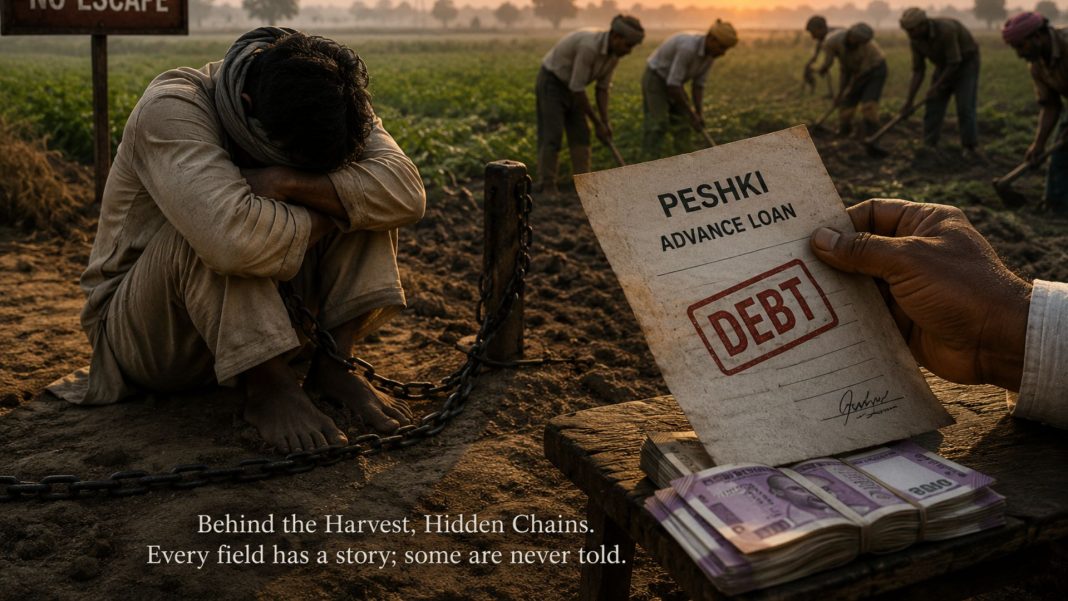

Shadows in the Fields: For decades, the engine of Punjab’s agricultural success has relied heavily on an influx of migrant labor, predominantly drawing from economically marginalized regions of Uttar Pradesh and Bihar.
While many migrant workers find legitimate livelihoods, human rights organizations and federal agencies have periodically uncovered cases of human trafficking, psychological abuse, and systemic exploitation.
A stark assessment by the Union Ministry of Home Affairs (MHA) and investigative reports from the Border Security Force (BSF) brought national attention to a severe breakdown in labor protections.
Official correspondences highlighted cases where human trafficking syndicates targeted individuals from impoverished backgrounds often capitalizing on physical or cognitive vulnerabilities luring them with the promise of stable wages, only to subject them to conditions of forced, unpaid labor upon arrival.
Systemic Extremes: From Debt Traps to Substance Exploitation
Shadows in the Fields: The operational reality of modern slavery or forced labor rarely mirrors ancient physical chains; instead, it utilizes systemic traps that make escape functionally impossible.
The Cycle of Peshki (Advance Loans): In many agrarian and brick-kiln setups across the region, a system of advanced payment traps vulnerable laborers. Once an advance is taken, opaque bookkeeping by employers ensures that the interest outpaces physical wages. This binds the individual to the farm for years and in extreme structural cases documented across South Asia, across generations.
Induced Substance Dependency: A highly concerning pattern reported by central agencies indicates that exploitative farm operators sometimes use narcotics or performance-enhancing drugs to keep laborers working extreme hours. Over time, this induces forced physical dependency, actively eroding the worker’s cognitive and physical health, rendering them unable to seek help or escape.
Cognitive Vulnerability as a Target: Reports from human rights watchdogs indicate that trafficking networks frequently target individuals who are already mentally feeble or physically isolated. By removing identification documents and severing ties with their home states, operators effectively isolate these workers from external rescue channels.
Deconstructing the Linguistic and Cultural Layers
Shadows in the Fields: The systemic vulnerability is further exacerbated by the deep social isolation experienced by non-native workers in rural clusters. In colloquial agricultural spaces, structural hierarchies manifest through everyday language.
Terms like “Seri” historically designated attached farm laborers under local customs, operating on a boundary line between contracted employment and permanent domestic attachment.
Furthermore, linguistic distortions or colloquial modifications of traditional surnames often function culturally to strip workers of their standard social identity, reinforcing their subordinate status within the household hierarchy.
The Institutional Reality and Legal Precedents
While regional political entities and local farmer unions often argue that extreme narratives are weaponized to politically discredit the agrarian community, legal and institutional data tells a different story.
The National Human Rights Commission (NHRC) has presided over numerous cases involving the identification and liberation of bonded laborers from Punjab’s brick kilns and cold storage units.
The Bonded Labour System (Abolition) Act of 1976 formally outlaws these practices, yet enforcement at the grassroots district level remains highly inconsistent due to a shortage of dedicated labor enforcement officers and insufficient tracking of interstate migrant registers.
The Path Forward: Structural Reforms and Human Rights Oversight
Addressing structural exploitation requires moving past temporary rescue operations toward permanent systemic adjustments. Human rights advocates insist on a multi-pronged policy execution:
Mandatory Inter-State Migrant Registrations: Local panchayats and state labor departments must maintain updated biometric and identification logs of all incoming seasonal and permanent farm hands to prevent unmonitored drop-offs.
Independent Grievance Redressal Cells: Setting up accessible, non-localized helplines managed directly by human rights commissions to bypass local administrative biases.
Strict Prosecutions Under the Anti-Trafficking Framework: Transitioning labor violations from simple monetary disputes into criminal prosecutions under the Indian Penal Code (IPC) whenever physical violence or mental coercion is proven.
Only by establishing rigorous, independent oversight can the agricultural heartland ensure that economic productivity is not built on the exploitation of India’s most invisible workers.
Also Read: AAP’s Performance in Delhi: What Does the Future Hold?