


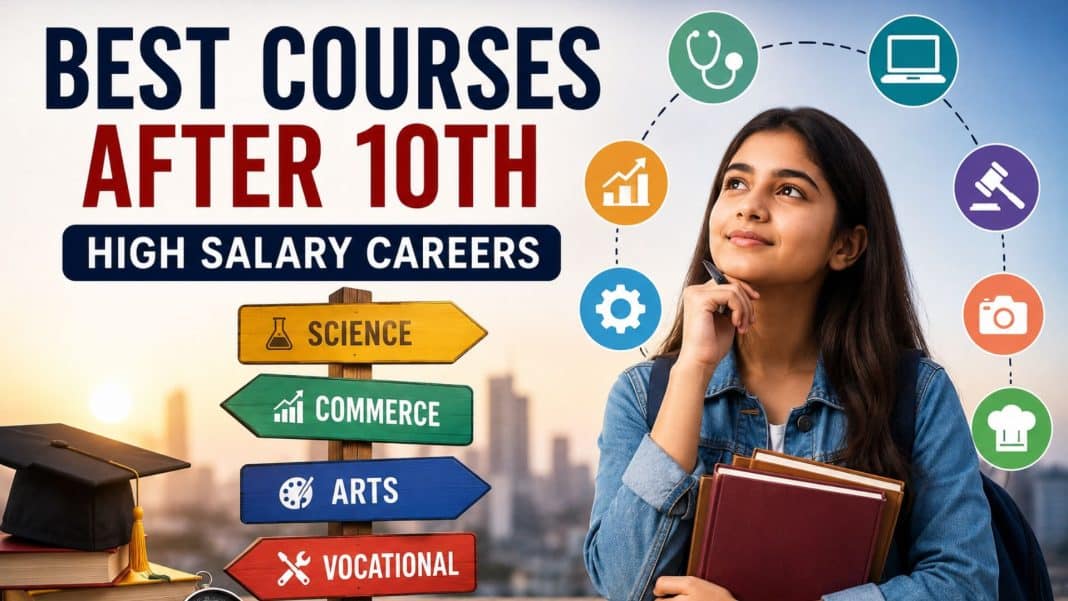

Best Courses After 10th: The transition from the 10th standard to higher secondary education is perhaps the most significant crossroad in a student’s life.
In India, this is the moment where “what do you want to be?” shifts from a dream to a strategic decision.
With the global job market evolving rapidly due to AI and automation, choosing a path that offers both high salary potential and long-term career stability is essential.
Whether you want to dive into a traditional academic stream, pick up a technical skill, or enter the creative workforce early, here is a comprehensive guide to the best courses after 10th.
The Academic Route: Choosing the Right Stream (10+2)
Best Courses After 10th: For most students, the 10+2 (Intermediate) path is the preferred gateway to high-paying professional degrees. Choosing a stream should be a balance of your interest and the market scope.
A. Science: The Gateway to Tech and Innovation
Science remains the most popular stream for students aiming for high-salary packages. It is divided into PCM (Physics, Chemistry, Maths) and PCB (Physics, Chemistry, Biology).
The Scope: Leads to careers in Engineering (B.Tech), Medicine (MBBS), Data Science, Artificial Intelligence, Robotics, and Environmental Sciences.
High-Salary Potential: Software Engineers, Surgeons, and Data Scientists consistently rank among the highest earners globally.
Key Interest: Logic, problem-solving, and a curiosity about how the world works.
B. Commerce: The Backbone of Business
If you are fascinated by numbers, trade, and the economy, Commerce is your field.
The Scope: Opens doors to Chartered Accountancy (CA), Company Secretary (CS), Investment Banking, Marketing, and Management (MBA).
High-Salary Potential: Senior Financial Analysts and Investment Bankers earn lucrative bonuses and high base salaries.
Key Interest: Finance, stock markets, and entrepreneurship.
C. Arts & Humanities: The Creative Powerhouse
The myth that Arts has no “scope” is dead. Today, some of the most dynamic careers emerge from the Humanities.
The Scope: Law (Integrated LLB), Journalism, Psychology, Civil Services (UPSC), Product Design, and Public Policy.
High-Salary Potential: Corporate Lawyers and Senior Policy Advisors often earn as much as top-tier engineers.
Key Interest: Communication, social structures, law, and creative expression.
Technical Excellence: Polytechnic Diplomas
Best Courses After 10th: If you prefer practical, hands-on learning over theory, a Polytechnic Diploma is an excellent choice. These are 3-year technical programs that make you job-ready by the age of 19.
Popular Specializations: Mechanical, Civil, Electrical, Computer Science, and Automobile Engineering.
Why Choose This? It allows for early entry into the workforce as a Junior Engineer.
The “Lateral Entry” Benefit: After a diploma, you can enter the second year of a B.Tech degree directly, saving a year of traditional schooling.
Vocational Training: ITI Courses for Direct Employment
Industrial Training Institutes (ITI) provide trade-specific training. These courses are ideal for students who want to secure a government or private sector job quickly.
In-Demand Trades: Electrician, Fitter, Mechanic (Motor Vehicle), and Computer Operator & Programming Assistant (COPA).
Career Potential: High demand in manufacturing, railways, and telecommunications. Many ITI graduates also start their own successful businesses.
Short-Term Professional Certifications (Job-Oriented)
In 2026, skills often matter more than degrees. Students can pursue these short-term courses (3 to 6 months) alongside their regular studies to boost their earning potential.
Digital Marketing: Learning SEO, Social Media Management, and Ads.
Graphic Design & Animation: High demand in the gaming and advertising industries.
Financial Accounting (Tally/GST): Essential for small and medium businesses.
Web Development: Learning HTML, CSS, and basic JavaScript to build websites.
Gender-Neutral Horizons: Career Paths for Girls
While every field from fighter pilot to data scientist is open to all genders, there are certain paths where female representation and success are currently skyrocketing:
Paramedical & Nursing: High demand in healthcare management and nursing administration.
Design & Styling: Fashion Design, Interior Design, and Jewelry Design offer immense freelance and corporate opportunities.
Teaching & Research: Academic careers in specialized subjects like Biotechnology or Psychology.
Corporate Leadership: HR Management and Hospitality Management.
Emerging Fields: Sports, Fitness, and Content Creation
The passion economy is booming. If you don’t want a 9-to-5 desk job, consider these:
Fitness & Nutrition: Certified Personal Trainers and Nutritionists are in high demand as health consciousness grows.
Content Creation: Social media management and professional video editing for YouTube/Instagram creators.
Culinary Arts: Baking and professional chef courses for the hospitality sector.
How to Choose? A 3-Step Strategy
Step 1: Assess Your Interest
Don’t choose Science just because your neighbor did. If you hate math but love storytelling, look at Mass Communication or Law. If you love taking machines apart, choose Polytechnic.
Step 2: Check the Market Scope
Look at job trends for 2030. Fields like Renewable Energy, Cybersecurity, and Nursing are expected to see massive growth.
Step 3: Financial Planning
Understand the cost of the course versus the expected starting salary (ROI). Government colleges and ITIs offer very low-cost education with high returns.
The “best” course is the one where your passion meets market demand. If you want a high salary, focus on specialization.
Whether it is becoming a specialized surgeon or a niche software developer, expertise is what pays.
Take your time to research, talk to counselors, and remember: 10th standard is not the end, but the beginning of an exciting journey.
Choose a path that makes you want to wake up and work every single day!