


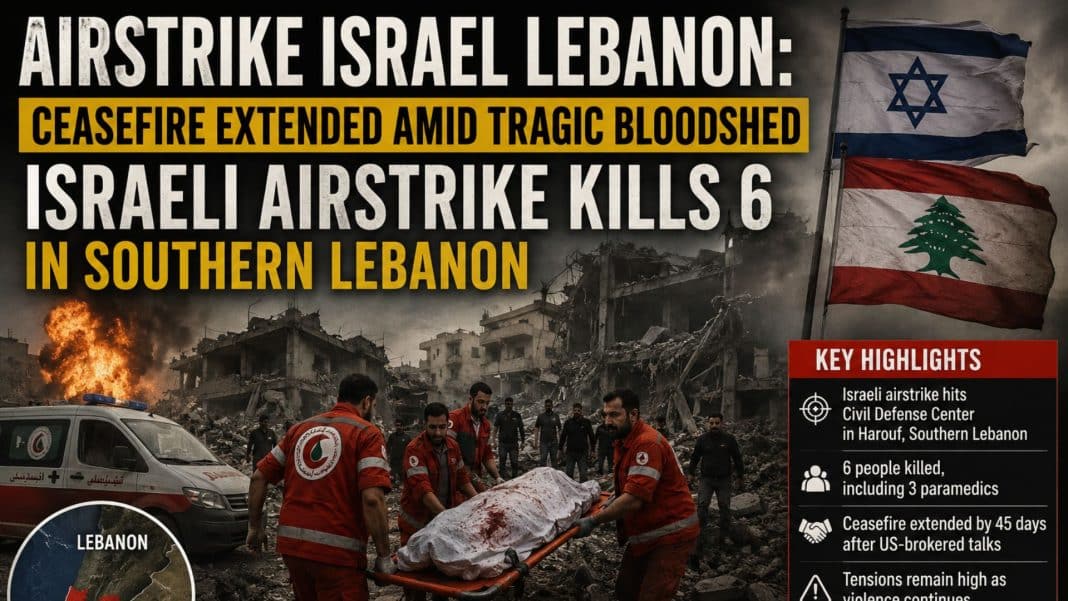

Airstrike Israel Lebanon: A major diplomatic breakthrough and a devastating tragedy have unfolded simultaneously in the Middle East.
While Israel and Lebanon have agreed to extend their US-brokered ceasefire for another 45 days, the ground reality remains highly volatile.
A fresh Israeli airstrike in Southern Lebanon has claimed the lives of six people, including three first responders, underscoring the fragile nature of the peace talks.
Key Highlights of the Situation
The Tragedy: An Israeli airstrike targeted a Civil Defense Center in the town of Harouf, Southern Lebanon, killing six people.
The Victims: The casualties include three paramedics, with another critically injured.
The Diplomacy: Following intense two-day talks in Washington D.C., Israel and Lebanon agreed to extend their current 45-day ceasefire.
The Paradox: Despite official truce extensions, near-daily cross-border violence between Israel and Hezbollah continues to threaten a wider regional war.
The Tragedy in Harouf: Medical Workers Under Fire
Airstrike Israel Lebanon: Ceasefire Extended Amid Tragic Bloodshed Israeli Airstrike Kills 6 in Southern LebanonThe latest wave of violence hit the town of Harouf in Southern Lebanon, where an Israeli airstrike completely devastated a local Civil Defense Center.
According to the Lebanese Health Ministry, the attack directly targeted emergency workers who were actively engaged in rescue operations.
Casualties at Harouf Civil Defense Center:
3 Paramedics Killed
3 Civilians Killed
1 Paramedic Critically Injured
The Lebanese Health Ministry fiercely condemned the strike, accusing the Israeli military of deliberately targeting medical personnel and civilian infrastructure.
In response, the Israeli Defense Forces (IDF) rejected these allegations. The IDF maintained that its operations strictly target Hezbollah fighters, weapon caches, and their operational infrastructure, rather than civilians or rescue workers.
Diplomatic Breakthrough: US Brokers Ceasefire Extension
Airstrike Israel Lebanon: In sharp contrast to the smoke and sirens in Southern Lebanon, diplomatic corridors in Washington D.C. saw a ray of hope.
Following a grueling two-day negotiation session, US mediators successfully convinced both nations to prolong their truce.
US State Department Spokesperson Tommy Pigott confirmed the agreement on Friday, stating that the extension is a crucial stepping stone.
“The United States hopes this extended ceasefire will serve as a foundational step toward establishing permanent peace and ensuring long-term border security for both nations.” , Tommy Pigott, US State Department
The Backstory of the Truce
The initial 45-day ceasefire was originally announced by US President Donald Trump on April 16. However, enforcement on the ground has been weak.
Just days before this new extension, the Lebanese Health Ministry reported another devastating airstrike that claimed the lives of 22 people, including eight children.
The Ground Reality: The Fight for a Buffer Zone
Why is the violence continuing despite the diplomatic agreements? The answer lies in the strategic goals of both sides on the ground.
Israel’s Objective
Israel has significantly intensified its aerial bombardment and artillery shelling across Southern Lebanon.
The primary goal is to establish a secure buffer zone along its southern border. Israel argues that pushing Hezbollah back from the border is the only way to protect its northern citizens from future rocket fire and cross-border incursions.
Hezbollah’s Retaliation
On the flip side, Hezbollah has refused to back down. The militant group continues to launch routine rocket barrages and explosive drone strikes targeting northern Israeli towns and military border outposts. This relentless back-and-forth has turned the border region into an active combat zone.
Global Concerns: Is a Wider Middle East War Imminent?
International geopolitical experts are watching the situation with growing anxiety. The paradox of signing peace extensions while actively launching deadly airstrikes highlights a deep-rooted mistrust between the two factions.
If the US-mediated truce fails to hold, experts warn that the Israel-Hezbollah conflict could spiral completely out of control, dragging other regional powers into a massive, full-scale Middle Eastern war.
While the 45-day extension offers a temporary sigh of relief for international diplomats, the civilian population on the ground remains caught in a deadly crossfire.
Also Read : Global Oil Lifeline at Stake: Xi Offers Trump Help on Strait of Hormuz Crisis as Iran Tightens Grip