


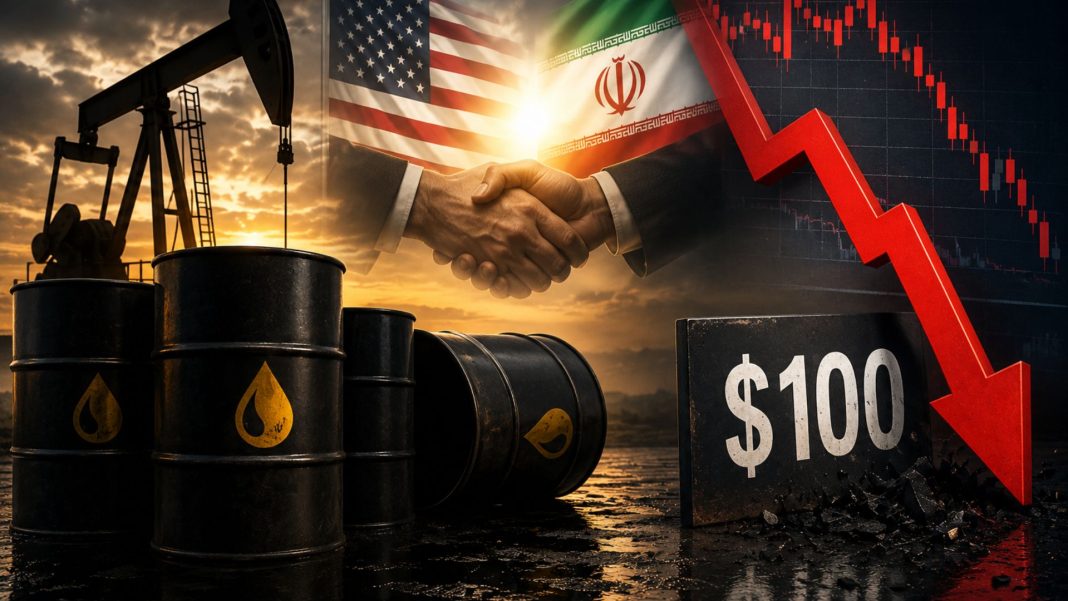

Crude Shock: The international oil market witnessed a dramatic meltdown on Monday, offering a massive sigh of relief to global economies, and potentially to Indian consumers who are currently battling a relentless streak of fuel price hikes.
In a stunning turn of events, crude oil prices crashed to their lowest levels in two weeks. The catalyst? Growing optimism that Washington and Tehran are on the verge of signing a historic peace treaty, which could unlock one of the world’s most critical energy chokepoints.
The Big Meltdown: Brent and WTI Take a Heavy Hit
Crude Shock: The bears officially took over the oil market on Monday morning. Brent crude, the global benchmark, plummeted by up to 6%, diving headfirst below the psychological support level of $100 per barrel. Simultaneously, the US West Texas Intermediate (WTI) crude suffered a similar fate, wiping out over 6% of its value to hover near the $90 mark.
Brent Crude: Trading at $97.74 per barrel (down 5.60%).
WTI Crude: Trading at $90.98 per barrel (down 5.82%).
This massive single-day drop follows an already weak previous week where US crude shed 8% and Brent lost over 5%. The market’s downward trajectory began when President Donald Trump paused scheduled airstrikes on Iran to give diplomacy a fighting chance.
However, despite this sudden cool-off, the ghosts of the conflict still linger. Oil prices remain over 30% higher than they were before the February 28 US-Israel military strikes on Iran.
From $115 to Sub-$100: What Triggered the Crash?
Crude Shock: The geopolitical rollercoaster has dictated oil prices all month. When the US-Iran conflict escalated, the energy market caught fire, pushing Brent crude to a dizzying peak of $115 per barrel earlier this month, a massive leap from its pre-war stability of $60 to $70.
So, what changed over the weekend?
On Saturday, US President Donald Trump announced that Washington and Tehran had largely finalized a Memorandum of Understanding (MoU) for a comprehensive peace agreement.
The biggest breakthrough of this deal is the potential reopening of the Strait of Hormuz. Before the conflict brought the region to a standstill, nearly one-third of the world’s total oil and Liquefied Natural Gas (LNG) shipments flowed through this narrow waterway. The mere prospect of reopening this vital trade artery sent speculative traders rushing to dump their positions, causing a 15% drop in Brent prices between May 4 and May 25.
Is the Energy Crisis Over? Not Just Yet
While the diplomatic breakthrough is phenomenal news, top financial minds are urging caution. Wall Street giant Morgan Stanley warned that the oil market is entering an incredibly turbulent phase.
Analysts point out that even if a peace treaty is signed tomorrow, repairing the heavily damaged energy infrastructure and restoring full cargo traffic through the Strait of Hormuz will take several months.
Up until now, the global market avoided an absolute catastrophe due to a combination of two factors: boosted crude exports from the United States and sluggish economic demand from China. However, Morgan Stanley dropped a major warning: If the Strait of Hormuz remains blocked beyond June, global supply shortages will bite back hard, and oil prices could skyrocket right back to record highs.
The Indian Dilemma: Relieving Corporate Pain Amidst Citizen Strain
For India, which imports over 80% of its oil, this global price crash is a double-edged sword that arrives at a critical juncture.
On one hand, Indian Oil Marketing Companies (OMCs) have been bleeding cash, absorbing massive under-recoveries due to high global procurement costs. To offset these staggering losses, oil companies hiked petrol and diesel prices yet again on Monday, marking the fourth price hike of this year.
The Fuel Price Sting: In a harsh reality check for commuters, domestic petrol and diesel prices have surged by a steep ₹2.73 per litre over the last 10 days alone, stoking fears of broader inflation.
On the other hand, this sudden drop in international crude offers a golden exit ramp. If Brent crude manages to stabilize below the $100 mark, the financial bleeding of Indian oil companies will reduce drastically.
Also Read : Oreshnik Missile: Russia Unleashes Nightmare Air Strike as ‘Oreshnik’ Strikes Ukraine Again!