


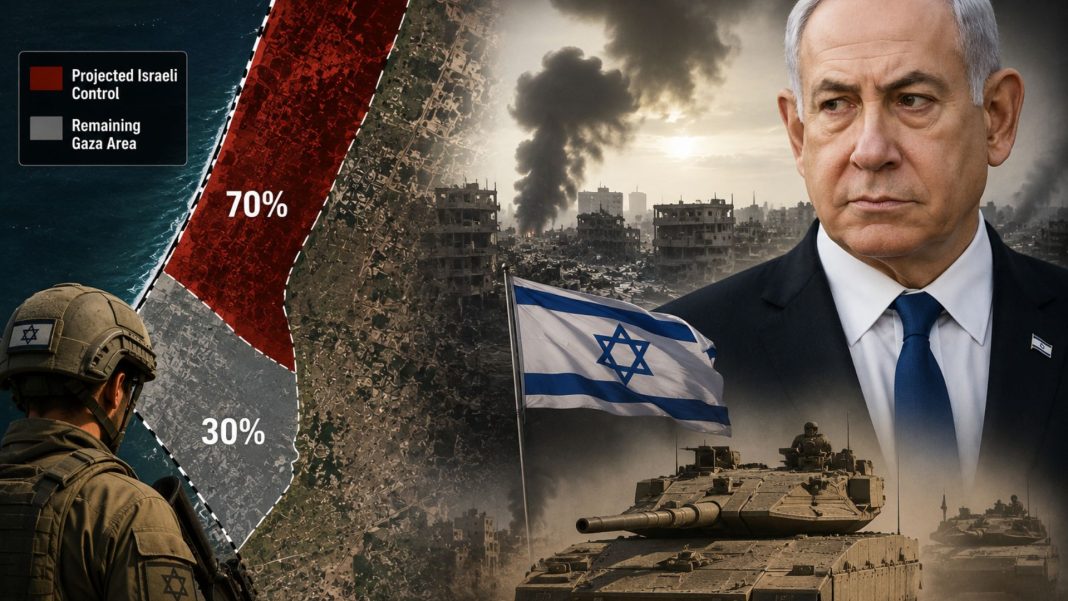

Netanyahu Gaza Control Plan: Israeli Prime Minister Benjamin Netanyahu has announced plans to expand military control over the Gaza Strip, targeting 70% of the Palestinian enclave. Speaking at an event in the West Bank, Netanyahu stated that the Israeli Defense Forces (IDF) are systematically widening their footprint to sustain pressure on Hamas.
The declaration comes amid an incredibly fragile security landscape in the Middle East, threatening to complicate ongoing ceasefire negotiations.
Incremental Expansion: From 50% to 70%
Netanyahu Gaza Control Plan: According to Prime Minister Netanyahu, Israel’s military presence in Gaza has grown significantly over the recent months of the campaign. He detailed a structured, phase-by-phase expansion of military governance within the territory.
Initial Phase: Israel previously maintained military control over approximately 50% of the Gaza Strip.
Current Status: That presence has officially expanded to 60%.
The Next Target: The immediate objective is to secure military dominance over 70% of the enclave.
“My directive is that we advance gradually, with the primary goal of securing 70% of this territory,” Netanyahu stated during his West Bank address. Reports from the venue noted that sections of the crowd responded to his speech with chants urging the government to take full control of the entire Gaza Strip.
The Humanitarian Impact and the 64% Reality
Netanyahu Gaza Control Plan: Data shared by the Israeli military aligns closely with the Prime Minister’s statements. In April 2026, the IDF shared an operational map with international aid agencies indicating that Israeli forces already exercised effective control over roughly 64% of Gaza.
Humanitarian organizations have raised immediate alarms over any further territorial expansion. Experts warn that pushing Israel’s military footprint to 70% will compress nearly 2 million displaced Palestinians into an even smaller, highly congested coastal zone. This raises severe concerns regarding:
Extreme overcrowding in designated safe zones.
Severe strain on already depleted water, food, and medical supplies.
Increased difficulty for international agencies distributing aid.
Ceasefire Talks Jeopardized as Casualties Rise
Netanyahu’s hardline stance comes at a critical juncture. International mediators are actively pushing for the next phase of a ceasefire agreement. The core tenets of the proposed deal include:
The complete disarmament of Hamas.
The phased withdrawal of Israeli troops from the Gaza Strip.
However, the reality on the ground presents a stark contrast to the diplomatic talks. Gaza health officials report that approximately 900 Palestinians have been killed in ongoing Israeli strikes since the current ceasefire framework was initiated.
While Hamas currently retains control over only a small fraction of the coastal territory, it continues to resist the IDF’s advances.
Aggression vs. Security: Both Sides Trade Blames
The latest announcement has triggered a fierce war of words, with both sides defending their positions while accusing the other of bad faith.
The Hamas Perspective:
has vehemently accused Israel of violating the terms of the agreed-upon ceasefire. A spokesperson stated that Israel’s forced incursions and territorial expansion are actively destroying any remaining hopes for long-term peace and stability in the region.
The Israeli Perspective:
The Israeli government maintains that sustained military pressure is the only viable path forward. Officials argue that expanding territorial control is absolutely necessary to systematically weaken Hamas’s operational capabilities and prevent any future cross-border attacks.
With Netanyahu openly committed to capturing 70% of the enclave, the path toward a permanent ceasefire appears increasingly complex, leaving millions of civilians caught in the crossfire of an expanding military map.
Also Read : Safe Passage of Indian Tanker: Nisos Keros Clears Tense Strait of Hormuz Amid Middle East Crisis