


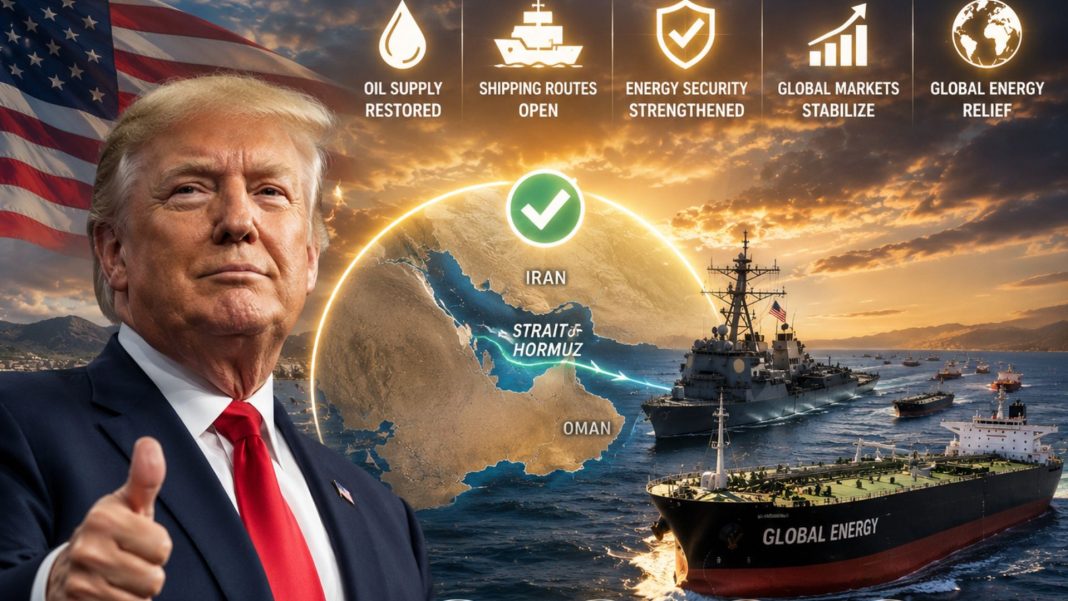

GLOBAL ENERGY RELIEF: In a major breakthrough for global trade and energy security, US President Donald Trump has officially announced the lifting of the naval blockade on the strategic Strait of Hormuz.
The decision brings immediate relief to the international community, signaling the return of normalcy to a vital maritime route that had been choked by months of intense geopolitical confrontation.
President Trump shared the development via a social media post, confirming that vessels currently stranded or stalled in the volatile region can now safely proceed to their respective destinations.
“The United States military will proactively work to clear underwater naval mines and neutralize other security threats in the area to guarantee that international shipping traffic is completely safe and unhindered,” the US President stated.
WHY THE STRAIT OF HORMUZ KEEPS THE WORLD RUNNING
GLOBAL ENERGY RELIEF: The Strait of Hormuz is widely regarded as the world’s most critical maritime chokepoint. Connecting the Persian Gulf with the Arabian Sea, this narrow strip of water serves as the literal backbone of global energy logistics.
The Lifeline by the Numbers:
Oil Cargo: Approximately 20% of the world’s total petroleum consumption passes through this strait daily.
Natural Gas: Huge volumes of Liquefied Natural Gas (LNG) are shipped via this route from major Middle Eastern producers to global markets.
Because of this extreme concentration of energy transit, any blockade or military standoff in the region immediately sends shockwaves through global oil markets, threatening spike-driven inflation worldwide.
GENESIS OF THE GULF CRISIS
GLOBAL ENERGY RELIEF: The crisis escalated rapidly earlier this year following a sharp rise in regional conflicts and military posturing in the Middle East. Seeking to apply maximum economic pressure on Iran, the United States enforced a strict naval blockade, which severely restricted commercial access to the shipping lane.
Fearing missile strikes or ship seizures, the majority of global shipping conglomerates chose to reroute their fleets around Africa or halt transits altogether, sending insurance premiums skyrocketing and throwing international supply chains into chaos.
THE SECRET INSIDE STORY: HOW INDIA BRAVED THE EMBARGO
GLOBAL ENERGY RELIEF: For India, the blockade was nothing short of a national security emergency. As a country that imports the lion’s share of its crude oil and LPG from Gulf nations, a total shutdown of the Strait of Hormuz could have triggered severe domestic fuel shortages and hyperinflation.
However, while international shipping lines pulled out, New Delhi executed a masterclass in risk management and strategic autonomy to keep its economic wheels turning.
- The Multi-Ministry War Room
Behind closed doors, the Indian government launched a highly coordinated, multi-layered defense strategy. While the Ministry of External Affairs (MEA) managed delicate backchannel diplomacy with all warring factions, three key ministries worked in absolute lockstep: the Ministry of Shipping, the Ministry of Petroleum and Natural Gas, and the Ministry of Chemicals and Fertilizers
.
Together, they audited and compiled a dynamic database of high-priority cargo vessels. Ships carrying critical crude oil, LPG, and essential agricultural fertilizers were fast-tracked and shielded under a specialized, state-monitored security blanket.
- Defying the Odds: Indian Sailors Kept Moving
While foreign-flagged commercial vessels anchored away from the danger zone, Indian merchant ships continued to navigate the blockaded waters with caution and calculated grit. By maintaining strict real-time monitoring and tactical routing, India ensured that its domestic refineries and bottling plants never ran out of raw materials.
CURRENT STATUS: POSITION OF INDIAN SHIPS IN THE GULF
Government data reveals that despite the high-stakes environment, 13 Indian commercial vessels are currently stationed or moving within the high-risk zone. These include crucial crude oil tankers, LPG cargo carriers, and container ships handling essential goods.
While these 13 ships previously operated under a high-alert security protocol, the formal removal of the blockade means they can now navigate the route smoothly.
The risk of military interception has dropped significantly, which will also fast-track transit times and drastically reduce heavy freight insurance costs for Indian imports.
THE TAKEAWAY: A TRIUMPH FOR INDIA’S ENERGY STRATEGY
The resolution of the Hormuz crisis underscores the maturity of India’s modern geopolitical strategy. Through proactive planning, airtight inter-ministerial coordination, and decisive diplomatic maneuvers, New Delhi successfully insulated its citizens from a massive global shock.
While the rest of the world watched the Gulf with anxiety, India’s calculated resilience ensured that its fuel stations remained stocked, its fertilizer supplies stayed intact, and its national energy security stood completely unbroken.
Also Read : Israel-Hezbollah War: 22 Hezbollah Attacks as Israeli Troops Push Deeper Into Lebanon