
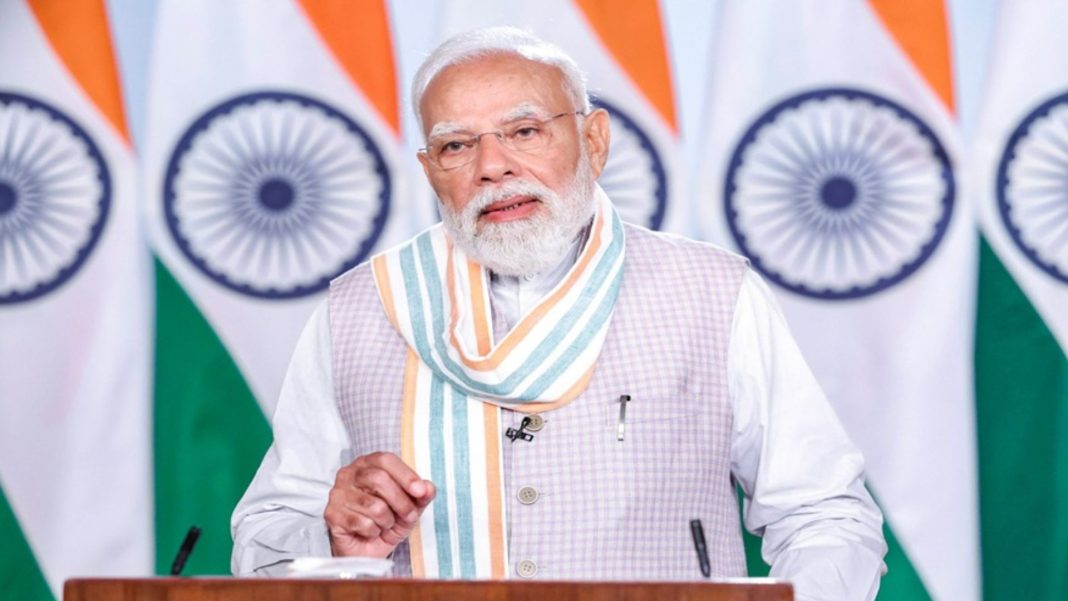

PM Modi Completes 12 Years in Office: Prime Minister Narendra Modi marked a historic milestone on Tuesday (June 9, 2026), completing 12 continuous years as the head of the Indian government.
Reflecting on this journey, which began in May 2014, PM Modi described the period as one entirely dedicated to “trust, development, and public welfare.”
The milestone coincides with the second anniversary of his third consecutive term, which commenced on June 9, 2024, following the National Democratic Alliance’s (NDA) victory in the 2024 general elections.
In a statement shared on social media platform X, PM Modi emphasized that his administration has consistently operated under the guiding principle of “Nation First,” focusing heavily on empowering the country’s youth, women, farmers, and marginalized communities while simultaneously elevating India’s global standing.
Redefining Political Longevity in Post-Independence India
PM Modi Completes 12 Years in Office: With 12 uninterrupted years at the helm, PM Modi’s tenure marks a significant chapter in India’s political history.
While India’s first Prime Minister, Jawaharlal Nehru, served for a total of nearly 17 years (1947–1964), his governance included an initial five-year period heading an interim government before India’s first democratic elections were institutionalized in 1952.
Political analysts note that PM Modi’s 12 continuous years represent the longest unbroken tenure of an elected Prime Minister in the modern era, surpassing the continuous post-1952 elected streaks of previous leaders.
Political scientists view this era as a profound shift from the long-standing “Nehruvian consensus” toward a new model of governance focused on civilizational identity and direct-benefit welfare.
Key Policy Moves: Welfare and Women’s Empowerment
PM Modi Completes 12 Years in Office: A corner-stone of the NDA administration’s 12-year tenure has been a massive scale-up of targeted welfare schemes designed to secure the economic foundations of underprivileged households:
Food and Housing Security: The government currently provides free monthly food grains to over 81 crore beneficiaries. Additionally, over 4 crore houses have been sanctioned and constructed under the PM Awas Yojana.
Clean Energy and Sanitation: Over 10.5 crore LPG connections have been distributed under the Ujjwala programme, and more than 12 crore toilets have been built nationwide to improve rural sanitation.
Financial Inclusion for Women: More than 32 crore women have been integrated into the formal banking ecosystem through Jan Dhan accounts.
Rural Livelihoods: Under the Lakhpati Didi initiative, more than 10 crore rural women have been linked to over 91 lakh self-help groups (SHGs), promoting grassroots entrepreneurship.
Furthermore, the administration approved permanent commissions for women in the Armed Forces, marking a major institutional shift.
Infrastructure Expansion and Digital Growth
The last decade has seen an unprecedented overhaul of India’s physical and digital infrastructure, aiming to improve domestic connectivity and boost economic efficiency:
Transit and Railways: India’s operational metro network now spans over 1,100 kilometers across 26 cities. The aviation sector saw expansion with the number of operational airports doubling from 74 to 164.
Landmark engineering projects completed during this tenure include the Atal Setu, Sudarshan Setu, and the Chenab Rail Bridge, alongside the deployment of 164 Vande Bharat trains.
Youth and Startups: To back the aspirations of the younger demographic, the government provided formal skill training to over 2 crore youth and disbursed ₹40 lakh crore in Mudra loans.
India’s startup ecosystem has subsequently grown to encompass over 2.2 lakh registered startups.
Healthcare Expansion: The Ayushman Bharat scheme now provides health coverage to approximately 80 crore people, recently expanding to offer free treatment up to ₹5 lakh for all senior citizens aged 70 and above.
This is supported by a network of over 19,000 Jan Aushadhi Kendras delivering affordable medicines.
Agricultural Support and National Security Upgrades
The Prime Minister also highlighted systemic interventions aimed at boosting agrarian income and reinforcing national defense:
Direct Farmer Benefits: The government has transferred over ₹4.3 lakh crore directly into bank accounts via the PM-Kisan Samman Nidhi. Crop insurance payouts have crossed ₹2 lakh crore, backed by a massive ₹26 lakh crore procurement at Minimum Support Price (MSP).
Defense and Security: Highlighting a structural shift from a defense importer to an exporter, India achieved a record ₹38,400 crore in defense exports. Security operations against cross-border terrorism and domestic Naxalism were heavily amplified.
Cultural Heritage: The administration successfully oversaw long-pending, high-profile national projects, including the construction of the Ram Mandir in Ayodhya and the comprehensive redevelopment of historical cultural centers like Kashi Vishwanath, Mahakal Mahalok, and Kedarnath Dham.
Looking ahead toward the remainder of his third term, PM Modi reiterated that the government remains fully committed to its core vision of transforming India into a fully developed nation Viksit Bharat by the year 2047 through consistent structural reforms, transparent governance, and sustained economic growth.
The Roadmap to 2047
As Prime Minister Narendra Modi concludes 12 continuous years in office, his administration has formally shifted focus toward its long-term strategic agenda: Viksit Bharat @ 2047.
The stated goal is to fully transition India into a developed nation by the centenary of its independence.
With the stabilization of macro-economic indicators, localized digital public infrastructure (DPI) leading global trends, and structural changes across defense and manufacturing, the next few years of his third term are positioned to test the scalability of this governance model amidst a changing global order.
Also Read: Tensions Peak in West Asia: US Apache Helicopter Crashes Near Strait of Hormuz