


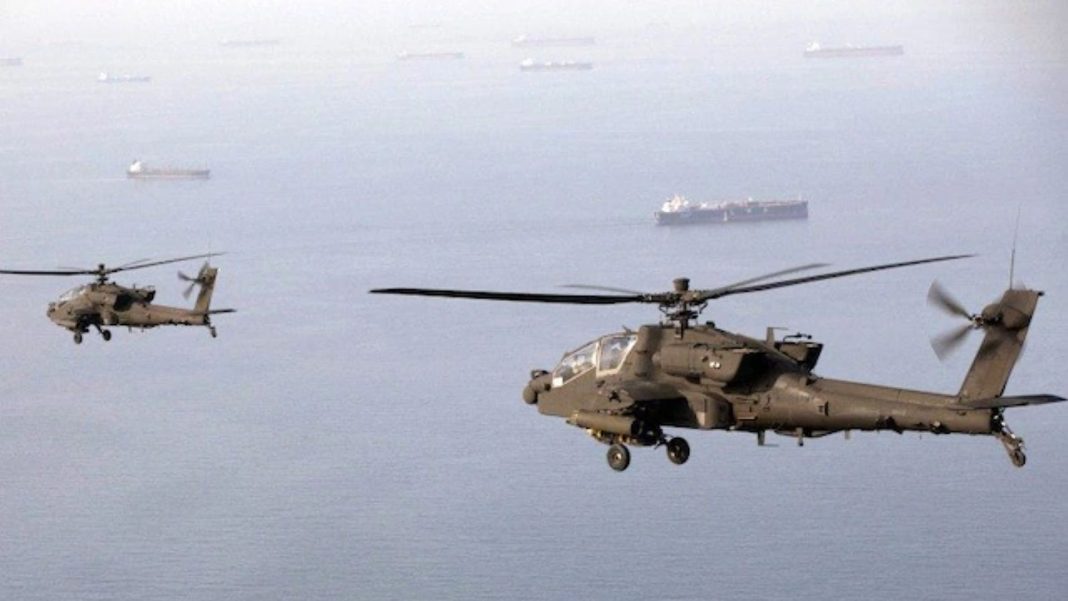

Tensions Peak in West Asia: In a development that has sent shockwaves through international defense corridors, a United States military AH-64 Apache attack helicopter has crashed near the highly volatile Strait of Hormuz.
This critical maritime chokepoint is already simmering with intense geopolitical friction, and the sudden downing of a premier American asset has pushed regional anxieties to an all-time high.
The incident occurred against the chaotic backdrop of ongoing, direct military exchanges between Iran and Israel. While the crash represents a significant tactical blow to US operations in the region, Pentagon officials breathed a sigh of relief regarding the human cost.
Both crew members aboard the attack helicopter were successfully rescued from the zone and are reported to be in stable condition.
Trump Breaks Silence: “Pilots Are Safe, Detailed Report Tomorrow”
Tensions Peak in West Asia: As speculation mounted globally over whether the helicopter was targeted by adversarial forces, US President Donald Trump addressed the situation directly to quell immediate panic.
“Our pilots are completely safe. They are doing fine,” President Trump stated, confirming the rescue operation’s success. “We are thoroughly investigating what happened out there.
We will release a detailed, comprehensive report tomorrow, but the most important thing right now is that both of our servicemen are safe.”
Despite the executive reassurance, the The New York Times, quoting defense officials, noted that the exact cause of the crash remains shrouded in mystery.
Investigators have not yet ruled out whether the Apache was brought down by hostile Iranian fire, suffered a catastrophic mechanical failure, or succumbed to severe environmental factors.
Timing Elements: A Theater of War
Tensions Peak in West Asia: What makes this crash deeply alarming to global military analysts is its timing. The Apache went down on the exact same day that Iran and Israel traded heavy military strikes, transforming the airspace around the Persian Gulf into a high-risk combat zone.
The Strait of Hormuz, through which a fifth of the world’s oil passes, has effectively become a no-go zone. While international trade bodies have clarified that the strait is not completely closed,
the presence of heavily armed warships and aggressive aerial patrols means the risk of a miscalculation triggering a wider global conflict is at its highest in decades.
American Firepower in the Hormuz: What is Uncle Sam Flying?
Tensions Peak in West Asia: The US military has deployed a formidable array of advanced weaponry to secure the waters and protect its strategic interests in the region. Apart from the lethal Apache attack helicopters, the American arsenal currently operating in and around the Strait of Hormuz includes:
MQ-9 Reaper Drones: The premier unmanned aerial vehicle used for high-altitude surveillance and precision airstrikes.
F-15E Strike Eagles: Dual-role fighter jets designed for deep-theater interdiction and air superiority.
F/A-18 Super Hornets: All-weather, carrier-capable multirole fighter jets patrolling the gulf waters.
F-35 Lightning II: Fifth-generation stealth fighters capable of evading advanced air defense systems.
War of Claims: Tehran Boasts Massive US Losses
While Washington maintains a calculated stance on its operational setbacks, Tehran has been quick to weaponize the optics of the conflict.
According to various regional military reports, since the current escalation erupted on February 28, Iran has claimed to have damaged or completely shot down at least 42 American aircraft and drones.
Iranian state media has frequently listed the high-tech MQ-9 Reaper drones, F-15E fighter jets, and the specialized MC-130J Commando II special operations aircraft among their successful intercepts.
While the Pentagon has fiercely disputed and downplayed the majority of Tehran’s claims, defense experts note that this Apache crash marks the first officially acknowledged loss of this specific helicopter variant since the February escalation began.
The Waiting Game: Eyes on the Pentagon Investigation
The international community now waits with bated breath for the promised US investigative report. The findings carry massive geopolitical weight:
If it was a Technical Failure: It will offer a diplomatic escape hatch, allowing both Washington and Tehran to avoid a direct, catastrophic military escalation.
If it was an Iranian Strike: It could compel the United States to launch direct retaliatory strikes against Iranian assets, potentially dragging the entire West Asian region into an uncontrollable, multi-nation war.
Until the telemetry data and pilot testimonies are analyzed, the waters of Hormuz remain on a knife-edge, waiting for the spark that could redefine global security.