


Swiggy HPCL LPG Delivery: Think back to five years ago. If someone told you that you could order a cooking gas cylinder and it would show up at your door within minutes just like a packet of chips or milk you would have laughed. Today, that is India’s reality.
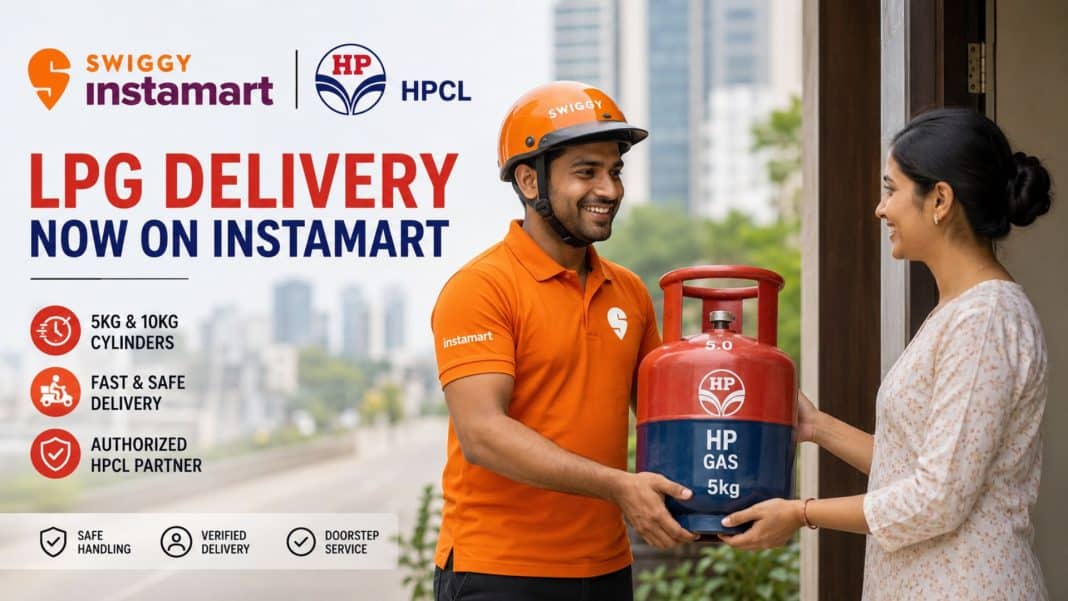
The recent partnership between Swiggy and Hindustan Petroleum Corporation Limited (HPCL) to deliver 5-kg and 10-kg LPG cylinders via Instamart is not just another product launch.
According to retail experts, it is a massive chess move in India’s brutal quick-commerce wars, and it completely changes the economics of how energy is distributed in urban cities.
Why Grocery Apps Suddenly Care About Cooking Gas
Swiggy HPCL LPG Delivery: To understand this move, we have to look behind the curtain of the quick-commerce business model. Platforms like Swiggy Instamart, Blinkit, and Zepto are facing a major challenge: how to increase the Average Order Value (AOV).
If a delivery partner travels 3 kilometers to deliver a ₹150 loaf of bread and eggs, the platform barely makes a profit after paying the rider.
But if that same rider delivers a high-value item like an LPG cylinder alongside those groceries, the order value shoots up dramatically.
By adding heavy-duty utilities to their catalog, Swiggy is turning its quick-delivery fleet into a highly profitable logistics machine.
Furthermore, this pilot project in Bengaluru targets a highly lucrative demographic:
The Migrant Workforce: Techies and young professionals who live in rented apartments and do not want the paperwork headache of a permanent 14.2-kg gas connection.
Nuclear Families & Students: People who don’t cook heavy meals daily and find a 5-kg or 10-kg cylinder much easier to manage and store.
The Logistics Challenge: Can a Delivery Bike Carry a Gas Cylinder Safely?
The biggest question raised by industry onlookers is safety. A gas cylinder is not a smartphone or a t-shirt; it is highly inflammable commercial fuel.
Media reports clarify that Swiggy is handled this smartly by completely altering the product design. Instead of the massive, back-breaking 14.2-kg iron cylinders we see in traditional households, this service relies heavily on:
5-kg Metal Cylinders: Compact, easy to mount on a two-wheeler, and perfect for quick swaps.
10-kg Composite Cylinders: Made of fiberglass rather than heavy steel, these modern cylinders are lightweight, rust-free, and translucent (meaning you can actually see how much gas is left inside).
The Regulatory Shield: According to sources close to the development, Swiggy isn’t letting just any random gig worker carry these cylinders. The delivery ecosystem is directly integrated with HPCL’s authorized local distributor network.
The people bringing the gas to your doorstep are trained personnel who understand handling protocols and regulatory compliance.
Breaking the Bureaucracy of Indian Utilities
Historically, getting a new gas connection in India felt like buying a piece of property. You needed local address proof, identity verifications, an in-person visit to a gas agency, and days of waiting time.
The Swiggy-HPCL alliance completely shatters this friction. While first-time buyers still have to undergo a mandatory identity check at the door (to comply with government safety norms), you do not need an existing HP Gas connection book.
The app acts as an instant onboarding platform. Once you buy the first cylinder, the next orders work on a simple “empty-for-full” exchange loop, seamlessly bringing a heavily regulated public-sector utility into the modern digital age.
What Lies Ahead: A Blueprint for the Future of Cities?
The Bengaluru pilot is essentially a stress test. If successful, it could pave the way for a nationwide rollout, threatening traditional gas distribution models that have remained unchanged for decades.
It also raises the stakes for competitors like Blinkit and Zepto, who will now have to look for their own public-sector or private energy tie-ups to keep up.
For the average consumer, it means one simple thing: the days of panic-calling the gas agency because the kitchen stove went cold mid-meal are officially drawing to a close.
Also Read: India Wholesale Inflation Rises to 9.87% in June 2026, Food Prices Push WPI Near Double Digits