


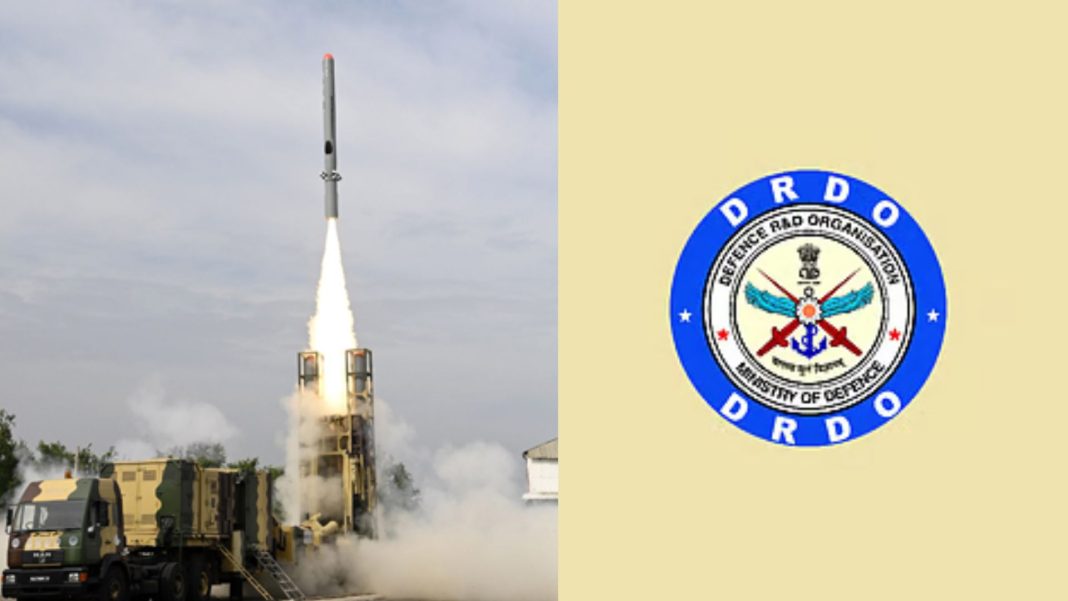

DRDO Ballistic Missile Test: In a major boost to national security, the Defence Research and Development Organisation (DRDO) successfully conducted three consecutive missile flight tests over a 24-hour span on June 10 and 11, 2026.
These back-to-back trials mark a historic milestone, showcasing India’s rapidly advancing multi-layered Ballistic Missile Defence (BMD) shield and its lethal maritime strike capabilities.
With these successful tests, India has firmly secured its position within an elite group of nations including the United States, Russia, China, and Israel that possess the high-tech architecture required to intercept and destroy advanced long-range threats, up to Intercontinental Ballistic Missiles (ICBMs).
Shielding the Skies: Advanced Interceptor Tests
DRDO Ballistic Missile Test: The core of this achievement lies in the successful testing of two advanced interceptor missiles from the Integrated Test Range (ITR) in Chandipur, Odisha.
While the government has kept the specific names of these interceptor systems classified, their performance metrics reveal a major leap in India’s defensive capabilities.
Target Class: The interceptors are designed to counter Intermediate-Range Ballistic Missiles (IRBMs) with ranges between 2,000 km and 5,000 km.
Dual-Layer Protection: The trials successfully validated both endo-atmospheric (within Earth’s atmosphere) and exo-atmospheric (in outer space) interception capabilities.
This multi-layered approach ensures that if an incoming enemy missile evades the initial outer-space interceptors, a secondary internal layer can still neutralise the threat before it impacts the ground.
Following the success of these development trials, government sources indicate that these interceptor systems will soon head for final user trials by the Indian Armed Forces.
Strengthening the Seas: Maiden Flight of NASM-MR
DRDO Ballistic Missile Test: Alongside the defensive shield trials, DRDO achieved a separate, highly anticipated offensive milestone: the maiden flight test of the Naval Anti-Ship Missile–Medium Range (NASM-MR).
Developed specifically for the Indian Navy to target small-to-medium warships like frigates and destroyers, the NASM-MR performed flawlessly during its debut launch from a naval platform.
The weapon demonstrated extreme precision navigation, locked onto its target with terminal accuracy, and utilized a low-altitude sea-skimming flight profile a technique where the missile flies just meters above the water’s surface to stay hidden from enemy ship radars.
Why India is Accelerating its Missile Defence Architecture
Strategic experts note that India’s intensified focus on a robust missile shield is a direct response to evolving geopolitical realities in South Asia.
The primary driver behind prioritizing the BMD program is the rapid modernization of regional arsenals.
Neighboring Pakistan has been actively developing and acquiring long-range ballistic systems, including the Fateh-I, Fateh-II, and the Chinese-origin P282 missile platforms, some of which feature multiple warhead capabilities designed to overwhelm conventional air defences.
By validating a system that can reliably intercept 5,000 km range class missiles, India reinforces its strategic deterrence.
This development fits into a broader chain of defensive upgrades, which includes the recent commissioning of INS Aridaman India’s third Arihant-class nuclear-powered ballistic missile submarine and ongoing research into reinforced underground “bunker-buster” missile modifications.
Leadership Commends the Milestone
The high-stakes exercises were closely monitored and verified by senior military leadership, including the Secretary of Department of Defence R&D and DRDO Chairman, Rajesh Kumar Singh.
He highly praised the seamless, synchronized efforts of DRDO scientists, domestic industry partners, and the armed forces in successfully executing multiple high-complexity missions within a tight 24-hour window.
Defence Minister Rajnath Singh formally congratulated the entire DRDO network, stating that this immense breakthrough drastically improves India’s overarching defensive posture and ensures the nation is fully prepared to counter complex, contemporary threats across both aerial and maritime domains.