


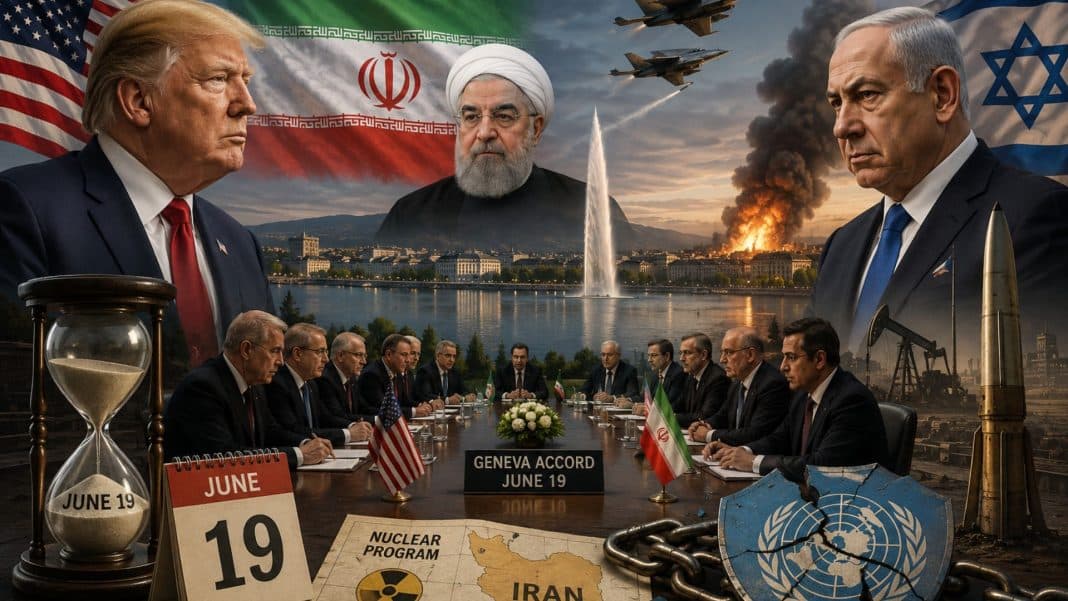

The Sunday U-Turn: A Fragile Peace Shakes the World
The Trump-Iran ‘Master Deal’ or Israel’s Rebellion: On Sunday, June 14, 2026, the global geopolitical landscape witnessed a historic rollercoaster. U.S. President Donald Trump celebrated his 80th birthday by announcing a monumental breakthrough: a complete framework peace agreement between the United States and Iran.
Backed by intense backchannel diplomacy from Pakistan and Qatar, the deal promised an “immediate and permanent” end to military operations across all fronts, the lifting of the U.S. naval blockade, and the reopening of the vital Strait of Hormuz.
“Ships of the world, start your engines. Let the oil flow!” Trump triumphantly posted on Truth Social.
Global markets rallied instantly, and crude oil prices tumbled by over 4%. However, the euphoria was short-lived. Within hours, Israel, Washington’s closest ally in the region, flatly rejected the deal, plunging the upcoming formal signing ceremony on Friday, June 19, 2026, in Geneva, Switzerland, into absolute uncertainty.
Inside the 14-Point Draft: Cash, Uranium, and a 60-Day Clock
The Trump-Iran ‘Master Deal’ or Israel’s Rebellion: The initial Memorandum of Understanding (MOU), slated to be signed in Geneva by U.S. Vice President JD Vance and Iranian officials, outlines a complex phased de-escalation plan.
According to leaked diplomatic drafts, the core mechanics of the deal revolve around financial relief and nuclear limitations:
The Financial Incentive: The U.S. has reportedly agreed to release up to $24 billion in frozen Iranian assets. Crucially, $12 billion is set to be unfrozen immediately before negotiations commence this week to ensure Tehran’s compliance.
The 60-Day Technical Window: The signing will trigger a strict 60-day period of intensive technical talks. The U.S. and European allies (U.K., France, Germany, and Italy) are demanding that Iran dilute its stockpiles of highly enriched uranium and allow rigorous IAEA monitoring.
The Ultimatum: Trump has made his position clear to the New York Times, warning that if Tehran fails to reach a final nuclear accord within these 60 days, military strikes will resume aggressively.
The Tel Aviv Defiance: Why Israel is Saying ‘No’
The Trump-Iran ‘Master Deal’ or Israel’s Rebellion: The primary catalyst threatening to derail the Geneva Accord is the furious resistance from Jerusalem. Sidelined from the secret bilateral negotiations, Israeli Prime Minister Benjamin Netanyahu’s right-wing coalition views the agreement not as a masterstroke of diplomacy, but as a catastrophic strategic failure.
Israeli Defense Minister Israel Katz issued a defiant directive stating that the Israeli Defense Forces (IDF) will maintain an “indefinite” presence in seized territories across Lebanon, Gaza, and Syria. Israel’s leadership argues that a permanent ceasefire gives Iran-backed proxies like Hezbollah a chance to regroup.
Furthermore, Finance Minister Bezalel Smotrich condemned the accord on social media, labeling it “bad for Israel and the entire free world,” asserting that Israel would creatively continue its campaign to independently topple the Iranian regime to prevent it from ever acquiring nuclear capabilities.
“I Make the Decisions!” , Trump and Netanyahu at War
This diplomatic friction has triggered a highly volatile, personal clash between Donald Trump and Benjamin Netanyahu. Tempers flared just before Sunday’s announcement when Israel launched a pre-emptive airstrike on Beirut’s southern suburbs, nearly collapsing the delicate negotiations.
Leaked reports via Axios reveal that an infuriated Trump confronted Netanyahu, explicitly stating that the Israeli Prime Minister lacked proper judgment. Defending his deal to international media as he prepared to head to the G7 Summit in the French Alps, Trump sent a blunt reminder of the geopolitical hierarchy to Jerusalem:
“I make the decisions. All of the decisions are made by me. Netanyahu doesn’t make the decisions.”
Trump further warned that without American intervention, Israel would not survive “two hours” if Iran achieved full nuclear capability.
The Tehran Narrative: Victory or Deception?
While Washington struggles to manage its allies, the domestic narrative inside Iran presents another challenge to the deal’s longevity. Iranian state television quickly broadcasted triumphalist rhetoric, with military generals claiming that their “divine and iron will” had forced the “humiliated American and Zionist enemies” into a state of surrender.
This posturing satisfies domestic hardliners in Tehran but adds immense political fuel to the fire in Washington, where hawkish Republicans, led by Senator Lindsey Graham, are already demanding that any final treaty be subjected to a rigorous congressional review and vote.
The Road to Geneva: Will the Accord Survive Until Friday?
The world now watches the high-stakes countdown to June 19. As G7 leaders gather in France to deliberate on global security, the fate of the U.S.-Iran deal hangs in a precarious balance.
Will Donald Trump successfully leverage America’s immense diplomatic and financial weight to force Israel into alignment? Or will a rogue military strike in the Levant shatter the framework before the ink even dries in Switzerland?
The next 96 hours will determine whether the region enters an era of calculated diplomacy or descends into an even more unmanageable phase of conflict.