


Vehicle Safety Tech License Scrapped: In a major bid to make Indian roads safer, the Central Government has officially scrapped licensing requirements for specific radio spectrum bands used in advanced automotive safety systems.
According to recent media reports and official gazette notifications, this regulatory breakthrough removes a long-standing commercial barrier for automakers.
The decision aims to rapidly accelerate the adoption of self-driving and collision-avoidance technologies across the country.
India currently holds one of the worst road safety records globally.
Local media reports and government data highlight that the country witnesses nearly half a million (5 lakh) road accidents every year, resulting in over 177,000 tragic fatalities in 2024 alone.
Experts believe this latest policy shift could be a massive game-changer in drastically reducing these numbers.
De-licensing the Frequency Bands: What Changed?
Vehicle Safety Tech License Scrapped: The government has freed up two major high-frequency bands that are critical for advanced automotive hardware, making it far easier for manufacturers to implement global safety standards without dealing with complex bureaucratic paperwork.
1.The 77-81 GHz Band (Radar Sensors)
This ultra-high frequency band has been de-licensed to smooth the way for radar-based sensors.
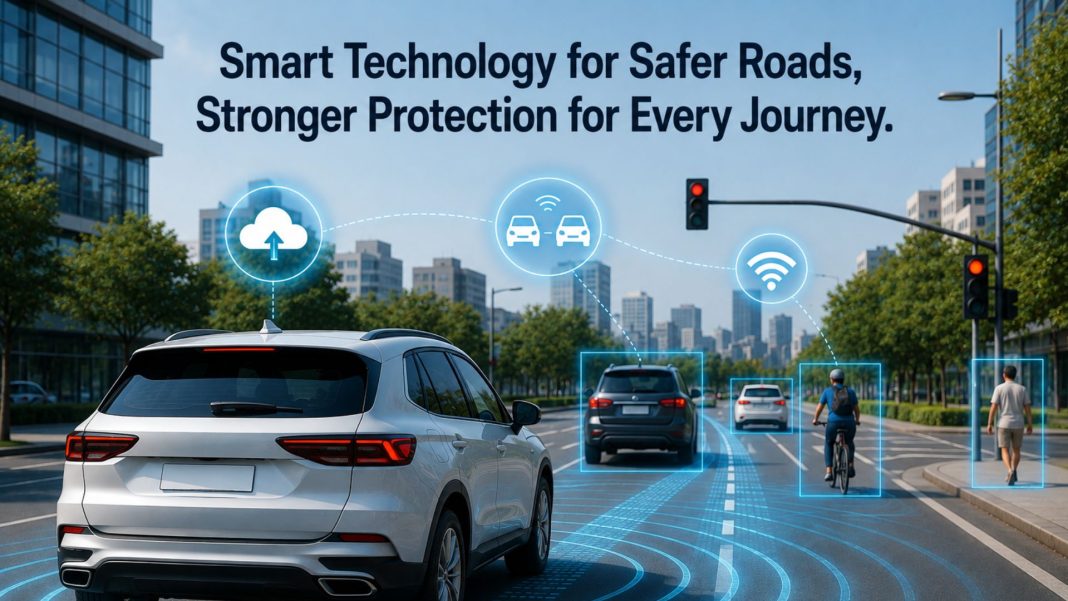
These sensors form the technical foundation for Advanced Driver Assistance Systems (ADAS). By removing the license barrier, cars sold in India can now seamlessly feature:
Collision Alerts & Emergency Braking: Sensors that calculate distance to objects ahead and automatically apply brakes if a crash is imminent.
Blind-Spot Monitoring: Warning drivers about vehicles or pedestrians hidden from their mirrors.
Adaptive Cruise Control & Automated Parking: Allowing vehicles to safely maintain distances and park autonomously.
2.The 5.875-5.905 GHz Band (V2X Communications)
A separate notification has cleared the licensing mandate for the 5.9 GHz band. This spectrum powers Vehicle-to-Everything (V2X) and Cellular-V2X (C-V2X) units.
This technology allows vehicles to securely share real-time data with other cars on the road, traffic lights, and nearby roadside infrastructure.
V2X is highly crucial for complex driving environments, as it warns drivers of hidden hazards beyond their line of sight such as an approaching ambulance or a vehicle abruptly braking around a blind, crowded curve.
Aligning with Global Standards and Boosting Exports
Vehicle Safety Tech License Scrapped: While this technology is relatively fresh for mass-market cars in India, international media reports highlight that global automotive hubs like the United States, Europe, China, and South Korea widely adopted these frequency regulations nearly six years ago.
By aligning India’s spectrum rules with these established EU and US frameworks, the government is enabling local and international carmakers to deploy standardized, off-the-shelf global hardware instead of forcing them to engineer expensive, localized variants.
According to industry experts:
Global Brands Benefit: Luxury carmakers like Mercedes-Benz and BMW can now smoothly bring their internationally proven, radar-heavy driving features directly to Indian buyers.
Mass Market Adoption: Domestic auto giants like Maruti Suzuki, Tata Motors, and Mahindra & Mahindra can source components at a lower cost, pushing high-end safety features into highly affordable, everyday hatchbacks and SUVs.
Export Potential: Industry analysts note that Indian automotive technology is already highly capable, matching the engineering standards of Europe and Japan. This regulatory alignment will make made-in-India cars globally compliant right out of the factory, providing a massive boost to vehicle exports.
Road Ahead for Indian Traffic Conditions
Implementing these systems on crowded Indian roads comes with a unique set of challenges, where drivers frequently encounter unstructured traffic, pedestrians, stray cattle, and a general lack of lane discipline.
A government panel previously noted that traditional camera and radar sensors can occasionally struggle in chaotic, blind scenarios which is exactly where V2X communication steps in to fill the visual gap.
The panel has also recommended integrating V2X evaluation metrics into the voluntary Bharat NCAP crash safety ratings, encouraging automakers to actively compete on electronic safety features rather than just structural crash-test performance.
Also Read: PM Modi France and Slovakia Visit: Inside the Mega Innovation & G7 Summit Agenda