


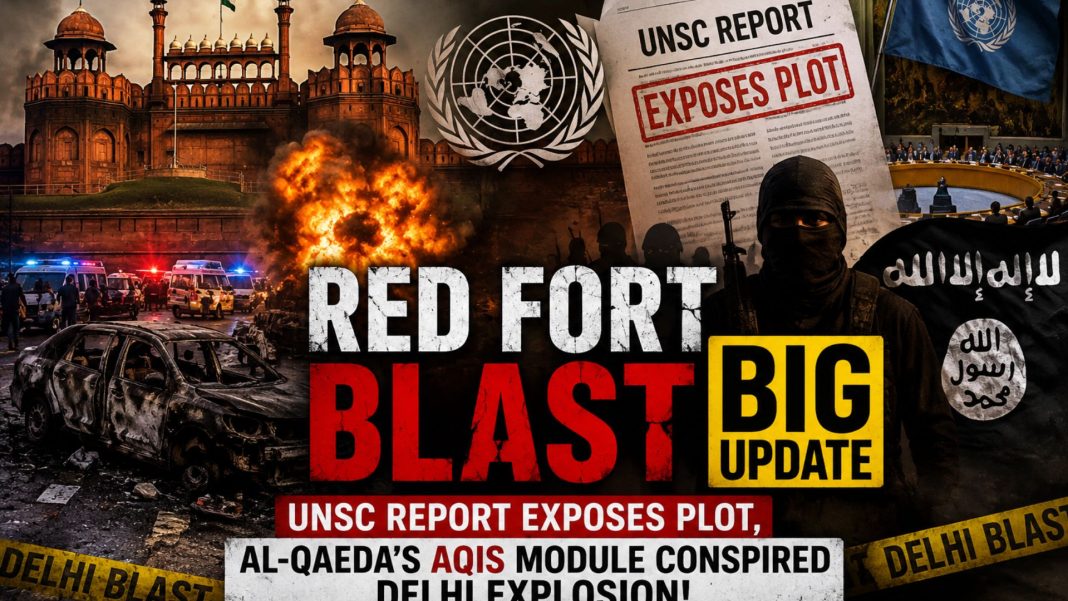

Red Fort Blast Big Update: A major international report has shed new light on the deadly explosion near Delhi’s historic Red Fort. According to the 38th report released by the United Nations Security Council (UNSC) Analytical Support and Sanctions Monitoring Team, the terrorist outfit Al-Qaeda in the Indian Subcontinent (AQIS) was behind the attack.
The tragedy, which occurred on the evening of November 10, 2025, claimed 11 lives and left several others severely injured. The latest UNSC findings align closely with the domestic probe conducted by India’s National Investigation Agency (NIA), which had previously charged individuals associated with AQIS networks.
Key Highlights of the Report
Red Fort Blast Big Update: Terrorist Footprint: UNSC’s 38th report attributes the November 10, 2025 Red Fort blast to AQIS.
Evolving Threat: AQIS has transitioned from a loose set of localized groups into a structured regional network operating via decentralized “small cells.”
Cross-Border Expansion: The terror outfit is actively trying to establish terror modules in Bangladesh, posing a fresh risk to South Asian security.
Chemical & Biological Risks: Global terror networks like Al-Qaeda and ISIL continue to publish online tutorials on producing lethal toxins such as Botulinum, Cyanide, and Ricin.
NIA Connection: India’s primary anti-terror agency, NIA, had already charged 11 individuals linked to AQIS and Ansar Ghazwat-ul-Hind (AGuH).
Contradictions in UNSC Findings: JeM vs. AQIS
Red Fort Blast Big Update: The latest UNSC monitoring report has brought a notable shift in international assessments regarding the attack:
| Report Version | Release Context | Terrorist Organization Named |
|---|
| 37th UNSC Report | Based on Member State inputs | Jaish-e-Mohammed (JeM) |
| 38th UNSC Report | Released on August 10 | Al-Qaeda in the Indian Subcontinent (AQIS) |
While the previous 37th report cited a member state pointing toward Jaish-e-Mohammed (JeM), the 38th report firmly points toward AQIS. This shift highlights how international intelligence agencies continuously update their evaluations as more forensic evidence emerges from local investigators.
How AQIS Shifted Strategy: The “Small Cell” Operational Model
The monitoring team highlighted a critical tactical evolution in how AQIS operates across South Asia:
Rather than orchestrating operations through large, easily identifiable training camps, AQIS now relies heavily on decentralized small cells. By setting up independent financial and logistical channels, these smaller units can carry out strikes while remaining under the radar of counter-terrorism agencies.
The UNSC report specifically flagged AQIS’s attempts to build terror modules in Bangladesh, warning that the group’s expansion poses a growing threat to regional stability across South Asia.
Alarm Over Chemical and Biological Warfare Attempts
Beyond regional terror networks, the 38th UNSC report issued a stern warning regarding the ongoing attempts by Al-Qaeda and ISIL (Daesh) to acquire chemical and biological weapons.
“Although producing weaponized biological or chemical agents remains technically complex, online networks linked to ISIL and Al-Qaeda actively disseminate instructions for crude poison production.”
— UNSC Analytical Support & Sanctions Monitoring Team
Ricin & Cyanide Manuals: In February, ISIL’s English magazine ‘Invade’ published instructional guides on synthesizing Botulinum toxin and Cyanide.
ISIL-K Activity: Over the past 12 months, ISIL-K networks shared detailed procedures on extracting and handling Ricin, one of the deadliest plant-derived poisons known.
What is AQIS? Background and Origins
Formation: Established in September 2014 by late Al-Qaeda leader Ayman al-Zawahiri.
Geographic Focus: Designed specifically to expand Al-Qaeda’s footprint across India, Pakistan, and Bangladesh.
Primary Operational Hub: Currently centered in Afghanistan, though operational cells exist across neighboring South Asian nations.
Global Designation: Declared a Foreign Terrorist Organization (FTO) by the United States in 2016.
Primary Tactics: Target killings, armed ambushes, hit-and-run tactics, and localized improvised explosive device (IED) blasts.
Domestic Probe: The NIA Chargesheet and Radicalized Professionals
India’s National Investigation Agency (NIA) has been investigating the Red Fort attack since November 2025, when initial site inspections confirmed a high-intensity Vehicle-Borne Improvised Explosive Device (VBIED) explosion.
Inside the 7,500-Page Chargesheet
In May, the NIA submitted a comprehensive 7,500-page chargesheet before the Rouse Avenue Court in New Delhi. Key facts from the investigation include:
11 Accused Named: The chargesheet names 11 individuals linked to Ansar Ghazwat-ul-Hind (AGuH) and AQIS.
580+ Witness Statements: Extensive testimony tracking the radicalization and logistical trail of the suspects.
Medical Backgrounds: Surprisingly, several accused were radicalized medical professionals who used their technical backgrounds to source hazardous chemicals both online and offline.
“Operation Heavenly Hind”: Investigating agencies revealed that during a secret meeting in Srinagar in 2022, the suspects revived the “AGuH Interim” module and launched a specialized campaign code-named Operation Heavenly Hind.
Self-Made TATP Explosives: The blast involved self-fabricated TATP (Triacetone Triperoxide) explosives, a highly volatile compound mixed using commercially acquired chemicals.
Advanced Weaponry Testing: Beyond IEDs, the cell was experimenting with crude rockets, drone-delivered explosives, and acquiring automatic rifles like AK-47s and Krinkovs.
Hearing on the NIA chargesheet is scheduled for August 27, while law enforcement agencies continue searching for remaining absconding suspects.
Why the UNSC Tracks the Red Fort Incident
The United Nations Security Council monitors global terrorist activities through dedicated mechanisms like the 1267 Sanctions Committee. This committee pools intelligence from UN member states to assess terror networks, block funding channels, and impose global travel bans or asset freezes on listed entities.
Because the Red Fort explosion involved networks linked to globally designated outfits like Al-Qaeda, the UNSC’s monitoring team integrated the incident into its global assessment to evaluate the changing security dynamics in South Asia.
Also Read : Karoline Leavitt Quits: Why Trump’s White House Press Secretary Is Stepping Down