


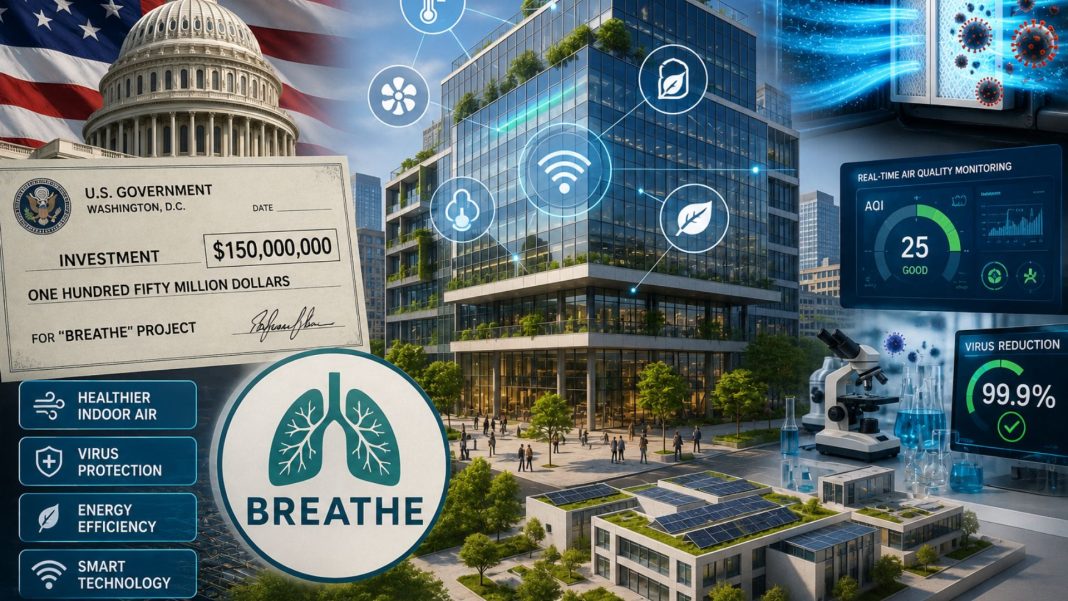

US BREATHE PROJECT: The COVID-19 pandemic permanently altered humanity’s relationship with enclosed spaces. It forced a critical realization: the air inside our homes, schools, and offices can be just as hazardous to health as any outdoor environmental pollutant.
For decades, architecture focused on structural integrity, energy efficiency, and aesthetic appeal. Now, a paradigm shift is underway.
Scientists are designing smart structures that mimic the human immune system. Backed by a massive ₹1,250 crore ($150 million) investment from ARPA-H (Advanced Research Projects Agency for Health), a high-tech health agency under the US government, a futuristic initiative named Project BREATHE (Building Resilient Environments for Air and Health) is set to redefine urban living.
The goal is to evolve buildings from passive concrete blocks into active, living shields that detect and kill airborne pathogens the moment they appear.
The Fire Alarm for Pathogens: Real-Time Biodefense
US BREATHE PROJECT: Under the current public health framework, identifying an indoor biological threat is incredibly slow. If a person carrying a highly contagious strain of influenza enters a crowded office, confirming the contamination requires taking physical air samples and sending them to a specialized laboratory.
This diagnostic bottleneck takes hours or even days. By the time the lab results come back, the virus has already replicated, spread through the ventilation system, and infected dozens of hosts.
Project BREATHE aims to eliminate this lag entirely. Dr. Jessica Green, the project’s program manager, explains that the system is engineered to function exactly like automated indoor fire safety infrastructure.
Immediate Environmental Detection: The moment a sick individual coughs, releases respiratory droplets, or sheds viruses, a network of ambient smart sensors sniffs out the pathogen in real-time.
Autonomous Building Reflexes: The building’s central automation engine processes the alert instantly. Instead of triggering a water sprinkler, it deploys a targeted, localized biological defense mechanism.
Customized Structural Adjustments: The architectural response adapts dynamically to the specific building type:
US BREATHE PROJECT: In High-Risk Environments (Hospitals & Schools): The system instantly activates deep-conduit Ultraviolet (UV-C) light arrays embedded inside the primary ventilation shafts. As contaminated air is pulled into the ducts, the UV-C light scrambles the genetic material of the virus, neutralising it instantly before it can cycle back into the rooms.
In Child-Centric Facilities (Day-Care Centers): Sophisticated AI-driven aerodynamic software maps out the exact trajectory of air moving from room to room. If a threat is localized in a specific nursery, the building seals off the airflow to adjacent zones and rapidly pumps massive volumes of fresh, filtered outdoor air into the impacted space to dilute the viral load to near-zero.
The ultimate target of this automation is remarkably ambitious: reducing the global burden of indoor respiratory illnesses by at least 25%.
The Quantum Leap in Biosensing: Tracking 100 Pathogens Concurrently
An autonomous biological shield is only as good as its eyes. The foundational core of Project BREATHE relies on a groundbreaking real-time sensor developed by Dr. Linsey Marr, a world-renowned environmental engineer.
Historically, electronic air monitoring was restricted to checking basic metrics like moisture, dust density, or general volatile organic compounds (VOCs). Dr. Marr’s new sensor uses molecular-level recognition to identify specific living organisms suspended in aerosol particles.
During a recent live demonstration, the technology proved its extreme sensitivity by instantly detecting the presence of dust mites, the microscopic, hard-to-track organisms living in household dust that serve as a primary trigger for severe, life-threatening asthma attacks.
The operational scaling roadmap for these sensors highlights an aggressive timeline:
Current Baseline Capability: The sensor can actively scan a single room and differentiate between 10 distinct, highly dangerous pathogens simultaneously in real-time. This includes tracking airborne particles of the Coronavirus family, standard seasonal Influenza, and weaponized or accidental bacterial contaminants like E. coli.
The Near-Term Scale Up: Research teams are optimizing the chip architectures to recognize a broader library of 25 distinct viral and bacterial strains, allowing them to flag everything from RSV (Respiratory Syncytial Virus) to common cold rhinoviruses.
The Ultimate Goal: The final production design aims to integrate a comprehensive diagnostic matrix capable of running automated, continuous checks for 100 different airborne threats without generating false positives.
The Great Scientific Schism: High-Tech Innovation vs. Practical Economics
Despite the revolutionary promises of Project BREATHE, the initiative has exposed a profound philosophical disagreement among global environmental engineers, architects, and public planners regarding practical implementation.
The Skeptics’ Case for Pragmatism: Critics argue that turning every school, apartment complex, and office building into an advanced bioweapon defense lab is financially unfeasible and overly complex. Giorgio Buonanno, a prominent Italian mechanical engineer, positions himself at the forefront of this criticism.
He argues that sophisticated biological sensors require continuous calibration, expensive replacement parts, and high power usage. According to Buonanno, a far more logical and immediate solution already exists: simply placing inexpensive Carbon Dioxide ($CO_2$) sensors in every room.
Since high $CO_2$ levels indicate stagnant, breathed-out air, buildings can simply use standard automated windows or basic mechanical fans to pull in outside air whenever $CO_2$ spikes. This achieves better air quality at a fraction of the cost.
The Visionaries’ Case for Total Evolution: Advocates for Project BREATHE dismiss basic $CO_2$ tracking as an outdated, defensive band-aid. Joshua Santarpia, a leading aerobiologist connected to the project, argues that historical progress requires radical, seemingly expensive leaps forward. To contextualize the $150 million investment, Santarpia offers a striking historical parallel:
“We didn’t get the internet just by figuring out how to send more paper mail; we had to invent something entirely new.” Proponents emphasize that a $CO_2$ sensor cannot tell the difference between a room filled with healthy people laughing and a room where a single individual is actively shedding a deadly, mutated pandemic virus. To stop a biological crisis before it shuts down cities, society requires specific, smart diagnostics, not just faster ventilation.
Socio-Economic Implications
Shifting Medicine from Reactive Treatment to Structural Prevention
For over a century, western medicine has approached airborne diseases reactively. A human host contracts a virus inside a poorly ventilated space, presents symptoms days later, visits a clinic, and receives therapeutic drugs or vaccines.
Project BREATHE fundamentally flips this healthcare model on its head. It shifts the primary line of biological defense away from the human immune system and places it directly into the physical infrastructure.
By utilizing architecture as a passive filter and an active pathogen-killer, society can disrupt the infection cycle at the absolute root. The building treats the air before the human lung ever has a chance to filter it.
This structural shield represents a crucial defensive layer for vulnerable populations, such as the elderly, newborn children, and immunocompromised individuals, who may not build strong immunity from traditional vaccines alone.
The Financial Paradox: High Initial CapEx vs. Long-Term Macroeconomic Gains
The primary argument against Project BREATHE is its massive upfront Capital Expenditure (CapEx). Retrofitting an existing 50-story corporate skyscraper with pathogen-hunting sensors, digital air-flow modeling software, and automated UV-C ventilation arrays will cost real estate developers millions of dollars per building. In the commercial real estate market, this cost is a tough pill to swallow.
However, a macroeconomic analysis reveals a completely different calculation. The global economy loses hundreds of billions of dollars every single year due to:
The Seasonal Flu: Millions of lost working hours, drops in corporate productivity, and overwhelmed hospital emergency rooms.
Sick Building Syndrome (SBS): Chronic, low-grade workplace absenteeism caused by poorly circulated indoor allergens and molds.
The Ultimate Risk: The trillions of dollars wiped clean from global GDP during major pandemic lockdowns.
When viewed through this lens, investing in immune buildings ceases to be an architectural luxury; it becomes a vital economic safeguard. A smart office building that completely prevents an outbreak from spreading among its workforce easily offsets its initial installation costs by protecting human capital and ensuring uninterrupted corporate operations.
The Geopolitical and Regulatory Horizon: The Blueprint of Post-2028 Cities
Project BREATHE is operating on a definitive, real-world timeline rather than existing as an open-ended lab experiment. The US government has designated 2028 as the hard deadline for the first true field deployment. The initial live test installations will be integrated into the Walter Reed National Military Medical Center and a network of public day-care centers across the United States.
These choices are highly strategic. Testing the system in a premier military medical facility provides a controlled, highly secure environment to judge sensor accuracy against real hospital pathogens. Concurrently, testing in day-care centers provides data on how the AI software handles highly dynamic, volatile air-flow environments filled with active, high-shedding children.
If the 2028 field trials demonstrate high accuracy and manageable operational costs, it will trigger an immediate rewriting of global building codes. Much like the mid-20th century saw the universal legal mandate of fire escapes, sprinkler systems, and structural earthquake proofing, the late 21st century will see legal requirements for biological air defense.
While the global community enjoys a temporary period of stability regarding major respiratory pandemics, the underlying structural vulnerability of our indoor spaces remains unchanged. Humans in industrialized nations spend roughly 90% of their lives inside enclosed, artificial environments that are accidentally optimized for pathogen transmission.
Project BREATHE represents the first coordinated, well-funded attempt to fix this architectural flaw. While the debate regarding cost and complexity is valid, the reality remains that relying on legacy ventilation models is an invitation for future public health crises. By turning our buildings into active participants in public health, we are not just upgrading real estate; we are building a more resilient civilization.
Also Read : Indian Citizens in Iran: Indian Embassy in Tehran Issues Critical Safety Advisory For Citizens in Iran