


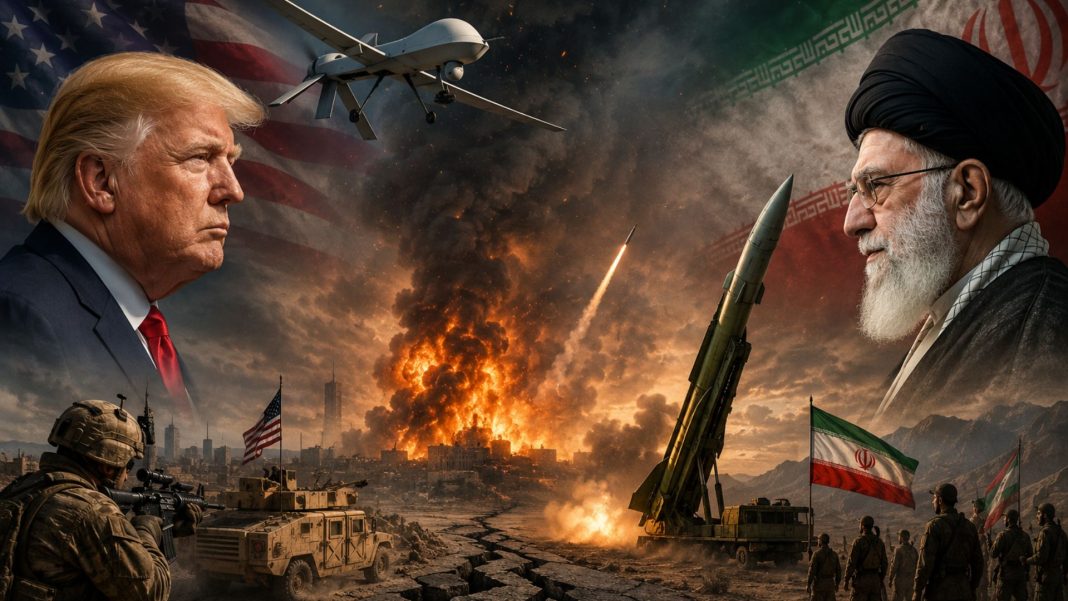

US-Iran Conflict 2026: The volatile Middle East has plunged into a dangerous new cycle of escalation. A rapid series of retaliatory military strikes between the United States and Iran has pushed a barely week-old ceasefire agreement to the verge of absolute collapse.
The crisis flared up dramatically following a drone strike on a commercial vessel in the Strait of Hormuz the world’s most critical maritime chokepoint, sparking immediate U.S. airstrikes on Iranian targets, followed by swift Iranian counter-strikes against American bases.
The Catalyst: Drone Strike on ‘M/V Ever Lovely’
US-Iran Conflict 2026: The latest round of hostilities ignited in the strategic waters of the Strait of Hormuz, a vital artery through which a major chunk of global energy supplies and commercial cargo passes daily.
The Incident: On June 25, the Singapore-flagged cargo ship M/V Ever Lovely was struck by a one-way attack drone as it was exiting the strait near the coast of Oman.
The Route Dispute: The attack took place amid severe friction over maritime paths. Shipping trackers revealed that despite stern warnings from Tehran that vessels must obtain explicit permission to transit, nearly half of the commercial traffic continued to use a southern lane along Oman’s coast, a route not approved by Iran.
The Toll: While the strike damaged the ship’s bridge, the vessel remained seaworthy, and all 21 crew members were reported safe. However, the political fallout was immediate and severe.
A “Foolish Violation”: Trump Orders Retaliatory Blasts
US-Iran Conflict 2026: Washington wasted no time in pointing the finger squarely at Tehran, treating the drone strike as a direct assault on the hard-fought diplomatic truce signed just days earlier on June 17.
The U.S. Retaliation: On Friday, the U.S. Central Command (CENTCOM) launched what it termed a “robust response.” American warplanes blasted Iranian military assets, hitting missile and drone storage facilities alongside coastal radar sites. A massive explosion was subsequently reported at the Taheruyeh pier in Iran’s southern port city of Sirik.
A Furious White House: Denouncing the drone strike, U.S. President Donald Trump took a hardline stance, declaring the action a “foolish violation of our ceasefire agreement.”
Vance Warns of Maximum Force: Reinforcing the administration’s position, Vice President JD Vance issued a blunt warning to Tehran on social media, writing:
“Iran signed a ceasefire agreement. We have honored it… violence will be met with violence.”
Iran signed a ceasefire agreement. We have honored it. If they have disagreements about how the MOU is being applied, they can pick up the phone.
— JD Vance (@JDVance) June 26, 2026
But violence will be met with violence. https://t.co/VWnBS1PWaV
Iran Fires Back: Revolutionary Guards Strike U.S. Bases
Rather than backing down under American fire, Tehran chose to escalate. On Saturday, Iran’s Islamic Revolutionary Guard Corps (IRGC) announced they had successfully targeted U.S. military installations across the Gulf region.
While the IRGC did not specify which American bases were hit, they issued a chilling warning that any further military moves by the U.S. would trigger an even more devastating response. State media quoted the Guards warning: “If aggression is repeated, our response will be far more expansive.”
The Parallel Diplomatic Tightrope
This explosive military showdown heavily overshadows intense, ongoing diplomatic efforts in Washington aimed at resolving the broader regional conflict that began back in late February.
- The Israel-Lebanon Peace Framework
In a separate but connected diplomatic development, Israel, Lebanon, and the U.S. signed a foundational peace framework in Washington.
Welcomed by Israeli Prime Minister Benjamin Netanyahu and Lebanese President Joseph Aoun, the deal aims to restore the Lebanese army to the south while maintaining an Israeli security zone until Hezbollah is fully disarmed.
However, the deal faces immediate internal friction, with Hezbollah lawmakers rejecting it on the grounds that it compromises broader regional negotiations.
- The Nuclear Watchdog’s Warning
Adding to the complexity, International Atomic Energy Agency (IAEA) chief Rafael Grossi warned that any permanent peace between Washington and Tehran is impossible without an ironclad verification system for Iran’s nuclear program. Grossi noted that while Iran claims it has no intention of developing nuclear weapons, “intentions are not enough,” warning that actual negotiations over an exhaustive inspection system have not even begun.
The Strategic Takeaway
The rapid escalation from a single drone strike to direct U.S.-Iran military exchanges proves just how paper-thin the current peace agreements are. With global trade routes hanging in the balance and both Washington and Tehran matching firepower with fiery rhetoric, the Middle East stands at a razor’s edge. The coming days will determine whether back-channel diplomacy can salvage the truce, or if the region will slide back into an all-out, multi-front war.
Also Read : PM Modi Seychelles Visit 2026: Why This 3-Day Historic Visit Matters for India’s Maritime Strategy