


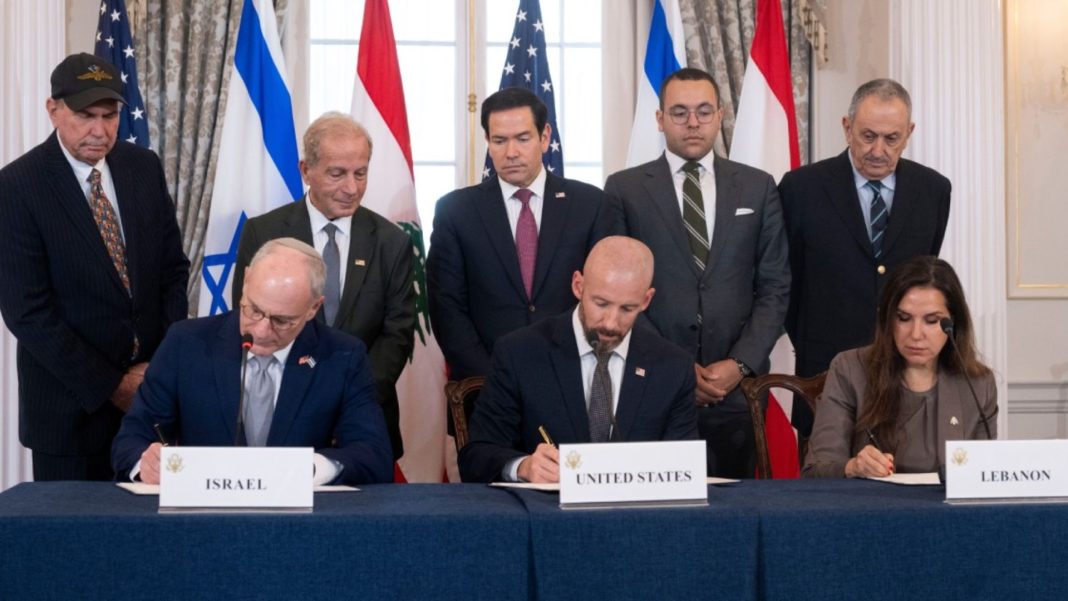

The Washington Breakthrough: In a historic diplomatic development, Israel and Lebanon have signed a landmark 14-point framework agreement mediated by the United States.
Signed on Friday in Washington D.C., the roadmap aims to end years of bitter hostility through a phased withdrawal of Israeli troops, the total disarmament of Hezbollah, and the restoration of strict Lebanese state control over its territory.
While celebrated as a monumental shift in Middle Eastern diplomacy, officials from all sides are maintaining a deeply cautious tone. Witnessed by US Secretary of State Marco Rubio, the agreement was formally signed by Israeli Ambassador Yechiel Leiter and Lebanese Ambassador Nada Hamadeh Mouawad. Rather than a final peace treaty, it is being described as the starting point of a long, treacherous diplomatic journey.
Inside the 14-Point Pact: A Phased Roadmap to Sovereignty
The Washington Breakthrough: The core philosophy of this framework is reciprocity. Instead of demanding immediate, sweeping changes, the agreement binds both nations to a step-by-step conditional process: as Lebanon hits verified security milestones, Israel will progressively withdraw its troops.
The “Pilot Zone” Strategy
To avoid sudden security vacuums, the implementation will begin in two mutually agreed-upon “pilot zones” in Southern Lebanon (including flashpoints like the town of Mansouri).
The Process: Non-state weapons will be cleared from these zones, allowing the Lebanese Armed Forces (LAF) to take exclusive security control.
The Result: Once the LAF establishes order, the Israel Defense Forces (IDF) will pull back, enabling displaced civilians to return and rebuild. If successful, this model will be expanded across the region.
State Monopoly on Force
The agreement explicitly states that only official Lebanese state institutions have the authority to determine national defense, war, and peace. It completely rejects the notion of any independent armed wing operating outside government control.
Key Takeaway: The framework notes that Israel has no territorial ambitions in Lebanon. Its military operations are categorized as strictly defensive responses to cross-border threats, which will cease once those threats are permanently neutralized.
The Ultimate Roadblock: Hezbollah’s Defiance
The Washington Breakthrough: Despite the optimism in Washington, the agreement faces an immediate, existential threat on the ground: Hezbollah has completely rejected it. The militant group was entirely excluded from the negotiations and refuses to accept the terms.
Following the ceremony, Hezbollah MP Hassan Fadlallah delivered a stark warning, stating that Lebanese authorities would not be able to enforce the pact “unless they plunge into a civil war with American backing.”
Hezbollah argues that under older UN resolutions, its disarmament is only required south of the Litani River, whereas this new framework demands a nationwide, verified dissolution of its military capabilities. Furthermore, Fadlallah dismissed the Washington agreement as a blatant attempt to derail the “Islamabad process”, the parallel, ongoing nuclear negotiations between the US and Iran.
Cash and Command: The US Enforcement Blueprint
Recognizing that the Lebanese Armed Forces currently lack the teeth to dismantle Hezbollah, the United States is stepping in with significant financial and logistical backing.
The Military Coordination Group: Washington will establish a tripartite oversight body to supervise the transition period and facilitate direct coordination between Israeli and Lebanese forces.
Immediate Financial Aid: The US will deploy $100 million in immediate humanitarian assistance through the United Nations for rebuilding infrastructure.
Boosting the Lebanese Military: Over $30 million has been pledged to upgrade the LAF’s capabilities.
However, US Secretary of State Marco Rubio made it clear that Washington’s wallet is not open unconditionally. Future military aid is strictly tied to measurable performance benchmarks proving that the LAF is actively asserting its monopoly on power and dismantling non-state militias. Strict financial safeguards will also be put in place to ensure reconstruction funds do not leak into the hands of terrorist organizations.
The Grim Reality: Why Both Sides Blinked Now
The driving force behind this sudden diplomatic breakthrough is the devastating human and military toll of the recent conflict. The latest escalations, which erupted in early March following joint US-Israeli military operations against Iran, have left both nations exhausted.
The toll has been severe on all fronts. Since March, Israeli military operations have resulted in over 4,000 lives lost in Lebanon and forced more than one million citizens to flee their homes.
On the other side, Israel has faced between 32 and 37 military casualties alongside civilian losses, while Reuters reports indicate that several thousand Hezbollah fighters have been killed.
While a fragile ceasefire was recently struck, the violence never truly stopped. Just hours before the signing, Israeli forces eliminated seven Hezbollah members near its self-declared “buffer zone” and dropped evacuation leaflets over the town of Mansouri. This ongoing instability made it clear to both Beirut and Tel Aviv that a military stalemate was unsustainable.
Two Distant Tracks: Separating Lebanon from Iran
A major geopolitical takeaway from this deal is Lebanon’s deliberate attempt to break free from Iranian oversight. Historically, Iran has used Hezbollah as a proxy to negotiate regional terms. However, as tensions spiked, Lebanese officials fiercely resisted letting Tehran dictate their future, choosing instead to pursue direct, US-mediated talks with Israel.
This makes the Israel-Lebanon framework fundamentally different from the parallel US-Iran interim agreement. While the US-Iran track focuses heavily on a 60-day window to untangle complex nuclear programs, the Washington framework is an immediate, localized attempt to re-establish sovereign borders and eliminate a state-within-a-state.
The Verdict: A Long Road to Tel Aviv-Beirut Drives
The long-term vision of the pact is surprisingly ambitious. Israeli Ambassador Yechiel Leiter expressed a desire for a future where Israelis could simply get into their cars in Tel Aviv and drive straight to Beirut for tourism.
Yet, the bridge to that future remains highly volatile. For Lebanon, this framework is a lifeline to reclaim its stolen sovereignty and rebuild its shattered economy. For Israel, it is a verified mechanism to secure its northern border. But as long as Hezbollah holds its ground and its weapons, this historic piece of paper faces a brutal, uphill battle on the streets of Lebanon.
Also Read : US-Iran Conflict 2026: How Did a Single Drone Strike Ignite a War? Can This Fragile Ceasefire Survive?