


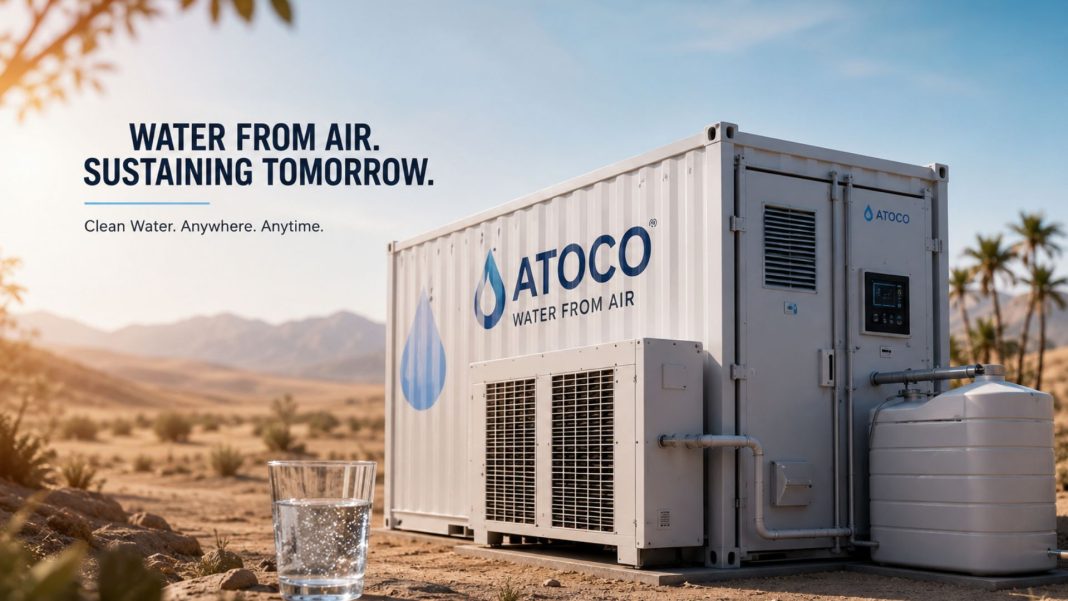

No Rivers Needed: As climate change and rapid environmental shifts accelerate global water insecurity, a revolutionary technology is promising to turn science fiction into a lifesaving reality.
Professor Omar M. Yaghi, a 2025 Nobel Prize-winning chemist, has spearheaded the development of an advanced atmospheric water generator capable of extracting up to 1,000 liters of pure drinking water every day directly from thin air.
According to media reports, the groundbreaking machine functions seamlessly even in hyper-arid environments with less than 20% humidity, offering a beacon of hope to billions of individuals living in water-stressed territories.
Commercialized through his technology company, Atoco, this innovative solution relies entirely on clean energy, marking a monumental shift in how humanity could soon access freshwater.
The Technology: How Do Metal-Organic Frameworks (MOFs) Work?
No Rivers Needed: The foundation of this air-to-water device is a specialized branch of science known as reticular chemistry, a field pioneered by Professor Yaghi at the University of California, Berkeley.
At the heart of the invention are Metal-Organic Frameworks (MOFs) highly porous, synthetic materials engineered at the molecular level.
To put their unique structural architecture into perspective, scientists state that just one gram of a MOF material possesses an internal surface area equivalent to an entire football field.
According to technical reports, these structures operate much like microscopic molecular sponges:
Moisture Capture: During the night or throughout the day, the ultra-porous MOFs trap ambient water vapor from the passing air within their crystalline pockets.
Solar Release: When heated by natural sunlight or ambient low-grade thermal energy, the material undergoes a temperature shift, releasing the trapped moisture as vapor.
Condensation: The released vapor is then funneled to hit cooler plates, where it rapidly condenses into clean, mineralized, and entirely safe drinking water.
Unlike traditional atmospheric water generators that rely on heavy, electricity-guzzling cooling compressors, Yaghi’s system operates completely off-grid.
According to company briefings, it requires zero external electrical power, relying instead on ambient solar heat to complete its cycle.
Addressing a Global Water Crisis with Decentralized Solutions
No Rivers Needed: This invention comes at a critical time when traditional freshwater reserves are under immense pressure. According to United Nations statistics, more than 2 billion people currently lack access to safely managed drinking water.
Conventional engineering alternatives like seawater desalination require massive industrial facilities, consume enormous amounts of grid electricity, and leave behind toxic brine waste that harms marine ecosystems.
In contrast, Atoco’s latest commercialized prototype is designed to be highly portable, packaged roughly inside a 20-foot standard shipping container. According to reports from the field, these self-sustaining water stations are ideal for deployment in:
Remote desert communities far away from any pipelines or rivers.
Disaster-hit zones where local water networks have been completely contaminated or destroyed.
Military outposts, research stations, and remote islands lacking freshwater infrastructure.
Recent media updates indicate that these containerized units are being actively explored for rapid disaster relief in small island nations like Grenada in the Caribbean, where extreme climate events like hurricanes have previously devastated centralized municipal water systems.
From a Refugee Community to the Nobel Prize: A Personal Mission
For Professor Omar Yaghi, who shared the 2025 Nobel Prize in Chemistry with Susumu Kitagawa and Richard Robson for their pioneering work on porous molecular architectures, the quest to harvest water from dry air is deeply personal.
According to biographical reports, Yaghi grew up in a crowded refugee community in Amman, Jordan, where clean water was a premium luxury.
He frequently recalls his childhood memories of waiting frantically for community water trucks to arrive just once a week, an experience that permanently shaped his scientific trajectory.
Through his corporate venture, Atoco, Yaghi envisions a future defined by “personalized water.”
Similar to how decentralized residential solar panels allow independent households to generate their own clean electricity, his long-term goal is to make miniature water-harvesting units available for individual homes, completely eliminating reliance on unstable, centralized public utilities.
Current Status, Scalability, and Future Outlook
As of mid-2026, the technology is rapidly moving from laboratory testing into real-world pilot programs.
According to reports from industrial observers, Atoco is currently conducting expansive field tests across severe environments, including the American Southwest and the Middle East, to evaluate how well the shipping-container-sized units endure dust storms and extended heat cycles.
Simultaneously, independent research teams, including engineers at MIT, are reportedly developing ultrasonic technologies to speed up the release cycle of the trapped water, which could potentially multiply the daily yield of MOF harvesters even further without increasing their physical size.
While a yield of 1,000 liters a day cannot single-handedly solve the shortages of a major metropolitan city, local administrative experts note that a single off-grid unit can easily sustain small villages, medical facilities, or schools indefinitely, permanently transforming local public health in the world’s most vulnerable drought corridors.
Legal Disclaimer: The details, technical specifications, and milestones outlined in this report are compiled from official company announcements by Atoco, academic publications, and preliminary media coverages of Professor Omar Yaghi’s ongoing research. Production capacities and field deployment timelines may vary depending on local environmental factors, climate variations, and continuing engineering modifications. The technology is presumed to be under continuous industrial optimization.
Also Read: Yamuna Water Project: Rajasthan, Haryana Sign Historic Agreement After 32 Years