


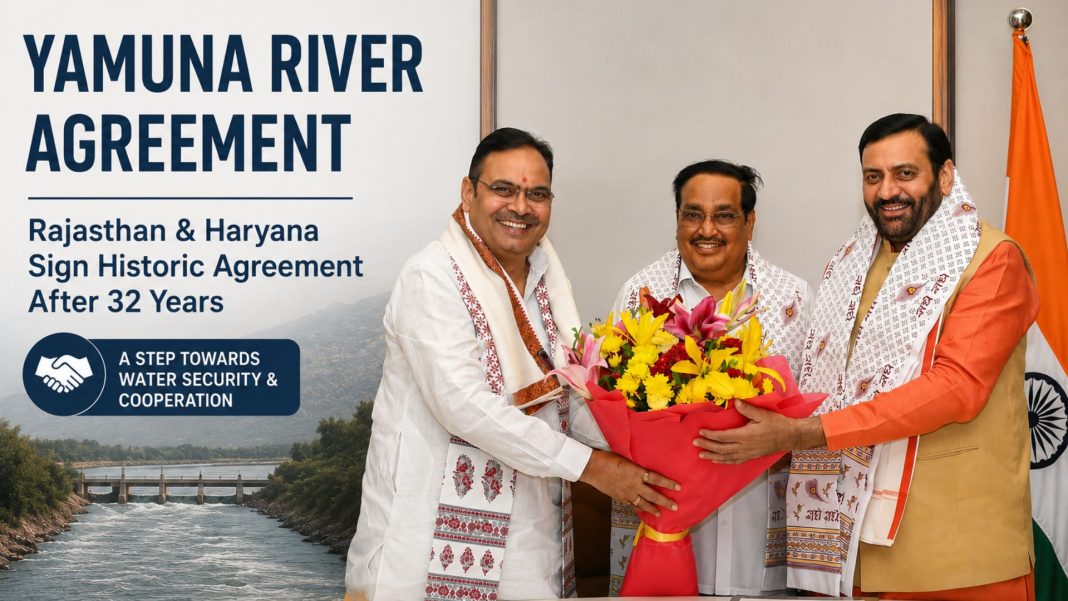

Yamuna Water Project: In a historic development aimed at boosting regional water security, the state governments of Rajasthan and Haryana signed a momentous Memorandum of Agreement (MoA) on Monday, June 29, 2026.
The landmark agreement marks the official green signal for the highly anticipated Rs 34,102-crore Yamuna Water Project, effectively bringing a successful resolution to a complex inter-state issue that had remained unresolved for nearly 32 years.
According to official reports, the high-profile signing ceremony took place in New Delhi in the presence of several top leaders.
Key dignitaries present at the event included Union Home and Cooperation Minister Amit Shah, Union Jal Shakti Minister C.R. Patil, Rajasthan Chief Minister Bhajanlal Sharma, and Haryana Chief Minister Nayab Singh Saini, along with senior bureaucrats representing both the Central and state governments.
What is the Rs 34,102 Crore Yamuna Water Project?
Yamuna Water Project: As per official documents shared with the media, the mega-infrastructure project is meticulously designed to implement the long-standing 1994 Upper Yamuna River Board (UYRB) agreement.
Under this newly signed MoA, Rajasthan will finally receive its allocated share of 577 million cubic metres (MCM) of Yamuna water.
According to the details released by authorities, the water will be drawn directly from the Hathnikund Barrage located in Haryana.
It will then be transported down to the Hansiyawas Reservoir situated in the Churu district of Rajasthan.
The transportation of this massive volume of water will be carried out through an expansive, modern underground pipeline network stretching approximately 295.5 kilometers.
This state-of-the-art layout has been chosen to minimize water loss due to evaporation and leakage, ensuring maximum efficiency.
Engineering Marvel: Key Technical Specifications of the Pipeline
Yamuna Water Project: Reports indicate that the project is not just a political success but also a massive civil engineering undertaking. The total estimated financial investment required for the completion of the project stands at a staggering Rs 34,102 crore.
According to official project summaries, the infrastructure layout includes:
The laying down of three massive underground pipelines, with each pipeline measuring an impressive 3.6 meters in diameter.
The construction of a dedicated inspection road running parallel to the pipeline path for regular maintenance.
The creation of specialized artificial reservoirs to manage the bulk flow of water.
The integration of a highly advanced, modern digital water management system to monitor flow rates and safety protocols in real time.
Interestingly, the project design has been created keeping the welfare of both states in mind.
Officials stated that the massive pipeline pipeline infrastructure has also been configured to supply crucial drinking water to ten specific locations within Haryana, turning the initiative into a mutually beneficial deal for both neighboring states.
Strategic Significance for Rajasthan’s Water-Scarce Regions
Speaking during the signing event in New Delhi, Rajasthan Chief Minister Bhajanlal Sharma heavily emphasized that ensuring reliable water security stands as a fundamental pillar of the central government’s broader development vision.
According to media reports, the Chief Minister warmly thanked Union Home Minister Amit Shah for his proactive intervention, sustained dialogue, and mediation, which ultimately helped both state administrations arrive at a harmonious consensus.
The execution of the Yamuna Water Project is expected to completely transform the socio-economic and industrial landscape of Rajasthan’s water-stressed zones.
According to regional reports, the water influx will primarily benefit the Shekhawati region and several adjoining water-scarce districts.
By channeling the surplus Yamuna river water during the crucial monsoon months, the project will guarantee long-term drinking water availability for future generations and provide the necessary liquid resources to stimulate regional industrial growth and agricultural stability.
Execution Framework: DPR and the Formation of a Dedicated SPV
According to administrative sources, the preliminary paperwork and technical assessments for the project are moving forward at a very rapid pace.
The state government of Rajasthan has already formulated the detailed project report (DPR) and uploaded the documentation to the Central Water Commission’s e-PAMS digital portal. Furthermore, the Haryana government has already granted its in-principle administrative approval for the proposed physical alignment of the 295.5-km pipeline route.
To ensure smooth coordination, rapid construction, and transparent operation, a dedicated entity will be formed to manage the project.
According to reports, a Special Purpose Vehicle (SPV) named the “Rajasthan-Haryana Yamuna Water Project SPV” (RHYW-SPV) will be established very soon.
This newly formed body will hold the absolute responsibility for the step-by-step implementation, structural construction, day-to-day operation, and long-term maintenance of the entire pipeline network.
A New Era of Cooperative Federalism
As per statements issued by the participating leaders, the breakthrough highlights a successful example of cooperative federalism and effective Centre-State coordination.
Chief Minister Sharma grouped this milestone with other high-priority national water initiatives, such as the Narmada Project, the ongoing Jal Jeevan Mission, the Ken-Betwa Link Project, and the recently highlighted Ram Jal Setu Link Project.
Local administrative experts indicate that with the formal signing completed, field surveys and preliminary structural deployment under the RHYW-SPV are expected to commence on the ground in a time-bound manner.
Legal Disclaimer: The details provided in this report are based on official press releases, government briefings, and preliminary media coverages following the inter-state meeting in New Delhi. The execution timelines and structural allocations are subject to ongoing administrative modifications, technical reviews, and regulatory approvals by the Central Water Commission and the respective state departments.
Also Read: Mumbai Muharram Procession Plot: Pune Man Arrested For Alleged Poisoning