
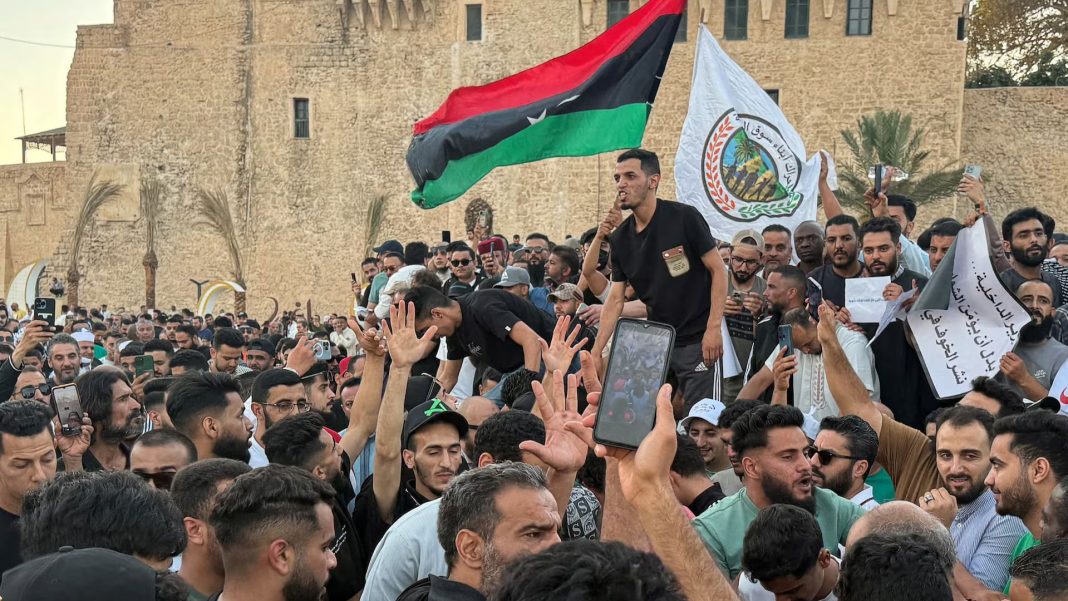

Beyond Middle East Pacts: In a major diplomatic development, Pakistan has quietly stepped onto the global stage as the central mediator in North Africa’s most stubborn conflict.
According to government sources, Islamabad has spent months running behind-the-scenes diplomatic channels to broker a comprehensive political settlement between Libya’s fiercely divided eastern and western power centers.
The initiative began late last year after both warring Libyan factions surprisingly approached Islamabad to request its assistance in facilitating peace talks.
Operating under the global radar, this mediation has moved parallel to broader international efforts. Crucially, the United States is not only “fully aware” of Pakistan’s backchannel role but is actively involved in backing the process.
The initiative is also strongly backed by key regional players, including Saudi Arabia, Qatar, and Turkey. This brings a highly polarized group of foreign patrons into rare diplomatic alignment to help pull the country in a unified direction.
THE BLUEPRINT: The 36-Month Power-Sharing Transition
Beyond Middle East Pacts: Negotiators from both sides of the fractured state are currently fine-tuning a structured, time-bound draft blueprint known as the “Libya Reunification Plan.” The framework establishes a 36-month (3-year) transitional period overseen by an umbrella Government of National Consensus.
Balancing the Scales: Split Control Over Seats and Sovereignty
To prevent a relapse into civil war, the transition divides supreme national authority down the middle:
The Prime Minister’s Seat: Abdulhamid Dbeibah, the current chief of the UN-recognized Government of National Unity (GNU) based in Tripoli (West), will continue to run the country’s civil cabinet during the 36 months.
The Presidential Council Presidency: Saddam Haftar, the influential Deputy Commander of the eastern-based Libyan National Army (LNA), is slated to chair the supreme Presidential Council.
The Cash and the Crude: Resolving the Economic War
Beyond Middle East Pacts: Historically, whoever controlled the capital controlled the central bank, while the eastern factions controlled the physical oil fields. To break this gridlock, the new draft framework grants the eastern administration, which physically controls the majority of Libya’s oil infrastructure, a massive, formalized role in overseeing the country’s national budget and oil revenues. ]
While sources caution that the plan is still undergoing rigorous debate and has not been officially signed, it offers a tangible compromise on the allocation of the state’s resource wealth.
THE STRATEGY: Why Factions Trust Islamabad’s Military Diplomacy
Pakistan’s sudden transition into a peace broker follows a series of calculated strategic moves in North Africa. Over the past year, Islamabad steadily expanded its engagement with the eastern-based LNA by exploring defense cooperation agreements. This tactical relationship opened communication lines that eventually transitioned into high-stakes political talks.
The Rawalpindi-Washington Pipeline
The diplomatic momentum reached a crescendo last month when Pakistan’s Chief of Army Staff, General Asim Munir, hosted Saddam Haftar for highly significant talks in Rawalpindi.
Immediately following his meetings in Pakistan, Haftar flew straight to Washington, D.C., for deep consultations with US Secretary of State Marco Rubio.
Following the huddle, the US State Department formally praised the effort, stating that Rubio welcomed the steps taken by Libyan leaders to overcome political divisions and reaffirmed Washington’s support for full unity.
Because Pakistan maintained critical defense ties with the East while holding open, direct administrative channels with the Western GNU in Tripoli, it emerged as a unique, non-threatening Islamic partner capable of bridging gaps that Western powers could not negotiate directly.
THE BACKGROUND: 15 Years of Anarchy Since the Fall of Gaddafi
To comprehend why this 36-month plan is a high-stakes gamble, one must trace Libya’s collapse back to the 2011 NATO-backed uprising. The revolution successfully overthrew and killed the long-ruling autocrat Muammar Gaddafi, but it left behind a catastrophic power vacuum.
Without a central authority, the nation split geographically into two parallel administrations, each operating its own parliament, central bank, military apparatus, and foreign alliances.
For a decade and a half, these factions turned Libya into a playground for foreign proxies, devastating the local population and destabilizing Mediterranean trade routes.
Solving the Historical Friction Points
Every previous peace accord eventually collapsed when local commanders refused to give up control of their regional turfs or resource networks. To solve this, the current framework addresses the three main obstacles that stalled past international efforts:
First, it solves the issue of absolute military control by splitting governing authority between a West-led Cabinet and an East-led Presidential Council. Second, instead of rushing to hold chaotic national elections immediately, it establishes a strict 36-month cooling period to allow both sides to systematically draft uniform governance and security rules.
Finally, it addresses the bitter feuds over oil wealth by giving the eastern administration direct, institutional oversight over budget allocations.
While officials confirm that Islamabad intends to play an active role in making sure this arrangement stays in play, whether this 36-month blueprint transforms into lasting stability depends entirely on whether the commanders in Tripoli and Benghazi finally value shared governance over absolute power.
Also Read : Damascus blast : Explosions Rock Damascus Near French President Emmanuel Macron’s Hotel