


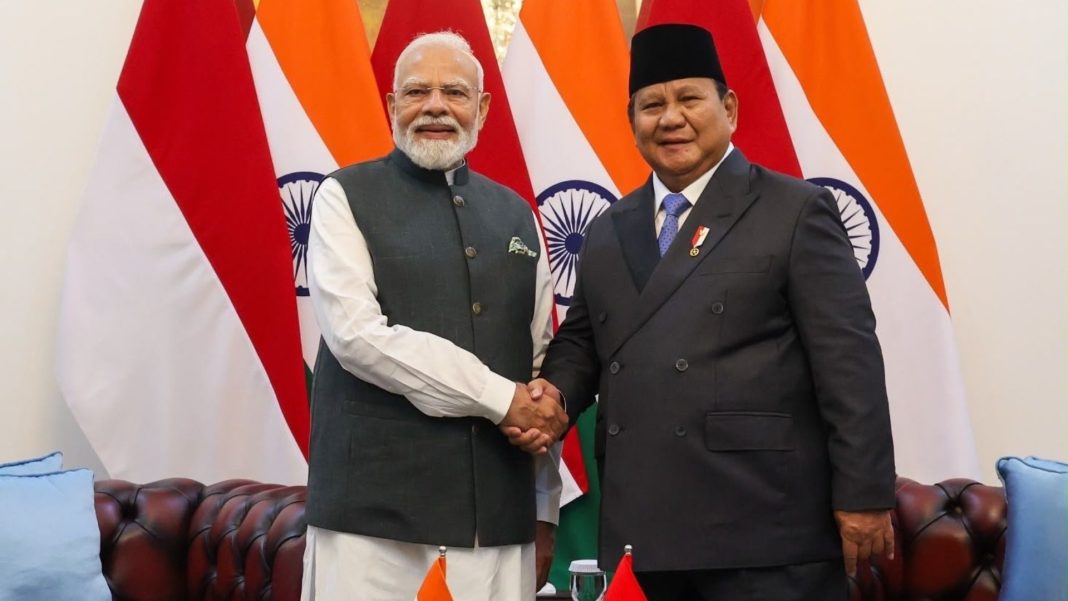

PM Modi Indonesia Visit: A stunning diplomatic image unfolded late Monday night at Jakarta’s international airport, immediately catching the attention of intelligence rooms from Washington to Beijing.
Breaking all standard state protocols, Indonesian President Prabowo Subianto personally arrived at the tarmac in the middle of the night to warmly embrace and welcome Indian Prime Minister Narendra Modi.
This unexpected midnight reception sets a highly charged tone for PM Modi’s critical three-nation tour covering Indonesia, Australia, and New Zealand.
While official statements focus on trade and regional stability, geopolitical insiders confirm the actual centerpiece of this high-stakes voyage is the operational deployment of India’s ambitious maritime strategy: ‘MAHASAGAR’ Diplomacy.
India’s Three-Nation Maritime Axis:
INDONESIA: Guarding the critical Malacca Strait.
AUSTRALIA: Controlling the Southern Ocean Domain.
NEW ZEALAND: Managing Pacific Edge Surveillance.
THE THREAT: Deconstructing China’s Deadly ‘String of Pearls’ Network
PM Modi Indonesia Visit: To understand why India has launched this massive oceanic counter-offensive, one must look at the immense security threat that has been brewing in the Indian Ocean Region (IOR) for over a decade.
Under its notorious ‘String of Pearls’ strategy, China has systematically targeted India’s immediate neighbors through predatory infrastructure loans, frequently termed “Debt-Trap Diplomacy.”
Beijing’s Strategic Encirclement Points:
Gwadar Port (Pakistan): Allowed heavy Chinese submarine access and naval presence close to India’s western coast.
Hambantota Port (Sri Lanka): Beijing secured a 99-year lease control here via massive unpayable debt.
Feydhoo Finolhu (Maldives): Used as a deep-water logistics hub to monitor global and Indian cargo lanes.
By weaponizing these infrastructure debts, Beijing successfully expanded its footprint right in India’s backyard. These locations function as active monitoring hubs and potential forward military bases designed to choke India’s naval movement and trap its trade routes.
THE ANTIDOTE: ‘MAHASAGAR’ Architecture Explained
PM Modi Indonesia Visit: The word Mahasagar translates to “vast ocean” in Hindi. However, in the corridors of India’s Ministry of External Affairs and Naval Headquarters, it stands for a precise institutional framework: Maritime Security and Economic Growth for All in the Region.
The Critical Pillars of MAHASAGAR:
Security: Joint anti-piracy patrols and real-time underwater threat monitoring.
Data Sharing: Interlinked regional radar networks across partner island nations.
Infrastructure: Upgrading deep-water berths, military runways, and naval refueling docks.
Instead of trying to match China’s trillion-dollar spending coin-for-coin, India’s counter-strategy focuses on building an interlocking grid of trusted democratic partnerships.
MAHASAGAR builds a security architecture where local sovereignty is respected, but military intelligence is shared instantly to neutralize any unauthorized hostile presence.
GROUND REALITY: India’s Major Military Bases on the Ocean Floor
Agalega Island (Mauritius): India’s Unsinkable Aircraft Carrier
India’s maritime policy has moved past simple joint statements; it is actively modifying the physical geography of the ocean. On the remote Mauritian territory of Agalega Island, India has built a massive, state-of-the-art military runway alongside deep-water heavy jetty facilities.
This multi-million dollar installation allows the Indian Navy to permanently station and operate its advanced Boeing P-8I Neptune maritime patrol aircraft. Equipped with cutting-edge radar and anti-submarine torpedoes, these aircraft can fly long-range missions from Agalega, effectively turning the southwestern sector of the Indian Ocean into a transparent zone where Chinese submarine movements are instantly flagged.
Assumption Island (Seychelles): Plugging the Western Flank
Further securing the western trade lanes, PM Modi’s personal diplomatic initiatives in the Seychelles successfully unlocked development rights on Assumption Island. By setting up forward listening posts and naval repair facilities here, India has constructed a defensive wall that screens the critical choke points of the Mozambique Channel, ensuring that no hostile actor can approach East Africa or the Arabian Sea unnoticed.
THE TECH GRID: The Invisible Radar Chain Catching Chinese Submarines
Connecting Colombo, Dhaka, and Naypyidaw to New Delhi
The most sophisticated element of India’s MAHASAGAR framework is completely invisible to the naked eye. India has funded, built, and integrated an extensive Coastal Surveillance Radar (CSR) System network across the shorelines of Sri Lanka, Bangladesh, and Myanmar.
Real-Time Tracking at the IFC-IOR
These high-frequency coastal radars feed live data streams directly into the Indian Navy’s Information Fusion Centre – Indian Ocean Region (IFC-IOR) located in Gurugram, India.
When a Chinese twin-shaft nuclear submarine or a satellite tracking ship crosses into these waters, its acoustic signature, speed, and trajectory are mapped in real-time. This digital shield deprives Beijing’s navy of its primary military advantage: tactical underwater stealth.
THE INDONESIAN MASTERSTROKE: Turning the Trap into a Chakraview
Closing the Malacca Strait Gateway
By bringing Indonesia deeply into the MAHASAGAR orbit during this current visit, PM Modi is executing what military experts call a geopolitical masterstroke. Indonesia sits on the edge of the Malacca Strait, the absolute bottleneck through which nearly 80 percent of China’s oil and energy imports must travel.
By pairing India’s upcoming Great Nicobar Trans-shipment Port with Indonesia’s deep-water Sabang Port (located just 160 kilometers apart), New Delhi and Jakarta are effectively setting up a joint security gate at the mouth of the strait.
Final Strategic Outlook
The predatory ‘String of Pearls’ that China carefully constructed to trap India has been compromised. By anchoring itself in Mauritius and Seychelles to the west, controlling the central radar networks in Sri Lanka and Bangladesh, and sealing the eastern Malacca gateway with Indonesia, India has successfully built an anti-access defensive perimeter.
This comprehensive network effectively transforms China’s intended maritime encirclement into an inescapable, multi-layered tactical cage, a modern geopolitical Chakraview right in the middle of the high seas.
Also Read : Damascus blast : Explosions Rock Damascus Near French President Emmanuel Macron’s Hotel