


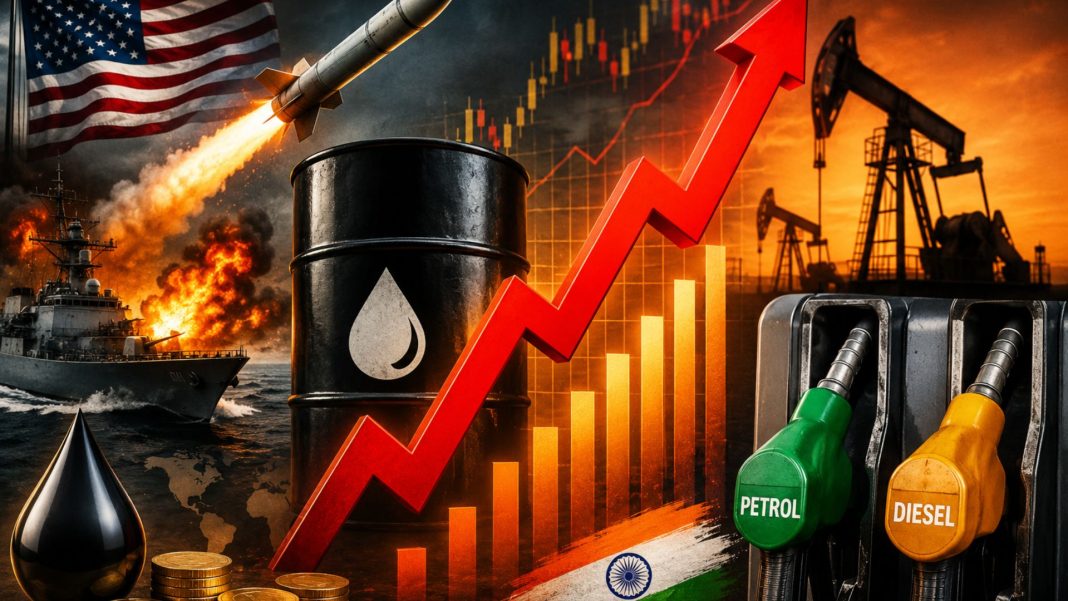

Oil Prices Surge: The recent downward trend in global energy markets has come to a grinding halt. On July 8, 2026, crude oil prices experienced a massive 6% surge within hours of trading.
The sharp reversal comes immediately after a major U.S. military offensive in the Middle East and the sudden revocation of an active Iranian oil sanctions waiver, heightening fears of prolonged supply disruptions through critical global choke points.
Market Breakdown: The Energy Surge in Numbers
Oil Prices Surge: After enjoying a brief period of declining prices that offered relief to major importing nations, energy benchmarks reacted aggressively to geopolitical developments:
Brent Crude: Settled 5.6% higher, rising to $78 per barrel.
West Texas Intermediate (WTI): Jumped roughly 5.8% to hit $74.55 per barrel.
Energy analysts warn that if diplomatic channels remain closed and regional cross-border exchanges continue over the next 48 hours, both benchmarks could comfortably cross the $80 to $85 per barrel threshold by the weekend.
Retaliation in the Gulf: U.S. Strikes Destroy 80+ Iranian Targets
Oil Prices Surge: The primary catalyst for the market panic was a sweeping nighttime military offensive launched by the United States against Islamic Revolutionary Guard Corps (IRGC) assets inside Iran.
Commercial Tanker Attacks: Three commercial tankers, including the Qatari-flagged ‘Al-Raqqiyat’, were struck by explosive drones and anti-ship projectiles while transiting the Strait of Hormuz.
U.S. Retaliatory Strikes: The Pentagon launched a massive response targeting and neutralizing critical coastal infrastructure.
Sanctions Re-Imposed: Washington immediately cut off diplomatic channels and economic waivers following the military flare-up.
While Tehran officially denied directing the maritime operations, Western intelligence agencies firmly attributed the maneuvers to regional proxies acting under Iranian command.
The Damage Assessment
U.S. Central Command confirmed that the retaliatory strikes successfully degraded significant Iranian coastal capabilities:
80+ Tactical Sites Hit: Air defense batteries, coastal tracking radar arrays, and anti-ship cruise missile launch pads were systematically destroyed.
60+ Fast-Attack Crafts Obliterated: Over sixty IRGC patrol boats used for maritime interdictions were taken out in their respective ports.
In response, Tehran issued a direct warning threatening symmetrical counteractions, pushing neighboring states like Kuwait and Bahrain to place their air defense systems on high operational alert.
The Policy Blow: Washington Kills June Sanctions Waiver
Compounding the military kinetic actions, the U.S. Department of the Treasury struck an immediate economic blow. Washington officially revoked the special general license that had been granted to Iran as part of an interim diplomatic framework reached in June.
The Ruptured Deal: Under the previous 60-day humanitarian truce, Iran was legally permitted to market and sell its crude oil volumes globally until August 21, 2026.
By pulling back the waiver effective immediately, the U.S. has effectively shut off Iran’s newly opened legitimate export pipelines. The sudden subtraction of these projected barrels from the global supply pool directly contributed to the market’s aggressive upward pricing loop.
Domestic Fallouts: Why India is Watching Closely
The sudden volatility in the Persian Gulf has sparked deep domestic concerns for India, the world’s third-largest energy consumer. New Delhi had previously calculated that the entry of legal Iranian barrels into the global supply stream would keep international oil prices subdued, paving the way for domestic state-run oil companies to slash retail petrol and diesel rates.
With those expectations shattered, India faces immediate macroeconomic vulnerabilities. Because the nation relies on foreign imports to meet 85% of its total domestic crude requirements, an extended pricing rally will inflate the country’s import bill, strain its foreign exchange reserves, and likely trigger a domestic inflationary cycle via upward adjustments at retail fuel pumps.
Also Read : PM Modi Indonesia Visit: How MAHASAGAR Diplomacy Countering China’s String of Pearls