


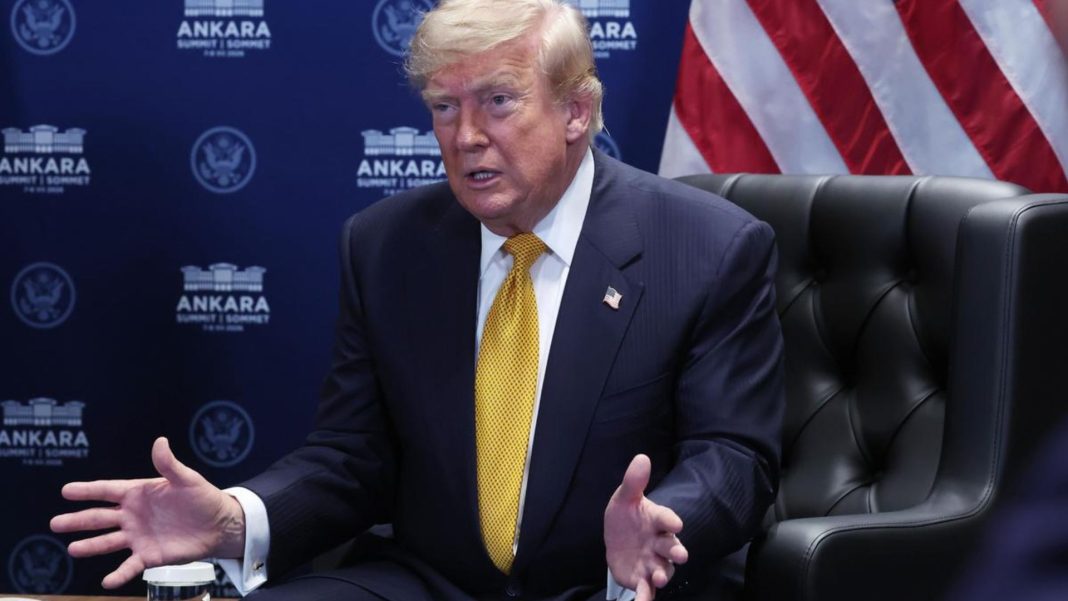

Trump Declares Iran Ceasefire Over: The fragile peace in the Middle East has collapsed. Speaking from the sidelines of the annual NATO Summit in Ankara on Wednesday, U.S. President Donald Trump announced that the month-old Memorandum of Understanding (MoU) with Iran is officially “finished.”
The declaration follows a severe, rapid escalation of military hostilities in the Persian Gulf, effectively ending a Pakistan-mediated 60-day truce that was meant to open windows for permanent peace talks.
Escalation in the Strait of Hormuz: How the Ceasefire Broke Down
Trump Declares Iran Ceasefire Over: The breakdown of the peace agreement did not happen in a vacuum. Tension had been building rapidly over the last 48 hours due to a sequence of intense military exchanges:
Commercial Tankers Targeted: The British maritime security agency (UKMTO) reported that an “unknown projectile” struck a commercial tanker passing through the vital Strait of Hormuz, sparking a fire. Two more vessels were subsequently hit, at least one via an explosive drone. Washington blamed Tehran for the attacks, citing civilian crews were put at risk.
Massive U.S. Retaliatory Strikes: In response, U.S. Central Command (CENTCOM) launched a massive wave of precision airstrikes against more than 80 locations inside Iran. The targets included air defense systems, coastal radar sites, command centers, and over 60 Islamic Revolutionary Guard Corps (IRGC) fast-attack boats.
Iran Strikes Back at U.S. Bases: Within hours of the American strikes, the IRGC Navy and Aerospace forces fired a barrage of missiles and drones, declaring they targeted U.S. military installations across the Gulf. Air defense alarms were triggered in Bahrain and Kuwait as hostile incoming targets were intercepted.
“They Are Liars and Scum” , Trump’s Blunt Assessment
Trump Declares Iran Ceasefire Over: During a joint press conference with NATO Secretary General Mark Rutte, President Trump did not mince his words regarding the Iranian leadership. When asked directly by journalists if the 14-point MoU was dead, Trump made his position clear.
“From my standpoint, I think it’s finished,” Trump stated. “I don’t want to deal with them anymore. They are scum, they are sick people led by sick people, and they are vicious, violent people. If they had a nuclear weapon, they’d use it.”
Trump accused the Iranian government of repeatedly distorting what was originally agreed upon when the ceasefire was signed on June 17.
“Everyone agreed, no nuclear weapons. We made a deal. Then they go outside, joke to the press, and say we never even talked about it,” Trump complained, adding that continuing diplomatic engagement with Tehran would be a “waste of time.”
The President also repeated severe allegations against the regime’s domestic actions, claiming they had violently suppressed internal dissent, stating they “killed 54,000 people” protesting within Iran. In a sharp medical metaphor, Trump compared the regime to a disease:
“We have to treat their cancer. You have to root out cancer at an early stage. That’s what I believe.”
Economic Warfare: The Oil Weapon Re-Engaged
The collapse of the diplomatic track has immediately spilled over into the global economy. Alongside the military strikes, the U.S. Treasury Department aggressively revoked a general license that had been issued in June.
By revoking the oil sanctions waiver, the U.S. has canceled Iran’s permission to sell crude oil internationally through August 21. Following this announcement, global oil prices surged by over 5% almost instantly. At the same time, CENTCOM’s offensive strikes have heavily degraded IRGC naval assets and coastal monitoring systems, leading shipping companies to completely avoid the Strait of Hormuz as maritime insurance costs skyrocket.
A senior U.S. official defended the sudden re-imposition of sanctions, stressing that the MoU was entirely performance-based. The official warned that Tehran would only see economic benefits if it demonstrated good behavior and ceased threatening international commerce.
International Reaction: NATO Backs the United States
Despite the sudden change in U.S. strategy, European allies have indicated solidarity with Washington regarding the latest flare-up. NATO Secretary General Mark Rutte publicly backed the American military action during the Ankara summit.
“I think what you did last night was absolutely necessary,” Rutte told Trump in front of reporters. “It was a very strong response, and I’m with you on this.”
However, Iranian negotiators have blamed the United States for acting in bad faith. Iran’s chief negotiator, Mohammad Bagher Ghalibaf, fired back, accusing Washington of committing major breaches of the MoU by abruptly pulling back oil waivers and attempting to enforce alternative maritime controls over the Strait of Hormuz.
Security experts note that Iran is highly sensitive to any western changes to shipping rules in the waterway. With both sides dug into their positions and active combat returning to the Persian Gulf, the brief hope for a lasting Middle East peace deal has effectively evaporated.
Also Read : PM Modi Indonesian Parliament Address: Historic Roadmap for Indo-Pacific Maritime Partnership