


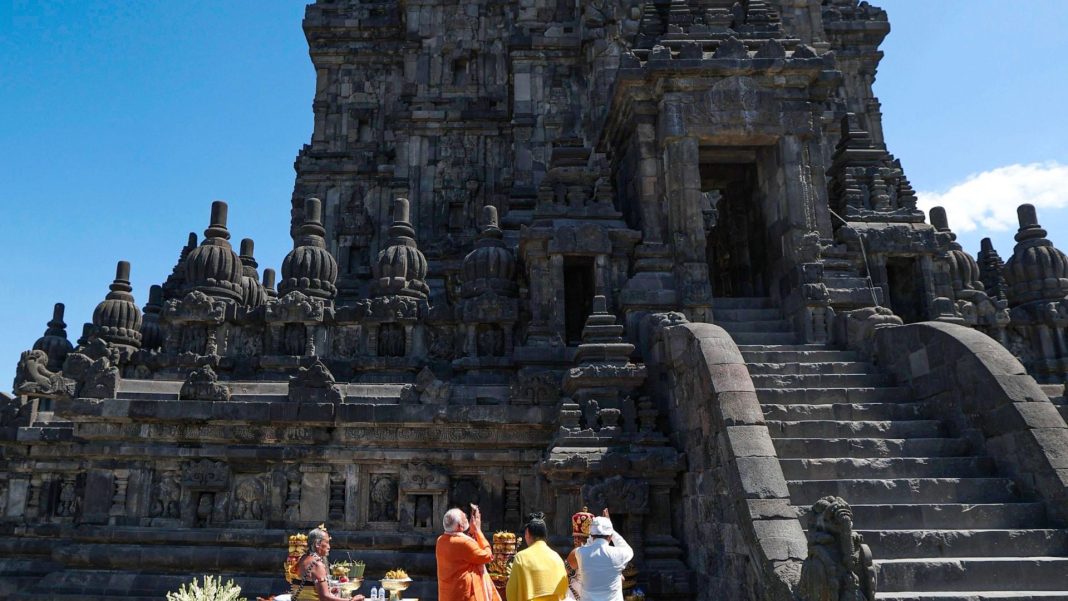

India-Indonesia Historic Deal: Marking a major milestone in Southeast Asian diplomacy, Indian Prime Minister Narendra Modi concluded a highly successful three-day bilateral visit to Indonesia today by launching a massive heritage preservation project.
The Archaeological Survey of India (ASI) will officially lead the restoration of the iconic 9th-century Prambanan Temple Compounds in Yogyakarta.
The grand preservation initiative was jointly inaugurated on Wednesday by PM Modi and Indonesian President Prabowo Subianto.
The event highlights a broad array of over 20 bilateral agreements encompassing defense hardware, maritime security channels, critical mineral supply chains, and cross-border digital payment systems.
Architectural Masterpiece: The Heritage of Prambanan
India-Indonesia Historic Deal: Built during the golden age of the Sanjaya Dynasty under kings Rakai Pikatan and Rakai Balitung, Prambanan stands as Indonesia’s largest Hindu temple complex.
Situated just a short distance from the famous Buddhist sanctuary of Borobudur, the two massive complexes coexist as historical proof that Hinduism and Buddhism thrived peacefully alongside each other in ancient Central Java.
The Layout of the Sacred Compound
The layout of the architectural compound is engineered across three concentric geometric squares:
The Outer Zones: Originally housed up to 240 individual structural temples, many of which were reduced to stone fields over centuries due to intense volcanic and seismic activity.
The Inner Sanctuary: Features 16 towering main temples. The undisputed centerpiece is the 47-meter-high central Shiva temple, flanked to the north by the Brahma temple and to the south by the Vishnu temple.
Inside the Shiva Temple: The inner sanctum is divided into four distinct chambers containing stone statues of Shiva, his wife Durga Mahishasuramardini, the Vedic sage Agastya, and the elephant-headed deity Ganesha. The external gallery walls feature detailed narrative bas-reliefs depicting the entire epic of the Ramayana.
The Thousandth Statue: The Myth of Roro Jonggrang
India-Indonesia Historic Deal: Local Javanese folklore brings a legendary story to the historic temple site. According to local myth, a powerful warrior named Bandung Bondowoso sought the hand of the beautiful princess Roro Jonggrang.
To reject his advances without causing a war, the princess challenged him to construct 1,000 stone statues in a single night.
Bondowoso Summons Genies ➔ 999 Statues Built ➔ Princess Fakes Daybreak ➔ Furious Warrior Curses Princess
Bondowoso summoned supernatural genies and nearly completed the task. To stop him, the princess ordered local villagers to burn fields and pound rice mortars, successfully tricking the roosters into crowing early.
Discovering the deception at 999 statues, a furious Bondowoso cursed Roro Jonggrang, turning her into stone to serve as the final, thousandth sculpture, locally identified by villagers as the beautiful statue of Durga inside the main tower.
Technical Challenge: ASI to Use ‘Anastylosis’ Reassembly
Though abandoned in the 10th century when the Javanese court shifted eastward, the site was recognized as a UNESCO World Heritage Site in 1991. Today, it serves both as a global tourist destination and a sacred site of active worship for Indonesia’s Hindu community.
Restoring the damaged site presents unique logistical difficulties. Following a field inspection by Indian engineers, the Archaeological Survey of India confirmed that the restoration will utilize the specialized technique of anastylosis.
What is Anastylosis? An architectural restoration method where a ruined building is meticulously reassembled using its original discovered stone fragments. New structural materials are introduced only when absolutely necessary for structural stability.
The project requires highly detailed cataloging. Centuries of earthquakes have left thousands of historic stone blocks scattered across the temple grounds, meaning Indian experts must precisely match each loose block back to its original structural position.
Act East: India’s Expanding Footprint of Heritage Diplomacy
This collaboration in Indonesia reflects New Delhi’s growing strategic focus on cultural diplomacy across Southeast Asia. By funding the restoration of shared historical landmarks, India continues to strengthen its geopolitical and economic partnerships throughout the region.
The Prambanan initiative follows a successful blueprint of similar international heritage restorations led by India:
Laos (2024): The successful structural restoration of the 1,000-year-old Vat Phou Shaivite mountain temple.
Myanmar (2017): Major post-earthquake architectural stabilization across the historic Bagan Archaeological Zone.
Vietnam (2014): Comprehensive preservation works targeting the ancient Cham ruins at the Mỹ Sơn Sanctuary.
Cambodia: Decades of specialized engineering and restoration support at the iconic Angkor Wat complex.
By taking an active role in preserving Southeast Asia’s historical monuments, India successfully transforms ancient cultural links into modern diplomatic assets.
Also Read : Damascus blast : Explosions Rock Damascus Near French President Emmanuel Macron’s Hotel