


UP Kanya Sumangala Yojana 2026: The empowerment of the girl child is foundational to the socio-economic development of any nation. In India, where regional and gender disparities have historically impacted the health, education, and survival rates of girls, state-led welfare initiatives play a transformative role.
Among the most successful initiatives is the Uttar Pradesh Mukhyamantri Kanya Sumangala Yojana (UPMKSY) 2026.
Launched originally in 2019 by the Government of Uttar Pradesh under the leadership of Chief Minister Yogi Adityanath, this flagship conditional cash transfer scheme has been updated to provide even stronger financial backing.
Designed to support a girl child from the moment of her birth through her higher education, the scheme serves as a powerful instrument for eliminating gender discrimination, stopping child marriage, and ensuring financial independence for young women.
Core Objectives of the Scheme
UP Kanya Sumangala Yojana 2026: The Kanya Sumangala Yojana is not merely a financial aid program; it is a highly structured social reform initiative. The primary vision of the Uttar Pradesh government through this scheme includes:
Eradicating Female Foeticide: By providing an immediate cash incentive upon the birth of a girl, the scheme actively counters deep-rooted societal preferences for male children.
Preventing Child Marriage: The financial milestones are strategically tied to school enrollment and completion, disincentivizing early marriages and keeping girls in the academic ecosystem.
Improving Health and Nutrition: The initial stages of the scheme mandate complete immunization, ensuring that infants receive vital healthcare during their most vulnerable years.
Reducing School Dropout Rates: Financial aid provided during transitions to middle school, high school, and higher education ensures that economic hardships do not force girls out of school.
Fostering Self-Reliance: By funding graduation and diploma courses, the scheme prepares young women to enter the modern workforce confidently.
Detailed Breakdown of the 6 Financial Milestones
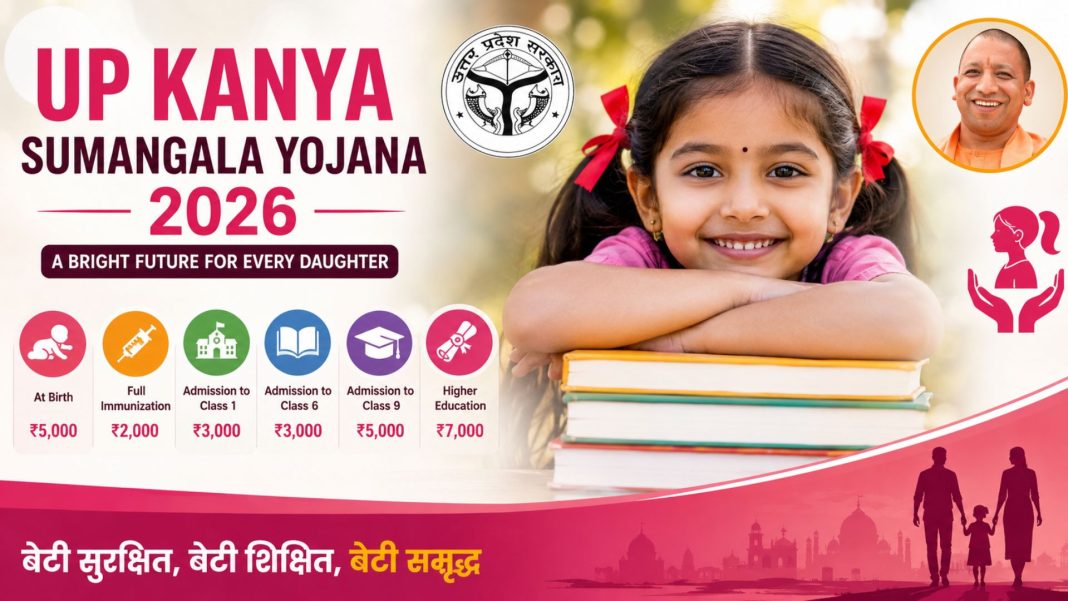
The hallmark of the UP Kanya Sumangala Yojana is its phased payout structure. Under the updated guidelines for 2026, the total financial assistance amounts to ₹25,000.
This sum is disbursed through the Direct Benefit Transfer (DBT) mechanism directly into the bank account of the beneficiary’s parent or legal guardian across six critical life stages:
| Installment Stage | Academic / Life Milestone | Condition for Disbursal | Financial Assistance Amount |
|---|---|---|---|
| First | At Birth | Granted to girls born on or after April 1, 2019, provided the application is submitted within the prescribed timeframe after birth. | ₹5,000 |
| Second | Full Immunization | Disbursed after the girl completes one year of age and receives all mandatory vaccinations. | ₹2,000 |
| Third | Admission to Class 1 | Paid when the child is formally admitted to a recognized primary school (Class 1). | ₹3,000 |
| Fourth | Admission to Class 6 | Provided upon successful enrollment in Class 6 at a recognized school. | ₹3,000 |
| Fifth | Admission to Class 9 | Granted when the student enrolls in Class 9, a crucial stage to reduce school dropouts. | ₹5,000 |
| Sixth | Higher Education | Disbursed after admission to a Bachelor’s Degree program or a minimum two-year recognized Diploma course. | ₹7,000 |
Total Cumulative Assistance: ₹25,000
Strict Eligibility Criteria
To ensure that the benefits reach the most deserving segments of society, the Women and Child Development Department of Uttar Pradesh enforces specific eligibility protocols:
State Domicile: The applicant’s family must be permanent residents of Uttar Pradesh. They must possess a valid proof of residence (such as a domicile certificate, voter ID, or electricity bill).
Economic Ceiling: The collective annual income of the beneficiary’s family must not exceed ₹3,000,000 (₹3 Lakhs). An official income certificate issued by the competent revenue authority (Tehsildar) is mandatory.
Family Size Limit: The scheme applies to a maximum of two daughters per family. However, there are two key exceptions:
If a woman gives birth to a single girl child in her first delivery and twins (both girls) in her second delivery, all three girls will be eligible.
If a family legally adopts a girl child, she can be included under the beneficiary count, provided the total number of biological and adopted daughters does not breach the updated policy rules.
Comprehensive Checklist of Required Documents
Before starting the digital application process, applicants must assemble a standardized set of scanned documents. Keeping these ready prevents technical delays or application rejections:
Institutional & Identity Documents
Domicile Certificate: Proof that the family resides permanently in Uttar Pradesh.
Income Certificate: Certified proof demonstrating that the total household income is below ₹3 Lakhs annually.
Identity Proofs: Scanned copies of the Aadhaar cards of the mother, father, or legal guardian.
Child’s Identity Proof: The Aadhaar card of the girl child (mandatory for later school-going stages, optional for the birth stage).
Stage-Specific Proofs
Birth Certificate: Issued by a government hospital, municipality, or gram panchayat (essential for Stage 1).
Immunization Card / Certificate: Certified by the health department showing timely vaccinations (essential for Stage 2).
School Enrollment Certificates: Official admission slips, fee receipts, or a declaration letter signed by the School Principal (mandatory for Stages 3, 4, and 5).
College/University Admission Proof: Fee receipt and identity card of the degree or diploma college (mandatory for Stage 6).
Financial & Contact Information
Bank Account Passbook: A clear scan of the passbook showing the account number and IFSC code. The account must belong to the mother/father or joint account with the child, and it must be seeded with Aadhaar to facilitate smooth DBT payments.
Photographs: Passport-sized photographs of the girl child and a joint photograph of the child with her parent/guardian.
Active Mobile Number: Required for OTP verifications, status tracking, and department notifications.
Step-by-Step Online Application & Registration Process
The Uttar Pradesh government has entirely digitized the application process through the dedicated MKSY Portal to maximize transparency and eliminate middlemen. Follow this step-by-step framework to apply online:
Step 1: Visit the Official Portal
Open your mobile or computer web browser and go to the official website: mksy.up.gov.in.
Step 2: Click on the Citizen Services Portal
On the main homepage, locate and click on the “Citizen Services Portal” option.
Step 3: Agree to Terms and Register
Read through the guidelines and terms displayed on the screen, check the “I Agree” box, and click proceed. Next, fill out the initial registration form by entering the applicant’s mobile number, parental details, and district information.
Step 4: Complete OTP Verification
A One-Time Password (OTP) will be sent to your registered mobile number. Enter this OTP into the required box on the screen to verify your identity and activate your account.
Step 5: Log In and Create Family Profile
After successful verification, use the system-generated Login ID and password sent to your mobile to log into the portal. Once logged in, fill in your complete family details, including information about the parents and the total number of children.
Step 6: Fill the Stage-Specific Form
Select the specific installment stage you want to apply for (such as the birth of the girl child, admission to Class 1, 6, 9, or entry into graduation/diploma). Then, carefully fill in all the required health or education details of the girl child.
Step 7: Upload Documents and Submit
Upload clear, scanned copies of all the necessary documents (like the birth certificate, domicile certificate, and bank passbook photo). Double-check all entered information for any errors, and click the Submit button.
Pro-Tip: After successful submission, the system will generate a unique Application Reference Number. Print out the acknowledgment slip and save this number carefully; it is required to track the approval status and view the beneficiary list later.
Tracking Application Status and Beneficiary Lists
Once a form is submitted online, it undergoes a verification process managed by local administrative officers (such as Block Development Officers in rural areas or Sub-Divisional Magistrates in urban sectors).
Applicants can monitor their file progress by logging into the mksy.up.gov.in portal using their credentials and clicking on the “Track Application Status” tab.
If the department flags any document discrepancies, the portal will specify the correction required. Once approved, the candidate’s name is added to the periodic Beneficiary List, triggering the automated release of funds via the electronic clearing system.
Important Guidelines for a Successful Direct Benefit Transfer (DBT)
A significant percentage of initial application delays happen due to simple banking mismatches. To ensure that the financial aid reaches your account without interruption, take note of the following critical points:
Aadhaar Seeded Bank Account: The bank account provided during registration must be properly mapped with Aadhaar data at the bank branch. Traditional manual accounts without digital mapping often fail to process DBT payments.
Active Account Status: Ensure the account is active, accepts electronic government subsidies, and does not have a restrictive maximum balance cap that might reject a ₹5,000 or ₹7,000 transfer.
Name Matching: The spelling of the parent’s name must match exactly across the Aadhaar card, the income certificate, and the bank passbook.
Conclusion
The UP Mukhyamantri Kanya Sumangala Yojana 2026 is a landmark social safety net that shifts how families view the birth and development of a daughter.
By structuring financial support around vital milestones like full immunization and school enrollments, the Uttar Pradesh government addresses root causes of gender inequality rather than just offering temporary relief.
For lower and middle-income families, this scheme relieves the immediate financial pressures of raising a child, allowing daughters to look past financial barriers and focus on higher education.
If you or someone you know qualifies under these terms, utilizing the online MKSY portal is an important step toward securing a girl child’s right to an educated, independent, and secure future.
Also Read: Mukhyamantri Jan Arogya Yojana UP 2026: How to Apply for ₹5 Lakh Cashless Treatment