


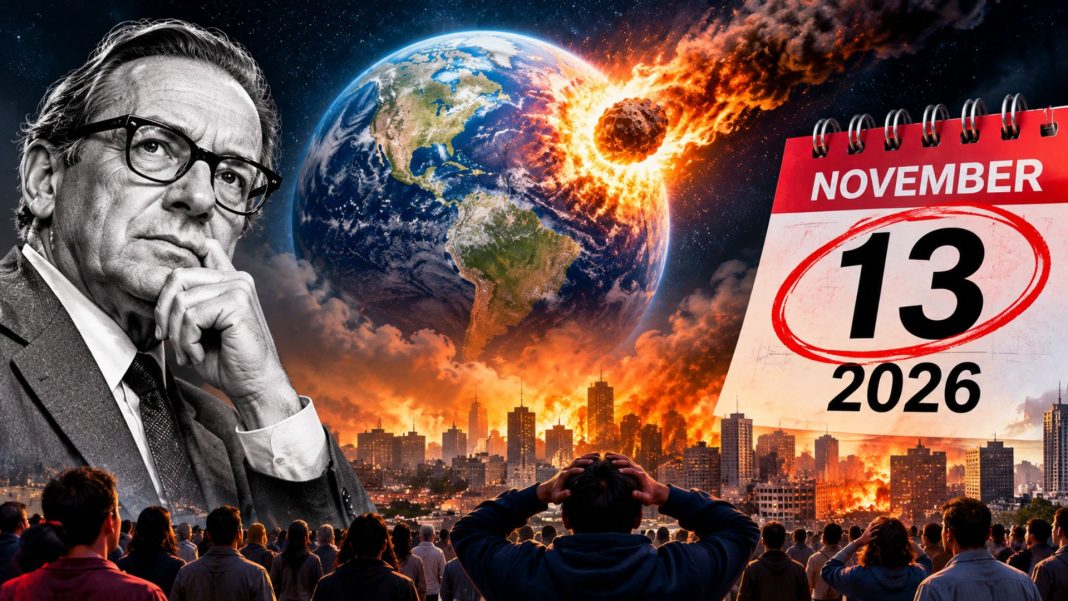

World Ending Prediction 2026: Today, November 13 2026, was once officially calculated by scientists as the exact day humanity would meet its end.
Back in November 1960, a prominent Austrian-American physicist and his colleagues published a chilling paper in the prestigious journal Science. Titled “Doomsday: Friday, November 13, AD 2026,” the research made a startling claim: human population growth was accelerating so fast that the Earth would eventually run out of space, leading to a catastrophic collapse.
The scientists famously warned, “Our great-great-grandchildren will not starve to death. They will be squeezed to death.”
Decades later, the dreaded date has finally arrived. However, the global population stands around 8 billion, a far cry from the infinite numbers predicted by the mathematical formula.
So, why did a brilliant physicist predict the apocalypse for this exact date, why did it miss the mark completely, and what can we learn from it today? Let’s break down the story behind history’s most famous population panic.
The Math Behind the Myth: Why November 13, 2026?
World Ending Prediction 2026: In 1960, physicist Heinz von Foerster teamed up with two colleagues at the University of Illinois Urbana-Champaign to analyze historical population numbers stretching all the way from 400 BC to 1958.
They noticed a striking trend: the time it took for the global population to double was shrinking rapidly. Using this pattern, they created a mathematical equation to project future population growth.
Their calculations revealed a shocking trajectory:
By 2020, the global population could surge past 25 billion.
If the trend continued unchecked, the population would eventually skyrocket toward infinity.
The researchers did not point to a specific resource like food or water running out. Instead, their “doomsday” was defined as the exact mathematical point where their equation broke down because the estimated population approached infinity.
According to their calculations, the equation pointed to the year 2026.87, allowing for a 5.5-year margin of error. When von Foerster looked closer at the timeline, he landed on a specific date, Friday, November 13, 2026, which happened to be his birthday. Media reports at the time quickly picked up on the catchy, apocalyptic milestone.
Why Demographers Called Out the Flaws
World Ending Prediction 2026: While the paper grabbed international headlines, population experts were deeply skeptical from the start.
One of the most glaring issues was the assumption that exponential growth could continue forever. Critics pointed out that human reproduction has natural limits and that population growth cannot double infinitely without hitting physical and biological barriers.
Just two years after the paper was published, public health expert Harold Dorn challenged the findings in Science, writing that the prediction would go down in history for setting a record for short-lived reliability.
Later, Patrick Gerland, head of the Population Estimates and Projection Section at the United Nations, pointed out the flaws in applying a single mathematical curve to the entire planet.
Demographers usually study individual countries, factoring in birth rates, death rates, and migration. Because social and economic conditions vary wildly across the globe, a blanket global equation simply could not account for local realities.
How Did the Prediction Go So Wrong?
For a brief period, von Foerster’s equation looked surprisingly accurate. By 1975, the global population hit roughly 4 billion, outpacing some early forecasts.
However, by the early 1990s, the projection began to drift wildly away from reality. Fertility rates in industrialized nations and China began to drop significantly. As families chose to have fewer children, the engine driving rapid population growth began to slow down.
By 2000, instead of the 7 billion predicted by the formula, the global population was closer to 6 billion.
By 2010, instead of an astronomical 11 billion, the world had roughly 7 billion people.
Today, we stand at around 8 billion, hundreds of billions short of the physicist’s runaway numbers, largely because birth rates today are roughly half of what they were in 1960.
Media reports have highlighted how the 1960 model fundamentally failed to account for changing social dynamics. As societies became wealthier, healthier, and better educated, family sizes naturally shrank, a crucial demographic shift the model ignored.
Was It Meant to Be Taken Literally?
Many researchers believe the 1960 paper was never meant to be a literal prophecy. Instead, it was a clever rhetorical device designed to sound the alarm about the dangers of unchecked population growth.
Joel Cohen, a mathematical population biologist at Rockefeller University, recalled hearing about the research as a student. He noted that von Foerster was likely drawing attention to a worrisome pattern rather than trying to accurately predict the future.
The researchers themselves admitted that their work aimed to spark debate on population control. Their arguments arrived during a time of widespread global anxiety over overpopulation:
In 1968, American biologist Paul Ehrlich published The Population Bomb, warning of mass famines.
In 1972, a computer-modeling report titled The Limits to Growth warned that resource consumption could collapse global systems by the 2020s.
Unfortunately, this panic had real-world consequences, inspiring aggressive international birth control programs, forced sterilization efforts in South Asia, and China’s strict One-Child Policy, which lasted until 2015.
Why This Prediction Still Matters Today
Even though von Foerster’s doomsday scenario did not come true, his paper remains a fascinating case study in how scientists model complex future events.
Today, similar anxieties have resurfaced, though the focus has shifted from overpopulation to the rapid rise of Artificial Intelligence (AI). In mathematics, the point where von Foerster’s equation breaks down is called a singularity, a term frequently used in modern discussions about AI and the hypothetical scenario where machines might advance faster than human control.
Reflecting on the prediction, experts note that extrapolating current trends into the infinite future is always a risky business. Javier Birchenall, an economist at the University of California, Santa Barbara, pointed out that the failure of the “doomsday equation” serves as a reminder of how dangerous it is to assume temporary historical anomalies will define all eternity.
For now, we can all breathe a sigh of relief. Friday, November 13, 2026, is just another ordinary day, and humanity’s end is nowhere in sight!