


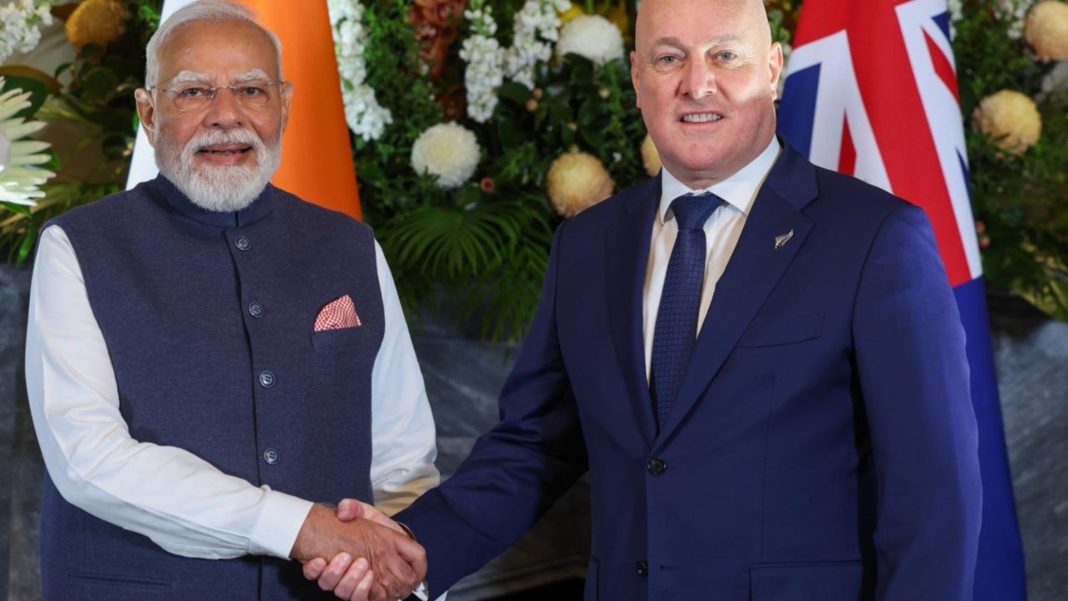

India New Zealand FTA : In a historic diplomatic breakthrough that fundamentally alters the geopolitical and economic architecture of the Indo-Pacific, India and New Zealand have officially elevated their bilateral relationship to a Strategic Partnership.
The momentous shift occurred during high-level bilateral talks in Auckland between Indian Prime Minister Narendra Modi and New Zealand Prime Minister Christopher Luxon.
This high-profile summit marks the first time an Indian Prime Minister has set foot on New Zealand soil in four decades, the last being Rajiv Gandhi’s state visit way back in 1986.
The intensive session yielded an aggressive economic blueprint headlined by 18 monumental decisions and the signing of 10 comprehensive Memoranda of Understanding (MoUs).
Chief among these outcomes is a binding commitment to double bilateral trade to ₹35,000 crore ($7 billion NZD) by the year 2030, driven by a freshly signed, record-breaking Free Trade Agreement (FTA).
Inside the 10 Major Pacts: Forging a Trans-Oceanic Alliance
India New Zealand FTA : The structural framework of this newly minted Strategic Partnership relies heavily on ten key agreements designed to establish integrated collaboration across security, economic development, and technological infrastructure.
Unlike previous regional trade understandings, these pacts introduce formal, reciprocal mechanisms between New Delhi and Wellington.
| Sector | Key Agreement | Strategic Significance |
|---|
| Defense & Security | Maritime Domain Logistics Pact | Enables reciprocal logistics, refueling, maintenance, and repair support between the Indian Navy and the New Zealand Defence Force, strengthening Indo-Pacific maritime cooperation. |
| Maritime Governance | Hydrography & Cartography Cooperation | Creates a joint framework for hydrographic surveys, nautical charting, and maritime safety across key Indo-Pacific sea routes. |
| Trade & Economic Cooperation | FTA Fast-Track Framework | Accelerates tariff reductions and trade facilitation measures to help achieve the bilateral trade target of ₹35,000 crore. |
| Agriculture & Dairy | Advanced Dairy Working Group | Brings New Zealand’s advanced dairy processing, cold-chain management, and livestock expertise to strengthen India’s rural dairy sector. |
| Science, Technology & Ocean Research | Food Technology & Marine Research Partnership | Promotes joint innovation in food technology, sustainable agriculture, climate resilience, and ocean science through public-private collaboration. |
Beyond these primary categories, additional formal understandings were finalized covering global disaster management protocols, tourism promotion pipelines, maritime heritage preservation, coordinated sports development programs, and deeper cross-cultural institutional exchanges.
Fast-Tracking the Economy: The Nine-Month FTA Miracle
India New Zealand FTA : Addressing business delegations and global press networks, Prime Minister Modi highlighted what he termed a “modern diplomatic miracle”, the finalization of the India-New Zealand Free Trade Agreement (FTA) in a record-breaking span of just nine months.
Typically, wide-ranging trade deals between major agricultural exporters and large developing consumer economies require years of grueling negotiations over complex tariff codes.
However, both administrations bypassed bureaucratic friction to push the historic trade package through in less than three quarters.
The newly implemented FTA acts as the primary economic engine behind the 2030 target. By aggressively slashing cross-border tariffs on nearly 95% of New Zealand’s export offerings while dramatically lowering entry barriers for Indian pharmaceutical, textile, and IT services in the Pacific, the trade deal is structurally designed to add immense momentum to both nations’ domestic GDPs.
Fueling ‘Viksit Bharat 2047’: New Zealand’s ₹1.72 Lakh Crore Pledge
Beyond immediate export-import numbers, the summit secured a long-term capital injection into the Indian subcontinent. Prime Minister Christopher Luxon announced an expansive capital allocation strategy under which New Zealand will invest ₹1.72 lakh crore ($20 billion USD) into the Indian economy over the next 15 years.
This multi-decade financial commitment is specifically calibrated to integrate with Prime Minister Modi’s centerpiece domestic development initiative, ‘Viksit Bharat 2047’, which aims to transition India into a fully developed nation by the 100th anniversary of its independence.
The sovereign-backed capital will flow primarily into three core pillars:
High-Tech Infrastructure: Transforming tier-2 and tier-3 Indian urban zones into smart-city digital hubs.
Agri-Tech Modernization: Funding precision farming initiatives, optimized logistics pipelines, and large-scale post-harvest waste reduction systems.
Green Energy Projects: Joint venture initiatives specializing in wind, sustainable hydro-infrastructure, and commercial-scale solar storage technologies.
Geopolitical Undercurrents: The Indo-Pacific Balance of Power
Strategic analysts point out that the timing and location of this historic summit carry heavy geopolitical significance. PM Modi arrived in Auckland as the final destination of a highly targeted three-nation regional tour through Indonesia, Australia, and New Zealand from July 6 to July 11.
The overarching objective of this diplomatic push centers directly on fortifying India’s Act East Policy and its overarching MAHASAGAR Vision, a comprehensive framework aimed at ensuring maritime security and sustainable development for all nations across the Indian Ocean Region and the wider Pacific.
“Our natural partnership is anchored by a shared, unshakable belief in democratic values, the absolute preservation of territorial sovereignty, and a rules-based international order,” noted PM Modi during his main address at Government House. “India and New Zealand are stable anchors in a rapidly changing world.”
With rising tensions and maritime assertiveness across the South China Sea and the wider Pacific corridors, the formal merging of Indian naval logistics with New Zealand’s defense networks represents a major pivot.
Furthermore, both leaders leveraged the summit to advocate for “bold, transparent, and effective” structural reforms within the United Nations, with Prime Minister Luxon reiterating New Zealand’s official support for India’s permanent inclusion in an expanded UN Security Council.
The Diaspora Surge and Departure
As the historic visit draws to a close, the focus has shifted from high-level statecraft to the immense cultural bridge connecting the two societies. To mark the arrival of the Indian delegation, Auckland’s iconic Sky Tower was completely illuminated in vibrant commemorative colors, drawing large crowds of onlookers across the city center.
Currently, Auckland is preparing for the final event of the tour: a massive, arena-scale community reception. Prime Minister Modi is set to deliver a headline address to an estimated 40,000 members of the Indian diaspora who have gathered from every corner of New Zealand.
The diaspora community, which now numbers roughly 300,000, represents one of New Zealand’s fastest-growing and most economically influential immigrant demographics.
Immediately following his address to the diaspora and brief scheduled meetups with prominent Kiwi business leaders and legendary sports personalities, Prime Minister Modi will arrive at Auckland International Airport.
He is scheduled to depart for New Delhi later tonight, successfully concluding a whirlwind, multi-nation tour that has fundamentally rewritten India’s foreign policy footprint in the Southern Hemisphere.