


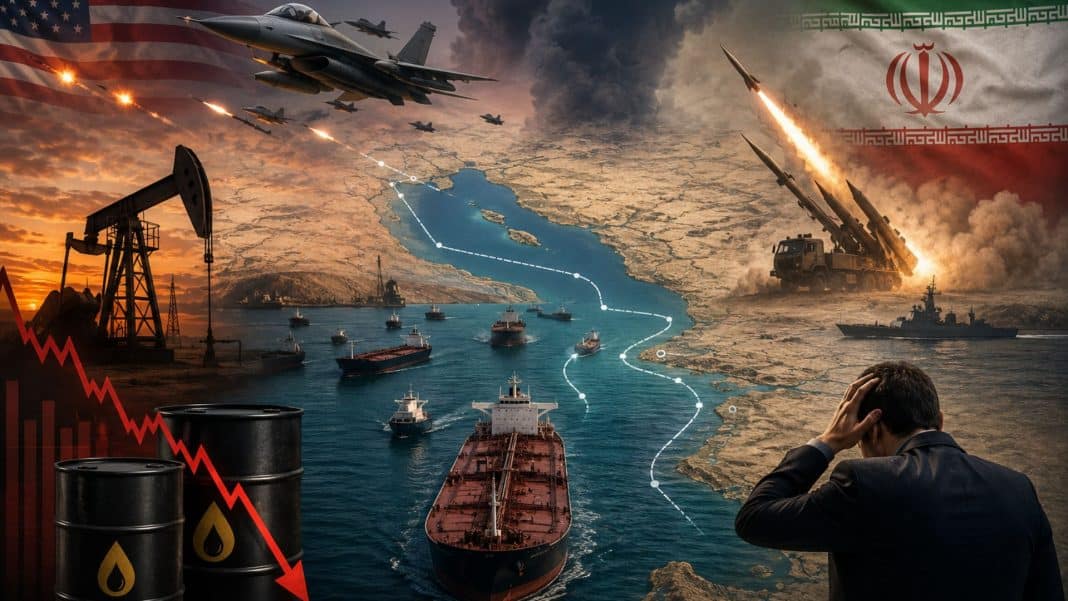

Hormuz Crisis: West Asia has slid back into the precipice of full-scale war after a fragile, weeks-long ceasefire shattered completely. The U.S. Central Command (CENTCOM) has concluded a devastating, multi-wave aerial assault targeting Iranian military infrastructure, triggering immediate, violent retaliation from Tehran against American bases across the Gulf.
The collapse of the truce has brought commercial shipping in the Strait of Hormuz, the world’s primary energy chokepoint, to an absolute standstill, sending shockwaves through global energy markets.
NIGHT WAVE: CENTCOM Precision Strikes Pound Iranian Strongholds
Hormuz Crisis: In an official statement released on X, CENTCOM confirmed that a heavy evening wave of airstrikes concluded at 9:00 PM ET on Wednesday. Utilizing high-precision-guided munitions, American fighter jets and naval assets pounded key Iranian assets.
Command & Control Centers: Key leadership and communications nodes were targeted to disrupt military coordination.
Air Defense Installations: Surface-to-air missile systems were struck to secure airspace for ongoing operations.
Missile & Drone Launch Capabilities: Production and launch sites were neutralized to suppress retaliatory volleys.
Coastal Surveillance Facilities: Radar and tracking stations along the gulf were hit to blind regional monitoring.
The operation heavily focused on degrading Iran’s ability to threaten international shipping. Blasts ripped through multiple strategic sectors, including the crucial port city of Bandar Abbas.
CENTCOM released dramatic footage of the operations, stating that the U.S. military is actively holding the Islamic Republic accountable at the direct order of the Commander-in-Chief.
— U.S. Central Command (@CENTCOM) July 16, 2026
90-MINUTE BLITZ: Dawn Raid Desecrates Island Defenses
Hormuz Crisis: The evening bombardment followed a highly concentrated, 90-minute morning blitz on Wednesday. U.S. forces concentrated heavy fire on Greater Tunb Island, an island situated directly within the narrow transit corridor of the Strait of Hormuz. The morning raid successfully targeted and neutralized coastal defense systems and cruise missile storage sites.
While the Pentagon withheld an exhaustive list of hit sites, Iranian state media confirmed that the scale of the American air campaign extended far beyond the coast. Explosions and air defense activations were reported at Semnan Airport east of Tehran, Khondab nuclear-linked regions, Qeshm Island, and the Sirik area in Hormozgan Province.
TEHRAN RETALIATES: U.S. Airbases in Jordan, Kuwait, and Bahrain Under Fire
Iran’s Islamic Revolutionary Guard Corps (IRGC) did not remain passive, launching a synchronized barrage of drones and missiles across the region into Thursday morning.
In Jordan, the military struck Al-Azraq Air Base, targeting radar sites, communications equipment, and vital fuel tanks used by U.S. forces. Simultaneously, Iranian forces attacked Ali Al Salem Air Base in Kuwait, destroying an early-warning radar associated with a short-range air defense system. Further U.S. assets in Bahrain also came under fire, where multiple aerial vectors were intercepted, triggering air raid sirens.
Kuwaiti and Bahraini authorities confirmed their air defense shields were activated to counter dozens of incoming hostile drones and cruise missiles.
THE HORMUZ DISPUTE: A Clash of Legal Interpretations
Unlike previous flare-ups tied to Iran’s nuclear enrichment programs, this rapid five-day escalation centers strictly on the physical administration of the Strait of Hormuz.
Washington asserts that the strait is an unalterable international waterway governed by the right of free transit. Conversely, Tehran claims total administrative oversight, pointing to a recently brokered US-Iran Memorandum of Understanding (MoU). Iranian officials argue the language permits them to police transit routes and potentially levy transit fees on commercial vessels.
Paragraph 5 of the US-Iran MoU explicitly states that the Islamic Republic of Iran will conduct dialogue with the Sultanate of Oman to define the future administration and maritime services in the Strait of Hormuz, in discussion with other Persian Gulf littoral states in line with the applicable international law and the sovereign rights of coastal states of the Strait of Hormuz.
Iran has begun enforcing this interpretation by intercepting and striking ships traveling along what it deems “unauthorized routes,” a move that directly triggered the five-day American bombing campaign.
Blockade Hardens as U.S. Navy Disables Oil Tanker
Tensions reached a dangerous new high point on Thursday morning after U.S. naval forces formally reinstated a strict naval blockade on all vessels traveling to and from Iranian ports.
In a stark demonstration of enforcement, a U.S. military aircraft targeted and disabled an unladen oil tanker transiting international waters toward Kharg Island, Iran’s primary crude export hub. According to CENTCOM, the vessel ignored multiple visual and radio warnings to halt, prompting an American fighter jet to fire Hellfire missiles directly into the ship’s smokestack.
The vessel was left immobilized in the water, signaling that Washington is willing to employ kinetic force to completely isolate Iran economically until the shipping lanes are freed. With both sides dug in, the global economy braces for severe energy disruptions as long as the world’s most vital oil artery remains a designated free-fire zone.