
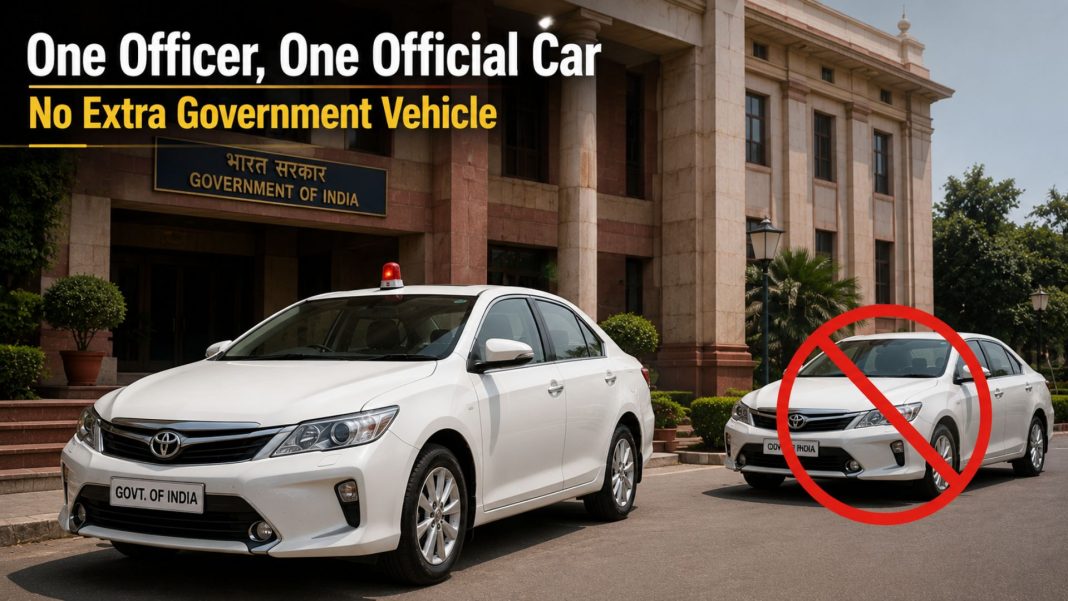

One Entitled Officer One Official Car Policy: In a major administrative push to eliminate the misuse of official vehicles, curb unnecessary operational expenditure, and streamline resource management across central bureaucracy, the Government of India has enforced a strict “One Entitled Officer, One Official Car” policy.
According to media reports, the Department of Expenditure under the Ministry of Finance has issued a fresh Office Memorandum directing that no bureaucrat or official will be allotted a second government vehicle, even if they hold additional charge of another ministry, department, or public sector unit.
The revised directive applies uniformly across all central ministries, departments, attached offices, Public Sector Undertakings (PSUs), and autonomous bodies.
No Extra Car for Additional Duties
One Entitled Officer One Official Car Policy: According to media reports, the primary trigger behind the new guidelines is the practice of officials claiming multiple government cars when assigned additional responsibilities.
Under the newly reinforced policy, if a bureaucrat already has an official vehicle allocated for their primary posting, they will not be entitled to request or draw a second staff car from any secondary ministry, department, PSU, or autonomous entity they are managing on an interim or additional basis.
The Finance Ministry has instructed all central departments to strictly enforce this rule and ensure that any idle government vehicles are safely stored or redeployed to avoid unnecessary maintenance costs.
Crackdown on Using PSU and Autonomous Body Fleets
One Entitled Officer One Official Car Policy: As reported by media outlets, the directive also targets the improper reliance on vehicle fleets belonging to allied public sector enterprises and autonomous institutions.
Key restrictions under the updated rules include:
No Regular or Personal Use: Central government officials are explicitly prohibited from using vehicles belonging to PSUs, autonomous bodies, or semi-government organizations for routine commuting or personal errands.
Conditional Tour Utilization: Officials visiting a PSU or autonomous body specifically for official work or field inspection are permitted to use local transport provided by that institution only for the duration of that specific official visit.
This measure is expected to stop the parallel use of multiple institutional vehicles by a single officer and prevent duplicative resource allocation.
Strengthening the 2022 Staff Car Guidelines
According to statements cited in press reports, this latest Office Memorandum is an extension designed to give more teeth to the September 2022 guidelines governing the regulation and deployment of government staff cars.
The circular has been circulated across all ministries, departments, financial advisors, and administrative heads to maintain uniform compliance throughout the central government structure.
By eliminating duplicate car allotments, the government aims to achieve:
Reduced Fuel and Maintenance Expenses: Cutting down on running, driver, and upkeep costs associated with secondary vehicles.
Financial Discipline: Ensuring public funds allocated to government administration are utilized judiciously.
Administrative Accountability: Establishing clear, transparent standards for bureaucratic perks and entitlements.
Key Takeaways of the New Rule
According to official guidelines detailed in media reports, the core framework of the policy rests on three main pillars:
Single Allocation Standard: One officer is entitled to strictly one official car, regardless of how many additional portfolios or departments they oversee.
Strict Monitoring of Idle Assets: Unused vehicles must be properly inventoried and protected from decay or unauthorized use.
Uniform Implementation: The rule applies without exception to all central government entities, PSUs, and autonomous bodies.
This policy shift represents a significant step toward administrative austerity, fiscal prudence, and resource optimization within India’s central administrative machinery.