


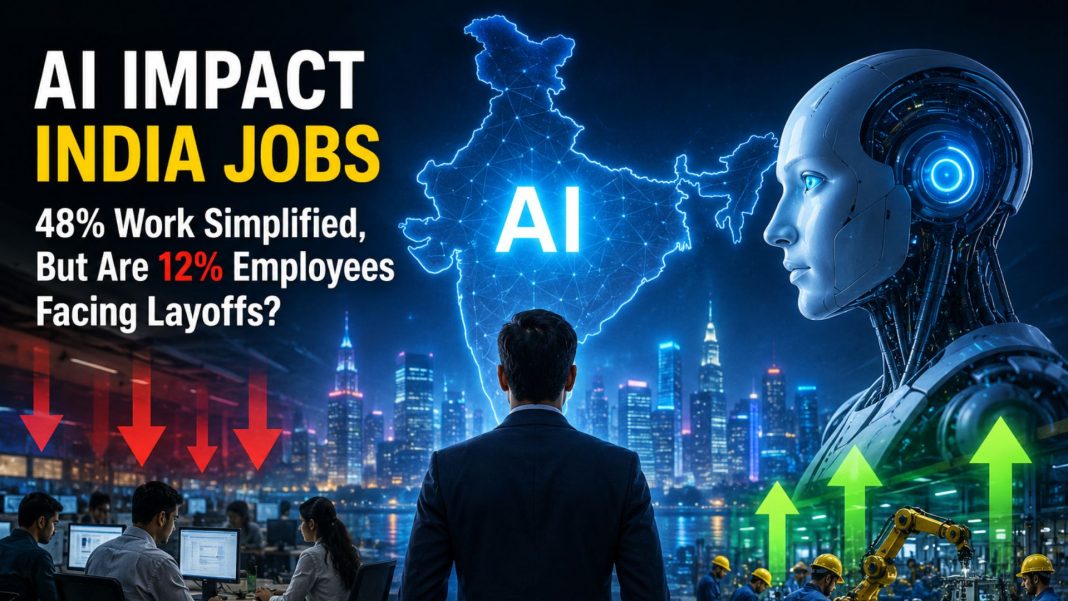

AI Impact India Jobs: According to media reports, global investment bank Goldman Sachs has released a comprehensive report examining the economic implications of Generative Artificial Intelligence (GenAI) on India’s workforce.
The study reveals that GenAI is poised to transform the nature of employment across the country, offering significant productivity gains while simultaneously creating targeted job crosswinds.
As reported by news outlets, the analysis estimates that approximately 42% to 48% of India’s non-agricultural jobs will benefit directly from AI augmentation.
The technology is expected to streamline repetitive tasks and make daily workflows vastly more efficient. Conversely, the report cautions that around 8% to 12% of non-agricultural roles face potential displacement or job substitution risks as automation capabilities advance.
Role-Wise Breakdown: Rising Opportunities vs. Increased Layoff Risks
AI Impact India Jobs: According to media reports, the integration of generative AI into the Indian economy will not impact all occupations equally.
Instead, the transition signals a shift toward manual and technical execution roles while reducing demand for routine administrative functions.
Roles Expecting Employment Growth
As per media reports, occupations centered on manual execution, physical labor, and machine operation are projected to experience rising demand:
Physical Workers: Employment growth projected to increase by 4%.
Craft & Trade Workers: Job opportunities expected to expand by 3%.
Machine Operators: Demand anticipated to rise by 2%.
Roles Facing Layoff Risks
Conversely, roles heavily dependent on repetitive data processing, documentation, and routine customer interactions face higher risks of substitution:
Clerical Support: Employment risk showing a 3% decline.
Professionals & Technicians: Automation exposure pointing to a 3% reduction.
Service & Sales Workers: Roles facing a 2% drop due to automated support tools.
Four Pillars of GenAI’s Impact on the Indian Economy
According to news reports, the Goldman Sachs research highlights four critical dimensions detailing how generative AI will reshape national productivity, employment trends, specialized hubs, and service exports:
1.Economy: Surge in Overall Productivity
According to media reports, GenAI has the potential to handle 9% to 17% of tasks within the non-agricultural workforce, depending on task complexity.
Under a baseline scenario (13–15% task exposure), AI adoption could boost India’s annual labor productivity growth by 0.8 percentage points over a 10-year period.
For instance, if baseline economic growth stands at 10%, GenAI integration could elevate it to 10.8%.
2.Employment: Tech Sector Dynamics and 7 Lakh New Roles
While top-tier IT service firms experienced a net drop of roughly 64,000 jobs over the past three years due to shifting industry demands, the broader technology sector added approximately 7 lakh jobs during the exact same period, as reported by media outlets.
The tech sector currently accounts for nearly 2% of total non-agricultural employment in the country.
4. Dedicated Hubs: Acceleration of Global Capability Centers (GCCs)
According to media reports, Global Capability Centers (GCCs) in India have expanded dramatically over the last 15 years:
The total number of GCC facilities has grown nearly 3-fold.
5.Workforce headcount across GCCs has jumped 6-fold.
Total GCC revenue has surged 8-fold, with projections estimating revenues to reach ₹9.3 lakh crore by fiscal 2025–26.
Industry: Expansion in Services Exports
As per news reports, India’s services exports rose to 10.7% of GDP in the January–March quarter, up from 10.1% in 2024. Crucially, software solutions and business services now account for a commanding 75% share of all services exports.
Major Bottleneck: India Lags in Data Center Infrastructure
Despite strong software talent, media reports emphasize that India faces a significant physical infrastructure hurdle in scaling AI adoption.
According to media reports, India currently accounts for only about 1% of global data center capacity.
By comparison, the United States holds approximately 47% of global capacity, while China commands nearly 25%.
India’s current operational compute capacity stands at roughly 1 Gigawatt (GW), highlighting the urgent need for massive investments in power, cooling, and digital infrastructure to support the country’s AI ambitions.
Also Read: Tatkal Ticket New Rules From August 1: Railways Launches Token System at Reservation Counters