


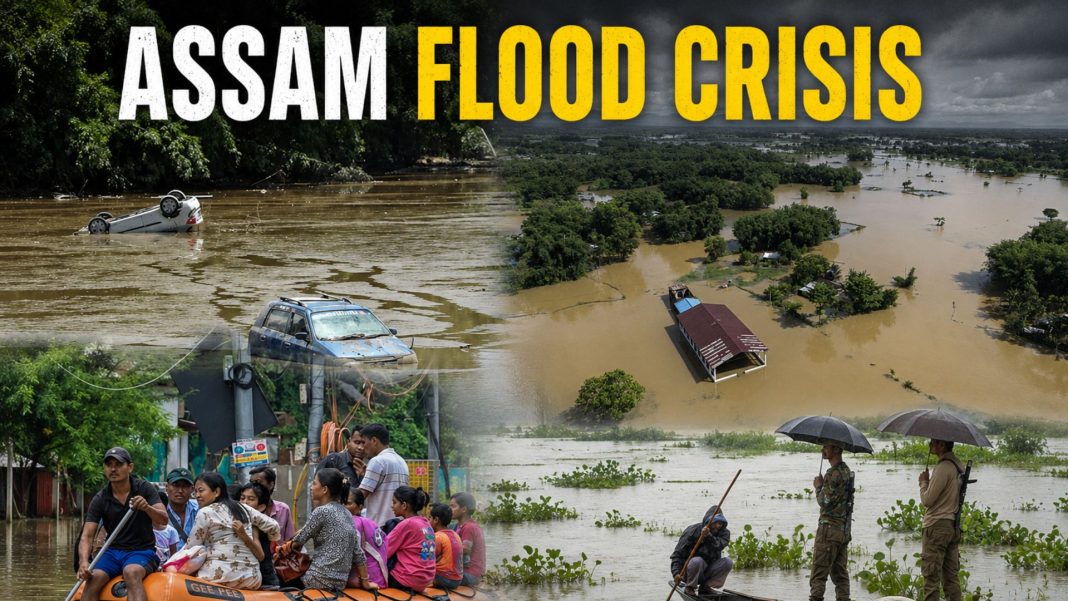

Assam Flood: According to official disaster management updates, the ongoing deluge in Assam has claimed 78 lives following three additional fatalities recorded across Sivasagar and Golaghat districts.
Data released by the Assam State Disaster Management Authority (ASDMA) indicates that over 300,000 residents across seven key districts continue to endure severe hardships due to widespread inundation.
Although water levels across major river systems have begun to stabilize in recent days, the scale of structural and agricultural destruction remains substantial.
As reported by official bulletins, 551 villages situated across 21 revenue circles remain submerged, while over 21,523 hectares of standing crop area have suffered extensive damage.
District Impact Breakdown: Charaideo and Upper Assam Suffer Maximum Damage
Assam Flood: According to media reports, Charaideo has emerged as the worst-impacted administrative zone in the state, with over 137,000 residents severely affected by the deluge.
Sivasagar follows closely as the second hardest-hit region, with more than 84,000 individuals struggling against floodwaters, while Jorhat reports nearly 50,000 affected citizens.
Key Statistics Surrounding the Deluge
Total Casualties: 78 confirmed deaths state-wide.
Affected Population: Over 300,000 individuals across seven districts.
Submerged Settlements: 551 villages spanning 21 revenue circles.
Agricultural Loss: 21,523 hectares of inundated farmland.
Displaced Citizens: Over 16,500 residents sheltered across 71 operational relief camps.
According to government reports, the latest three fatalities were recorded in Upper Assam, with Sivasagar reporting two deaths and Golaghat recording one within a 24-hour period.
Infrastructure Damage and Urban Inundation Present Post-Flood Challenges
As reported by news outlets, Assam Chief Minister Himanta Biswa Sarma noted that while the overall flood intensity showed signs of easing after rainfall reduced following July 21, the structural damage inflicted by the disaster presents an enormous recovery challenge.
Thousands of displaced citizens remain unable to return to their homes due to heavy mud deposits, structural instability, and severe siltation.
Furthermore, remote communities situated along the Nagaland border remain cut off from district headquarters.
Torrential rainfall in the neighboring hills triggered severe landslides that damaged critical highway stretches and washed down massive volumes of water into Assam’s low-lying plains, hampering ground-level relief logistics.
Persistent Urban Waterlogging in Guwahati
While rural zones battle riverine overflows, urban regions within Kamrup Metropolitan district continue to struggle with prolonged waterlogging.
Major urban centers and residential localities including Zoo Road, Hatigaon, Nabin Nagar, and Anil Nagar have reported persistent urban flooding that continues to disrupt daily life and local transportation networks.
IMD Issues Fresh Orange Alert: Heavy Downpours Threaten Recovery Efforts
The India Meteorological Department (IMD) has issued a fresh Orange Alert warning of heavy to very heavy rainfall and localized thunderstorms across vulnerable pockets of Assam, Nagaland, and Arunachal Pradesh.
According to meteorologists, daily precipitation levels ranging between 6 cm and 20 cm are anticipated across bordering districts, threatening to trigger fresh flash floods, landslides, and urban waterlogging.
State disaster response authorities have cautioned that renewed downpours could severely impede ongoing recovery operations, particularly in regions where floodwaters have only recently begun to retreat.
Local administrations in sensitive districts, including Tinsukia, Dhemaji, and Lakhimpur, have been placed on high alert to facilitate rapid evacuations if river levels rise again.
Multi-Agency Relief Operations and Central Assistance
According to media reports, multi-agency rescue teams including personnel from the Indian Army’s Spear Corps under ‘Operation Rahat’, the NDRF, SDRF, and medical corps remain actively deployed.
Army personnel have successfully evacuated over 1,000 marooned citizens while distributing tens of thousands of food packets, clean drinking water, and essential medical supplies to affected families.
State Welfare and Financial Interventions
Relief Distribution: Over 30 specialized distribution centers have been operationalized to provide essential food rations to more than 72,000 individuals residing outside formal relief camps.
Orunodoi Welfare Disbursal: The state government announced the resumption of its flagship Orunodoi financial assistance scheme, disbursing direct monthly aid of ₹2,500 to eligible beneficiaries in severely hit districts such as Sivasagar, Charaideo, Jorhat, and Golaghat to aid rehabilitation.
Central Government Support: Union Home Minister Amit Shah reviewed the situation directly with Chief Minister Sarma, assuring full financial and logistical backing from the Central Government.
Chief Minister Sarma confirmed that domestic administrative resources remain sufficient to manage the crisis effectively without requiring external international aid.
Also Read: AI Impact India Jobs: 48% Work Simplified, But Are 12% Employees Facing Layoffs?