


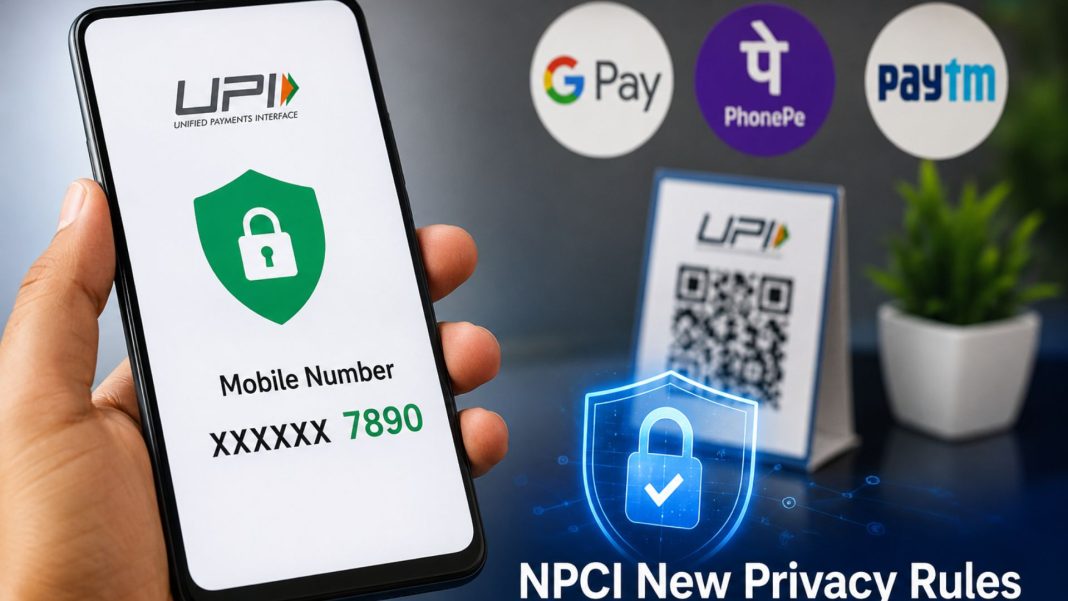

NPCI New Privacy Rules: In a decisive effort to protect user data across digital transactions, the National Payments Corporation of India (NPCI) has issued fresh privacy guidelines for all Unified Payments Interface (UPI) third-party apps, including Google Pay, PhonePe, and Paytm, as well as partner banking institutions.
According to media reports, these structural updates comply with the Digital Personal Data Protection (DPDP) framework.
The mandate aims to prevent sensitive customer details from being exposed to unauthorized third parties during everyday digital transfers.
Under the new instructions, all payment platforms and banking entities have been given a firm deadline of September 4 to reconfigure their systems and enforce these privacy protocols.
Mandatory Mobile Number Masking: Only Last Four Digits Visible
NPCI New Privacy Rules: As reported by media outlets, the primary change centers on masking personal identifiers specifically mobile numbers, virtual payment addresses, and linked bank account information across every customer-facing display.
Going forward, when a payment is processed via phone numbers or scanned QR codes, the recipient or sender will no longer see the complete 10-digit mobile number.
Instead, the user interface will display only the final four digits, obscuring the preceding numbers to preserve confidentiality.
Key Operational Changes Under the NPCI Circular
Identifier Masking: Full phone numbers, complete bank account details, and default payment handles will be hidden across payment confirmation screens.
Partial Display: Only the last four digits of the payee or payer’s mobile number will remain visible for cross-verification.
QR Code Security: Transactions executed by scanning static or dynamic QR codes will also suppress full mobile contact details.
Strict Implementation Deadline: All UPI service providers and banks must roll out these interface changes by September 4.
According to media reports, this intervention will significantly reduce the risk of personal numbers falling into the hands of strangers, telemarketers, or scammers.
The measure is expected to be particularly beneficial for women and privacy-conscious users who have raised concerns about data exposure during everyday transactions at physical retail shops.
Shift Toward Username-Based VPA Allocation
Under the fresh circular cited in media reports, NPCI has instructed payment applications to actively promote and simplify the creation of username-based Virtual Payment Addresses (VPAs) rather than relying on phone numbers by default.
Currently, a vast majority of users rely on their mobile number prefixed to a bank domain as their default UPI ID. While custom username-based handles are already supported by the architecture, public awareness remains low.
To resolve this, app developers are being instructed to redesign their onboarding and account setup flows.
By encouraging users to choose unique handles (such as username@upi), the system will minimize the need to reveal phone numbers during peer-to-peer or peer-to-merchant transfers.
Alignment With the Digital Personal Data Protection (DPDP) Framework
According to media reports, NPCI has been holding regular technical consultations with member banks, payment system providers, and digital wallet companies to ensure the entire UPI framework fully aligns with the DPDP legislation.
Authorities emphasize that masking contact details serves as a crucial preventive barrier against unsolicited calls, spam messages, identity tracking, and potential financial fraud.
By restricting public data exposure on payment confirmation screens, the payment ecosystem aims to strengthen user trust without slowing down transaction speed.
Centralized Recurring Payments Management Feature Under Development
Alongside the privacy mandates, media reports highlight another major functional upgrade currently being developed by NPCI.
The authority is working on a centralized management interface that will allow users to monitor and control all active automated or recurring payments (auto-debits) through a single UPI application.
At present, consumers managing multiple subscriptions or bill payments often have to open individual apps to modify or cancel recurring mandates.
The proposed unified dashboard will allow users to track, pause, or terminate all active auto-pay arrangements from one place, simplifying personal financial management across participating banks.
Through these combined policy shifts enforcing strict data masking, encouraging custom payment IDs, and streamlining mandate management the digital payments ecosystem is moving toward a model where transaction security and user privacy receive the same priority as operational speed.
Also Read: AI Impact India Jobs: 48% Work Simplified, But Are 12% Employees Facing Layoffs?