


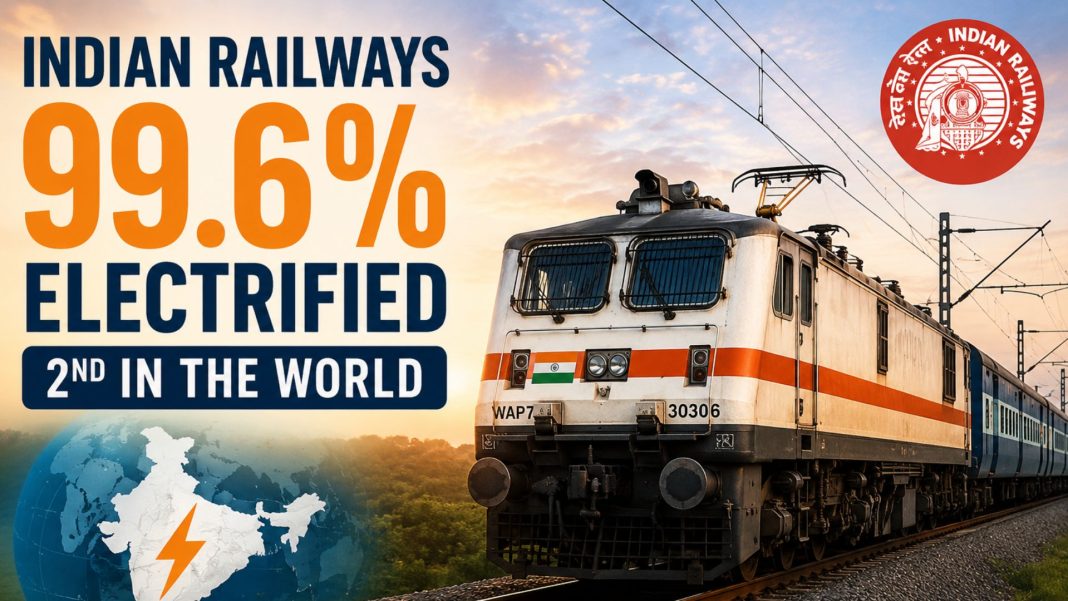

Indian Railways Electrification: In a major advancement for national infrastructure and green mobility, Indian Railways has officially completed the electrification of 99.6 percent of its total broad gauge network.
According to official reports, this landmark accomplishment elevates India to the position of the world’s second most electrified large railway system, trailing only Switzerland, which maintains a fully electrified network.
The achievement represents one of the fastest and largest railway electrification drives ever undertaken globally.
Unlike many industrialised nations that restrict overhead electric infrastructure strictly to high-density passenger or freight corridors, India has pursued a comprehensive strategy of electrifying its entire broad gauge network to drastically reduce carbon emissions and cut operational costs.
Rapid Acceleration Over the Past Decade
Electrification of Indian Railways before 2014: According to information shared in Parliament by Union Minister for Railways Ashwini Vaishnaw, the speed of network electrification experienced a dramatic surge over the last decade.
Between 2014 and 2026, Indian Railways electrified 48,072 route kilometres under a dedicated mission-mode framework. In sharp contrast, only 21,801 route kilometres had been electrified during the nearly six decades preceding 2014.
Media reports highlight that the Union government has made electric infrastructure an integral, mandatory component of all new line approvals and track-doubling projects.
To overcome operational challenges associated with executing electrification on active, live tracks, Indian Railways deployed streamlined project monitoring systems including the Project Monitoring Group (PMG) portal while delegating enhanced financial powers directly to field units.
How India Compares on the Global Stage
Indian railways electrification latest news: According to international railway data, India’s 99.6 percent electrification figure places it well ahead of most major global economies that operate large rail logistics systems.
While Switzerland holds the top spot with 100 percent coverage, its overall network length is significantly smaller than India’s vast rail footprint.
| Rank | Country | Railway Electrification Level |
|---|---|---|
| 1 | Switzerland | 100% |
| 2 | India | 99.6% |
| 3 | China | 82% |
| 4 | Spain | 67% |
| 5 | Japan | 64% |
| 6 | France | 60% |
| 7 | Russia | 52% |
| 8 | United Kingdom | 39% |
As noted by media reports, India has comfortably surpassed major railway operators including China, Japan, France, and the United Kingdom, cementing its standing as an international leader in sustainable transit infrastructure.
Environmental Benefits and Massive Foreign Exchange Savings
Indian railways electrification status: The gradual phasing out of diesel locomotives has yielded immediate environmental and financial dividends. According to findings from a NITI Aayog study, rail transport produces approximately 11.5 grams of carbon dioxide per tonne-kilometre.
This represents an 89 percent reduction in greenhouse gas emissions compared to road transport, which generates roughly 101 grams of CO₂ for moving the same volume of freight.
Furthermore, official data reveals a substantial decline in fuel consumption. Annual diesel usage for train traction plummeted from 293 crore litres in FY 2015-16 down to approximately 108 crore litres in FY 2024-25.
This structural reduction has saved nearly 185 crore litres of diesel, saving valuable foreign exchange reserves that would have otherwise been spent on crude oil imports.
Clean Energy Integration and Regional Progress
Indian Railways Electrification: To power its expanding electric fleet with clean energy, Indian Railways has actively built up its renewable energy infrastructure.
According to government releases, the rail sector commissioned over 1,260 MW of renewable power capacity as of mid-2026.
This portfolio includes around 1,161 MW of solar capacity combining rooftop and ground-mounted projects along with 103 MW of wind energy capacity.
Operationally, electric locomotives offer higher acceleration and superior load-hauling performance compared to diesel engines.
Reports indicate that these advantages have increased average train speeds, reduced travel times, and boosted overall network capacity across high-density freight and passenger routes.
At the regional level, 15 individual railway zones including Central, Northern, Eastern, Western, South Central, and East Coast Railways, alongside Konkan Railway and Kolkata Metro have achieved 100 percent electrification.
At the state level, full electrification has been achieved across Andhra Pradesh, Bihar, Gujarat, Madhya Pradesh, Maharashtra, Odisha, Punjab, Telangana, Uttar Pradesh, and Delhi.
Other states are nearing total completion, including Rajasthan (99.8%), Tamil Nadu (98.3%), Assam (97.9%), and Karnataka (96.8%).
Also Read: World’s Most Elite Schools: Where the Wealthiest Families Educate Their Children