


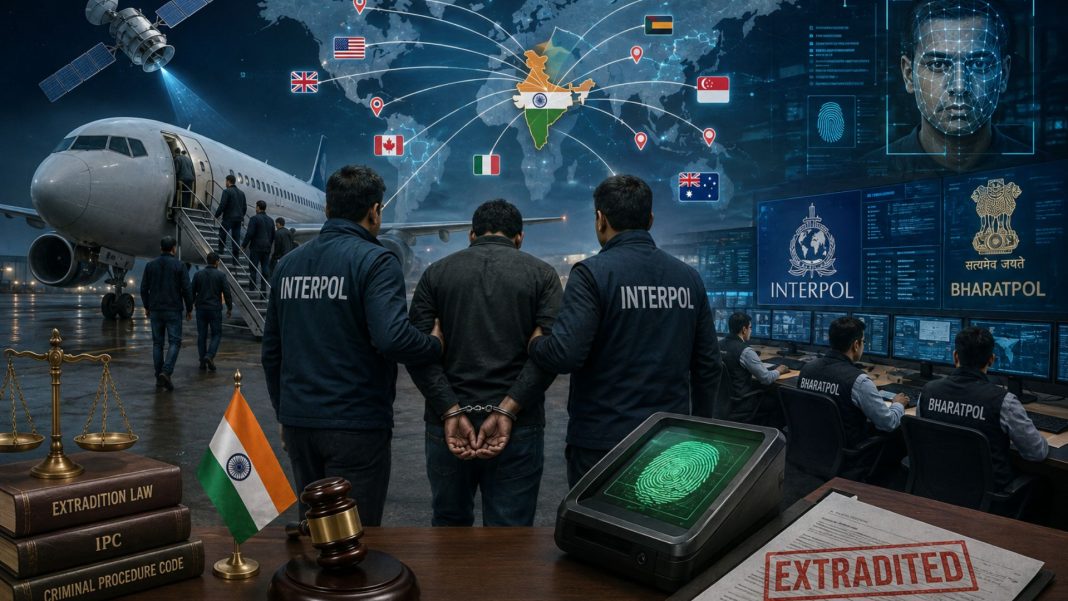

Operation Trishul: Think fleeing abroad, changing your name, altering your physical appearance, and crafting a new identity will protect you from Indian law enforcement? Think again.
Through a coordinated nationwide initiative led by central agencies, most notably under ‘Operation Trishul’, India is closing international escape routes for high-profile criminals, terrorists, and financial fraudsters.
The Numbers: 274 Fugitives Brought Back Home
Operation Trishul: Between 2019 and July 2026, Indian security and intelligence agencies successfully extradited or deported 274 fugitives from 36 different countries.
These extraditions cover a wide spectrum of serious offenses spanning violent crimes, economic fraud, and national security threats:
| Offense Category | Number of Extradited Fugitives |
|---|---|
| Murder Accused | 62 |
| Sexual Offenses | 53 |
| Organized Crime | 42 |
| Terrorism Accused | 17 |
| Financial Fraud & Economic Offenses | 100+ |
A prime showcase of this international leverage was bringing Tahawwur Rana, a key accused in the 2008 Mumbai terror attacks—back from the United States to face trial on Indian soil.
From Legal Paperwork to High-Tech Intelligence
Operation Trishul: Extradition used to be a notoriously slow process reliant solely on diplomatic channels and legal dossiers. Today, Indian intelligence relies on advanced surveillance and digital forensics:
Satellite Tracking: Monitoring physical movements across borders in real time.
Digital Footprint Analysis: Tracking online activity, encrypted communication channels, and device logins.
Geo-Location & Profile Mapping: Pinpointing exact locations even when suspects operate under stolen or forged identities.
This technological shift ensures that even if a criminal changes their name or appearance, their digital footprint eventually exposes them.
Hitting Criminals Where It Hurts: Economic & Property Seizures
Beyond physically capturing fugitives, India’s law enforcement strategy focuses heavily on dismantling the financial networks that sustain them while on the run.
Under the Prevention of Money Laundering Act (PMLA):
₹17,874 Crore worth of criminal property has been formally seized.
₹18,762 Crore has been successfully recovered.
By freezing assets and seizing proceeds of crime, agencies strip fugitives of the resources needed to hide or fund lengthy legal battles in foreign courts.
‘Bharatpol’ and the ‘Whole-of-Government’ Model
A major bottleneck in law enforcement has historically been the speed of information sharing. To eliminate delay, two major structural reforms were introduced:
The Bharatpol Portal
Connecting over 1,400 law enforcement agencies across India, the Bharatpol portal has dramatically accelerated inter-agency communication. Intelligence that previously took up to 20 days to route between state police forces and central bodies now moves seamlessly in just 3 to 10 days.
Multi-Agency Synchronization
Under the Intelligence Bureau’s (IB) Multi-Agency Center (MAC), 10 key security and investigative agencies have been unified under a single “Whole-of-Government” operational model. State police, central intelligence, financial intelligence units, and border authorities now operate as one cohesive network.
The Message is Clear
The message from India’s anti-crime apparatus is unambiguous: commit a crime on Indian soil, and the global net will eventually close in. With real-time digital tracking, synchronized multi-agency portals, and active extradition operations across 36 nations, international borders no longer offer sanctuary to criminals.
Also Read : India condemns Pakistan: India Takes Tough Stand Over Pak Army’s Indiscriminate Firing, Demands Accountability