


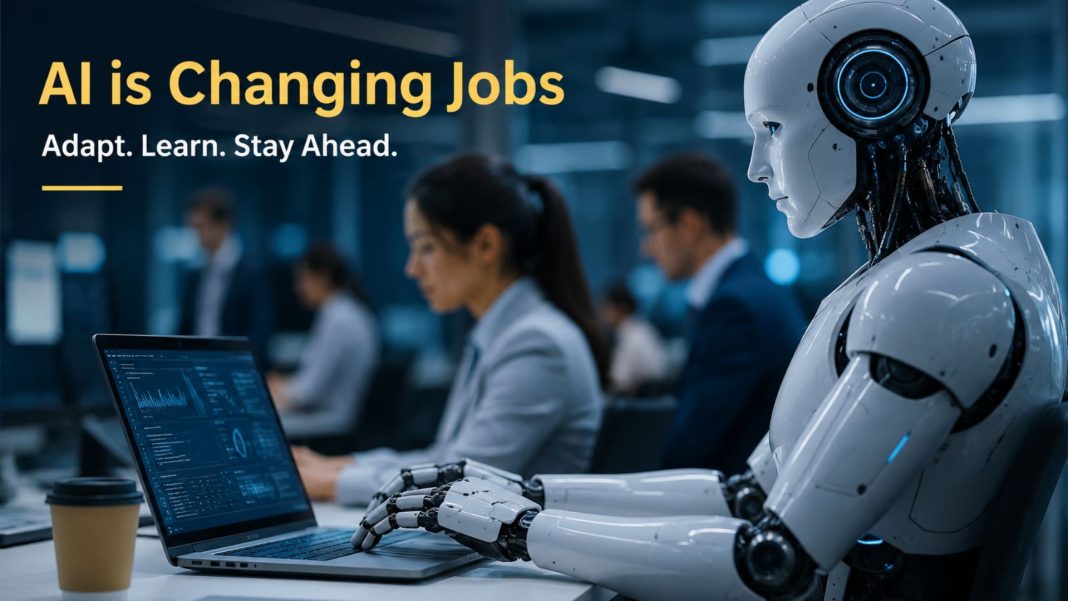

5 Jobs AI Will Replace First: Artificial intelligence has rapidly evolved from an experimental technology into an operational foundation for industries worldwide.
As machine learning algorithms, large language models, and automated processing tools become more sophisticated, the global labor market is experiencing a significant structural shift.
Major industry analyses and workforce reports suggest that while AI will create millions of new technical and strategic roles, it will also automate specific entry-level and routine positions much faster than previously anticipated.
According to media reports analyzing studies from organizations like the World Economic Forum, McKinsey, and Goldman Sachs, artificial intelligence primarily impacts roles structured around repetitive tasks, fixed rules, and standardized data processing.
Understanding which positions are most exposed helps professionals upskill and adapt to an AI-driven economy. Here is a detailed look at the five job categories most likely to experience primary transformation and displacement first.
1.Tier-1 Customer Support and Telemarketing
What jobs will AI replace by 2030: According to media reports, entry-level customer service and telemarketing roles are among the highest-risk positions for immediate automation.
Modern conversational AI platforms and intelligent voice agents now operate with advanced natural language capabilities, enabling them to resolve routine consumer inquiries around the clock without human intervention.
In high-volume contact centers, standard inquiries such as checking account balances, tracking shipment status, or processing basic returns are increasingly delegated to AI models.
These systems process requests instantaneously, operate without downtime, and significantly reduce operational overhead for large organizations.
Industry reports indicate that while complex, emotionally sensitive customer interactions still require human empathy, routine script-based telemarketing and tier-1 help desk jobs are rapidly transitioning to fully automated workflows.
2.Data Entry and Administrative Clerical Support
5 Jobs AI Will Replace First: Data entry has long been a candidate for digital automation, but recent advancements in optical character recognition (OCR) and intelligent document processing (IDP) have accelerated the shift.
As reported by media outlets tracking workplace technology, modern AI systems can scan, format, extract, and categorize information from physical invoices, medical records, and legal filings with accuracy levels exceeding 97 percent.
Administrative roles involving routine scheduling, email sorting, and document management are experiencing a similar transformation.
Virtual administrative assistants powered by machine learning can handle calendar coordination, meeting summary generation, and database updates seamlessly.
While executive assistants who manage complex logistics and high-level interpersonal stakeholder relationships remain essential, pure data-entry and routine clerical roles are shrinking rapidly across enterprise environments.
3.Basic Bookkeeping and Entry-Level Accounting
Top 10 jobs replaced by AI: Financial record-keeping relies heavily on precision, structured rules, and numerical consistency qualities where algorithms excel.
Industry reports show that traditional bookkeeping assistant positions, payroll processing, and basic reconciliation tasks are being automated through cloud-based AI accounting software.
Modern automated software can categorize transaction data, detect accounting anomalies, generate financial reports, and reconcile balance sheets automatically.
Media reports note that small businesses and large enterprises alike are adopting these solutions to minimize human error and cut operational costs.
While certified public accountants (CPAs), strategic financial advisors, and tax strategists who offer high-level fiscal judgment remain indispensable, basic data-focused accounting assistant roles are being consolidated into automated software platforms.
4.Formulaic Content Writing and Basic Translation
5 Jobs AI Will Replace First: Generative AI models have disrupted the media and marketing sector by demonstrating the ability to generate short-form text, product descriptions, basic promotional copy, and standard press releases within seconds.
According to industry analyses, entry-level copywriting and formulaic content production roles are facing substantial disruption.
Similarly, language translation for routine text, user manuals, and online articles is increasingly conducted by neural translation engines paired with lightweight human editing.
Media reports highlight that while nuanced storytelling, investigative journalism, brand strategy, and deep cultural localization still demand human creativity, high-volume, low-complexity writing tasks are now largely created or streamlined by AI tools.
5.Entry-Level Software Testing and Routine Coding
Software development is undergoing a double-edged transformation. While global demand for software architects, cybersecurity experts, and machine learning engineers continues to grow, basic code generation and routine software testing are becoming heavily automated.
AI coding assistants can write boilerplate code, identify syntax errors, execute automated test scripts, and debug existing programs in real time.
As per recent media reports on tech hiring trends, entry-level programmers tasked solely with writing simple scripts or running manual software tests are seeing their roles reshaped.
Companies are increasingly expecting junior developers to act as code reviewers and system orchestrators rather than manual coders, elevating the baseline skills required for entry-level tech roles.
Navigating the Transition to an AI-Augmented Future
The overarching consensus across market research is that task-level automation does not necessarily mean the immediate disappearance of entire professions.
In most sectors, artificial intelligence automates the repetitive fractions of a job, allowing human workers to shift their focus toward strategic problem-solving, critical thinking, emotional intelligence, and complex decision-making.
As media reports consistently emphasize, the professionals least vulnerable to AI replacement are those who learn to integrate these automated tools into their daily workflows.
By moving away from manual execution and focusing on domain expertise, human connection, and strategic oversight, workers can future-proof their careers and thrive alongside emerging technologies.
Also Read: AI in Wedding Planning: Indian Couples Cut Prep Time by 50% Through Smart Technology