

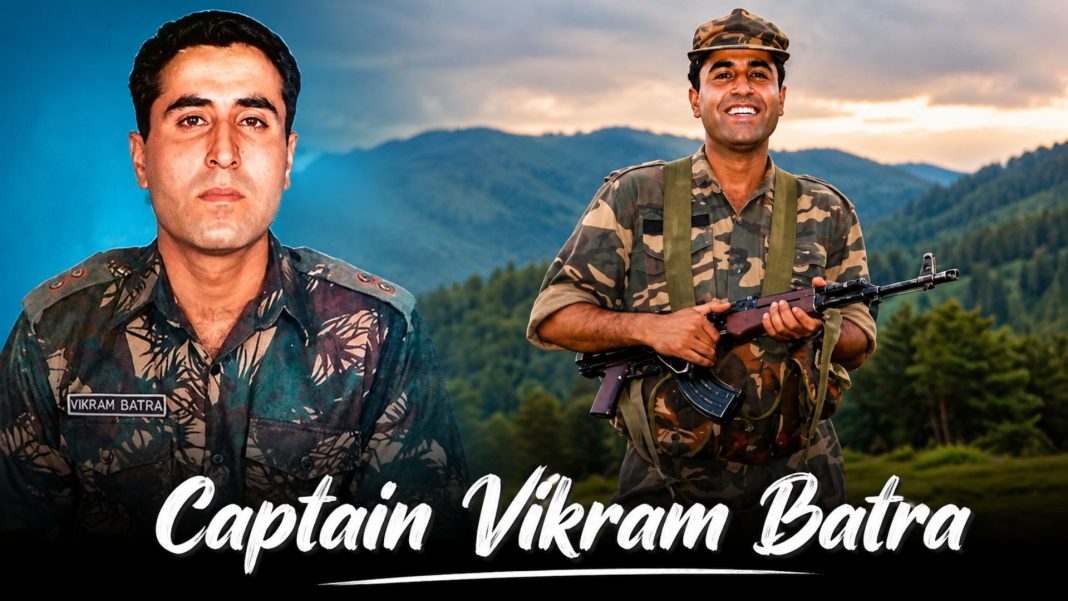

Captain Vikram Batra Biography: Long before his war cry echoed across the snow-capped peaks of Kargil, Vikram Batra was a spirited boy from Himachal Pradesh who dreamed of doing something extraordinary for his country.
Known to his battalion by the codename Sher Shah, he became a household name across India for his daring leadership, infectious energy, and unyielding courage under fire.
From leading a dangerous cliff assault at Point 5140 to charging enemy positions at Point 4875, Vikram’s journey is a story of grit, passion, and ultimate sacrifice. His life remains a timeless inspiration for millions of young Indians dreaming of serving the nation.
Personal Overview
| Attribute | Details |
|---|---|
| Full Name | Captain Vikram Batra |
| Codename / Nickname | Sher Shah; “Luv” (Childhood Nickname) |
| Date of Birth | September 9, 1974 |
| Date of Martyrdom | July 7, 1999 (Aged 24) |
| Place of Birth | Palampur, Himachal Pradesh, India |
| Parents | Girdhari Lal Batra (Father) & Kamal Kanta Batra (Mother) |
| Siblings | Twin Brother Vishal Batra (“Kush”); Sisters Seema and Nutan |
| Education | B.Sc. Medical Sciences, DAV College, Chandigarh |
| Military Academy | Indian Military Academy (IMA), Dehradun |
| Unit | 13th Battalion, Jammu and Kashmir Rifles (13 JAK RIF) |
| Rank | Captain |
| Famous Motto / Signal | “Yeh Dil Maange More!” |
| Highest Decoration | Param Vir Chakra (PVC) – Posthumous |
Roots and Early Life
Vikram Batra was born on September 9, 1974, in the quiet valley town of Palampur, Himachal Pradesh. He was born fourteen minutes before his twin brother, Vishal.
Their mother, a devoted reader of the Ramayana, fondly nicknamed the twins ‘Luv’ (Vikram) and ‘Kush’ (Vishal).
Growing up in a modest household his father was a school principal and his mother a teacher Vikram showed an early penchant for leadership and active living.
He excelled in academics, held a green belt in Karate, and played table tennis at the national level alongside his brother.
College Life and the Call to Duty
Captain Vikram Batra Biography: After completing his schooling in Palampur, Vikram moved to Chandigarh in 1992 to pursue a Bachelor of Science degree at DAV College. It was during these years that his passion for the military took firm shape.
NCC Leadership: He joined the Air Wing of the National Cadet Corps (NCC), earning recognition as the best Air Wing cadet in his directorate. He later trained in paratrooping at Pinjore Airfield.
Choosing the Uniform: In 1995, while still in college, Vikram was selected for a lucrative job in the Merchant Navy with a Hong Kong-based shipping company. However, he turned it down, stating he wanted to do something bigger for his country.
Passing the CDS Exam: To prepare for the Combined Defence Services (CDS) examination, he enrolled in an M.A. English program at Panjab University while working part-time.
In 1996, he cleared the CDS exam in his first attempt, ranking among the top candidates nationwide.
Military Training and Early Postings
Captain Vikram Batra Biography: Vikram joined the Indian Military Academy (IMA), Dehradun, in June 1996 as part of the Manekshaw Battalion.
After completing 19 months of rigorous training, he was commissioned as a Lieutenant into the 13th Battalion, Jammu and Kashmir Rifles (13 JAK RIF) on December 6, 1997.
Following regimental training in Jabalpur and the Young Officer’s Course in Mhow (where he earned an ‘Alpha’ grading), Vikram was posted to Sopore in Jammu and Kashmir.
In early 1999, he completed the demanding Commando Course at Belgaum, Karnataka, securing the top Instructor’s Grade.
The Kargil War: Taking Center Stage
In June 1999, as Pakistani troops occupied strategic high-altitude positions in the Kargil sector, the 13 JAK RIF was ordered to move to Dras.
At altitudes exceeding 16,000 feet, where temperatures dipped far below freezing, the battalion was deployed into high-stakes mountain warfare.
The Capture of Point 5140
On June 17, 1999, Vikram’s company (Delta Company) was assigned the crucial task of recapturing Point 5140, a heavily fortified enemy peak dominating the region.
The Success Signal: Before the assault, Vikram selected the catchy advertising phrase “Yeh Dil Maange More!” as his company’s success signal.
The Cliff Attack: On the night of June 19, Vikram led his men up a steep, bare rock face to take the enemy by surprise. Despite facing heavy machine-gun fire and suffering injuries, he pressed forward, threw grenades into the bunker, and eliminated three enemy soldiers in close combat.
Triumph: By 04:35 AM on June 20, Point 5140 was cleared without a single casualty on his team. His famous words radioed back to base “Yeh Dil Maange More!” instantly resonated across India.
Following this victory, Vikram was promoted to the rank of Captain.
The Battle of Point 4875 and Ultimate Sacrifice
In early July 1999, the battalion moved on to capture Point 4875, another critical high-altitude peak held by enemy forces.
Despite suffering from fever and fatigue after continuous combat operations, Captain Batra volunteered to lead a team up the narrow, rocky ridge of Area Flat Top on the night of July 6.
Clearing the Bunkers: Reaching the peak in pitch darkness, Batra led a direct charge against fortified machine-gun positions under severe enemy fire.
Rescuing a Comrade: During the intense gunfight, one of his team members was shot. As Batra exposed himself to heavy fire to pull his injured comrade into a safe trench, he remarked to a fellow soldier, “You have a family, move back; I’ll take the head.”
The Final Moments: While dragging the soldier to safety, Captain Batra was hit by enemy sniper fire and splinter rounds. He succumbed to his injuries on July 7, 1999, at the age of 24. His bravery galvanized his troops, who successfully held and secured Point 4875 shortly after.
Honours and Param Vir Chakra
On August 15, 1999, during India’s 52nd Independence Day, Captain Vikram Batra was posthumously awarded the Param Vir Chakra, India’s highest military award for valour. His father received the honor on his behalf from President K. R. Narayanan.
Key Military Distinctions
Param Vir Chakra (Posthumous)
Operation Vijay Star
Special Service Medal
Operation Vijay Medal
Legacy and Impact
Captain Vikram Batra’s life left a lasting imprint on Indian popular culture and military history:
Landmarks Named in His Honour: Point 4875 was officially renamed Batra Top in his memory. Strategic locations, intersections, and halls across military campuses carry his name.
Cinematic Portrayals: His heroics inspired character depictions in the 2003 film LOC: Kargil and were highlighted in the 2021 biographical war film Shershaah.
National Icon: His infectious positivity, courage under extreme conditions, and simple patriotism continue to inspire young generations preparing for military service.
Lesser-Known Facts
A Twin Connection: His twin brother, Vishal Batra, maintains close ties with Vikram’s battalion and regularly interacts with young aspirants across the country to share Vikram’s life story.
Multi-Talented Athlete: Vikram represented his school and college in table tennis national tournaments and was a trained Karate practitioner.
Deep Bond with His Hometown: Whenever he visited his hometown of Palampur on leave, he was known to spend long hours chatting with childhood friends at the local Neugal Cafe.
Unshakeable Optimism: Before heading to Kargil, when a friend reminded him to stay safe during the war, Vikram famously replied that he would either return after hoisting the Tricolour or come back wrapped in it but he would return for sure.
Also Read: Dhruv Rathee’s Video Blocked in India: Google Informs Delhi High Court After GAC Action