


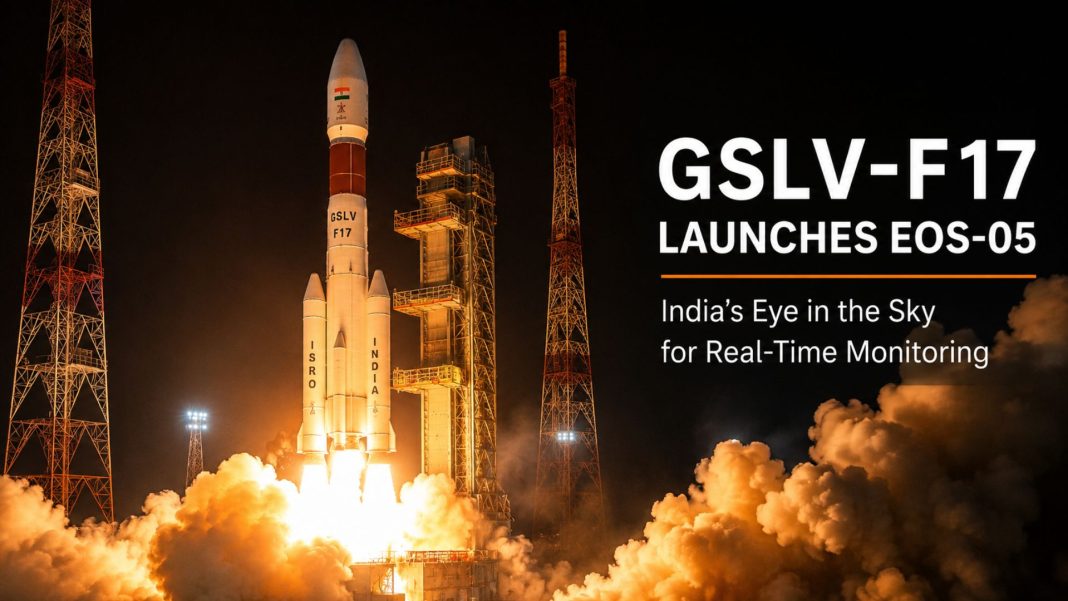

ISRO Naughty Boy Rocket Launch: At 2:55 AM IST on September 4, 2026, the Satish Dhawan Space Centre in Sriharikota witnessed a decisive breakthrough in Indian space exploration.
Breaking the night silence, the Indian Space Research Organisation (ISRO) successfully launched the GSLV-F17 mission. Carrying the 2,367 kg EOS-05 Earth observation satellite, the launch delivered a major operational triumph for the country.
According to media reports, the mission carries immense weight, coming at a time when analysts were raising questions about India’s launch capabilities following recent setbacks in the Polar Satellite Launch Vehicle (PSLV) fleet.
The successful deployment of EOS-05 reinforces ISRO’s resilience and capability to execute complex space missions.
Taming the ‘Naughty Boy’: The GSLV’s Journey to Reliability
ISRO Naughty Boy Rocket Launch: The Geosynchronous Satellite Launch Vehicle (GSLV) Mk II has long carried the informal nickname “naughty boy” due to its turbulent history.
Media reports highlight that out of 19 past launches, the rocket encountered six failures, making every liftoff a high-stakes event.
However, behind its unpredictable reputation lies a story of technological self-reliance:
The Cryogenic Challenge: In the early 1990s, foreign technology denial regimes prevented India from acquiring complete cryogenic upper-stage engine technology.
Indigenous Innovation: Refusing to be sidelined, ISRO scientists spent over two decades developing indigenous cryogenic propulsion from scratch.
High-Value Successes: Despite past struggles, the GSLV family has proven its mettle, including launching high-profile payloads like the NASA-ISRO Synthetic Aperture Radar (NISAR) satellite.
With the successful deployment of GSLV-F17, the launch vehicle has once again proven its capability for heavy-lift missions into sub-geosynchronous transfer orbits.
What Makes EOS-05 an ‘Eye in the Sky’ for India?
ISRO Naughty Boy Rocket Launch: Unlike traditional Earth observation satellites that sit in Low Earth Orbit (LEO) and capture periodic snapshots as they pass over specific regions, EOS-05 is designed for a much higher vantage point.
Positioned to reach a geostationary orbit nearly 36,000 kilometers above the planet, the satellite will effectively deliver continuous, near-real-time monitoring.
| Feature | Key Specifications & Capabilities |
|---|---|
| Payload Weight | 2,367 kg — heaviest payload carried by a GSLV to Sub-GTO |
| Operational Orbit | Geosynchronous Orbit (~36,000 km altitude) |
| Imaging Spectrum | Advanced imaging across visible, infrared, multispectral, and hyperspectral bands |
| Expected Lifespan | 7 years assured; designed to function beyond 9 years |
| Primary Capabilities | Disaster management, oceanography, disaster warning, cyclone tracking, and real-time surveillance |
According to media reports quoting senior space officials, EOS-05 acts as a spiritual successor to the GISAT-1 (EOS-03) satellite lost in 2021.
Equipped with multi-spectral and hyperspectral sensors, the spacecraft will provide uninterrupted imaging over the Indian subcontinent and surrounding oceans.
Representatives from the armed forces were also present at the launch, underlining the satellite’s strategic value for maritime domain awareness and national security.
Rebuilding Momentum After PSLV Setbacks
ISRO Naughty Boy Rocket Launch: The timing of the GSLV-F17 success could not be more vital for India’s space program. The trusted workhorse rocket, PSLV, faced grounding and investigation following anomalies in late 2025 and early 2026.
The successful GSLV-F17 launch proves that India’s launch ecosystem remains versatile and capable of handling high-priority national deployments without relying solely on a single rocket class.
As ISRO Chairman Dr. V. Narayanan noted following the launch, the successful deployment achieved an even better-than-expected transfer orbit, providing additional margins for the satellite’s operational maneuvers.
Looking Ahead: Human Spaceflight and Future Horizons
With this critical mission accomplished, ISRO turns its focus toward an ambitious schedule ahead. Reports indicate that up to six more launches are planned for the current financial year.
Most notably, the space agency is preparing for the uncrewed Gaganyaan (G1) test flight before the end of the year, a critical stepping stone toward launching Indian astronauts into orbit on an indigenous vehicle.
The flawless liftoff of GSLV-F17 represents far more than a single successful flight; it stands as a testament to persistence, self-reliance, and India’s growing footprint in deep space applications.
Also Read: Lucknow Live-In Murder Case: Girlfriend Strangled Over ₹50,000 Dispute, E-Rickshaw Driver Arrested